

Enable is the correct standard English word when you mean to make something possible, allow someone to do something, or turn on a feature. Inable is generally not the correct spelling when you mean “enable.” In standard modern English, use enable.
Quick Answer
Enable is the correct word, while inable is usually a misspelling or a nonstandard form when the intended meaning is “make possible” or “turn on.” For example, “Please enable notifications” and “This training will enable employees to perform their jobs better.” The word enable is a verb and is widely used in everyday, professional, academic, and technical English. Remember: enable starts with “en-,” not “in-.”
What Does Enable Mean?
Enable is a verb that means to make something possible, give someone the ability or opportunity to do something, or activate a feature or function.
It is commonly used when talking about technology, skills, opportunities, permissions, systems, and actions.
Examples of Enable
- This setting will enable dark mode.
- The course enabled her to improve her skills.
- Please enable notifications on your phone.
- The new system enables faster payments.
- Good communication enables teams to work effectively.
What Does Inable Mean?
Inable is not normally used as the standard modern English equivalent of enable.
When a writer wants to say that something makes an action possible, gives someone the ability to act, or activates a feature, the correct word is enable.
Incorrect: Please inable the feature.
Correct: Please enable the feature.
Because enable is the established standard form, inable should generally be avoided in modern English.
See Also:
The Core Rule: Enable Is Correct
The easiest rule is:
Use “enable” when you mean “make possible,” “give the ability,” or “turn on.”
| Word | Standard English? | Meaning |
|---|---|---|
| Enable | Yes | Make possible, give ability, or activate |
| Inable | No, in ordinary modern usage | Usually an incorrect form of enable |
How to Use Enable in a Sentence
Enable Meaning “Make Possible”
Use enable when one thing makes another action possible.
- The scholarship enabled him to attend university.
- The new technology enables faster communication.
- These tools enable businesses to save time.
Enable Meaning “Give Someone the Ability”
Enable can describe giving someone the means, opportunity, or ability to do something.
- The training enabled employees to use the new software.
- Education can enable people to develop new skills.
- The device enables users to monitor their activity.
Enable Meaning “Turn On”
In technology, enable often means to activate a setting, function, feature, or option.
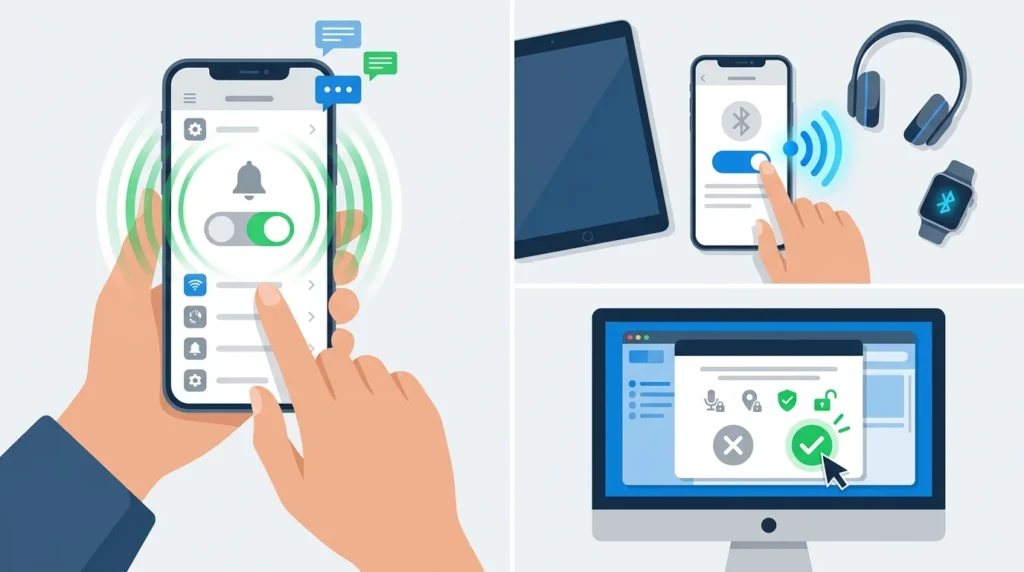
- Enable Bluetooth on your phone.
- Please enable location services.
- You can enable automatic updates in the settings.
Correct Examples of Enable
- Please enable notifications before leaving the page.
- The new software enables users to work more efficiently.
- This feature enables automatic backups.
- Her education enabled her to pursue a successful career.
- The password will enable you to access your account.
- Training enables employees to handle difficult situations.
- Please enable two-factor authentication.
- The new road will enable faster travel between the cities.
- This tool enables customers to track their orders.
- The update enables several new features.
- Good planning can enable a team to reach its goals.
- The device enables users to monitor their heart rate.
Incorrect vs Correct: Enable and Inable
| Incorrect | Correct | Why |
|---|---|---|
| Please inable notifications. | Please enable notifications. | Enable is the standard spelling. |
| You need to inable Bluetooth. | You need to enable Bluetooth. | Use enable for activating a feature. |
| This tool inables users to edit files. | This tool enables users to edit files. | The third-person form is enables. |
| The update inabled the feature. | The update enabled the feature. | The past form is enabled. |
| Education inables people to grow. | Education enables people to grow. | Enable is the correct verb. |
| The course inabled me to improve. | The course enabled me to improve. | Use enabled as the past tense. |
| Inable automatic updates. | Enable automatic updates. | Enable means activate. |
| This feature will inable access. | This feature will enable access. | Enable is the standard form. |
| The system inables online payments. | The system enables online payments. | Enable means make possible. |
| They inabled the security option. | They enabled the security option. | The correct past form is enabled. |
Why Do People Write Inable Instead of Enable?
The confusion often comes from the prefixes en- and in-. Both combinations appear in English words, so writers may assume that inable is a possible form of enable.
Another source of confusion is pronunciation. In some accents, the beginning of enable may not sound as distinct as its spelling looks, which can lead to an incorrect written form.
Confusion With the Prefix In-
English uses in- in many words, including inactive, incorrect, and incomplete. However, that does not mean every word that sounds like it starts with “in” should be spelled with in-.
The established word for making something possible or activating something is enable.
Confusion From Pronunciation
People sometimes spell unfamiliar words according to how they sound. Because pronunciation does not always reveal the exact letters in English, this can result in forms such as inable.
See ALso:
Enable vs Unable
Another reason for confusion is the word unable. The words enable and unable look similar but have completely different meanings.
| Word | Meaning | Example |
|---|---|---|
| Enable | Make possible or activate | The app enables automatic updates. |
| Unable | Not able to do something | She was unable to attend. |
Do not confuse enable with unable. The first means to make possible or activate, while the second means not able.
Enable vs Disable
Enable and disable are common opposites in technology.
See Also:
| Word | Meaning | Example |
|---|---|---|
| Enable | Turn something on or make it available | Enable notifications. |
| Disable | Turn something off or make it unavailable | Disable notifications. |
For example, if you turn notifications on, you enable them. If you turn them off, you disable them.
Enable in Real English
Enable is extremely common and natural in modern English. It is used in everyday communication as well as professional, academic, business, and technical writing.
In technology, phrases such as enable notifications, enable Bluetooth, enable access, and enable automatic updates are especially common.
In general writing, enable is often followed by an object and then to + verb:
enable + someone/something + to + verb
For example:
The training enabled employees to work more efficiently.
This construction is standard and natural.
Enable vs Allow
Enable and allow can sometimes have similar meanings, but they are not always interchangeable.
Allow often focuses on giving permission, while enable often focuses on making an action possible or providing the means to do it.
- The manager allowed me to leave early.
- The software enabled me to complete the task.
In the first sentence, the manager gives permission. In the second, the software makes the action possible.
See Also:
Word Forms of Enable
Learning the related forms can help prevent spelling mistakes.
| Form | Example |
|---|---|
| Enable | This feature can enable automatic backups. |
| Enables | This feature enables automatic backups. |
| Enabled | She enabled the security option. |
| Enabling | Enabling this option improves security. |
| Enablement | The program supports the enablement of new features. |
Common Mistakes to Avoid
- Do not write inable when you mean enable.
- Use enables, not inables.
- Use enabled, not inabled.
- Use enabling, not inabling.
- Do not confuse enable with unable.
- Remember that enable commonly means “make possible” or “turn on.”
An Easy Way to Remember Enable

A useful memory trick is to connect enable with the word enabled that you often see in technology settings.
Think:
Enable = turn on or make possible.
For example:
Enable Wi-Fi.
Enable notifications.
Enable access.
Remember the beginning: EN-able, not IN-able.
Frequently Asked Questions
Is enable or inable correct?
Enable is the correct standard word when you mean to make something possible, give someone the ability to do something, or activate a feature. Inable should generally not be used for this meaning.
Is inable a word?
Inable is not normally used as the standard modern English equivalent of enable. In ordinary writing, use enable.
What does enable mean?
Enable means to make something possible, give someone the ability or opportunity to do something, or activate a feature or function.
What is the difference between enable and unable?
Enable means to make something possible or activate it. Unable means not able to do something.
What is the past tense of enable?
The past tense is enabled. For example, “She enabled the security feature.”
Is it enable or inable notifications?
The correct phrase is enable notifications. Use enable when you mean to turn a feature on.
Is enabling or inabling correct?
Enabling is correct. For example, “Enabling automatic updates can improve security.”
What is the opposite of enable?
The common opposite of enable, especially in technology, is disable. Enable means to activate or make available, while disable means to turn off or make unavailable.
Can enable mean allow?
Sometimes. Enable can mean to make an action possible, while allow often emphasizes permission. The exact choice depends on the context.
How do you remember the spelling of enable?
Remember the phrase EN-able. The standard spelling begins with en-, not in-.
Quick Summary
Enable is the correct standard spelling, while inable is generally incorrect when the intended meaning is “make possible,” “give ability,” or “turn on.” Enable is widely used in everyday, professional, academic, and technical English. You can enable a feature, enable access, enable someone to perform an action, or enable a system to work more efficiently. Its common forms are enables, enabled, and enabling. Do not confuse enable with unable, which means not able. The easiest way to remember the correct spelling is to think of EN-able: use “en,” not “in,” when writing this word.
See Also:
Protestors or Protesters: Which Is Correct?
Kinesthesiology vs Kinesiology: Differences and Correct Usage