


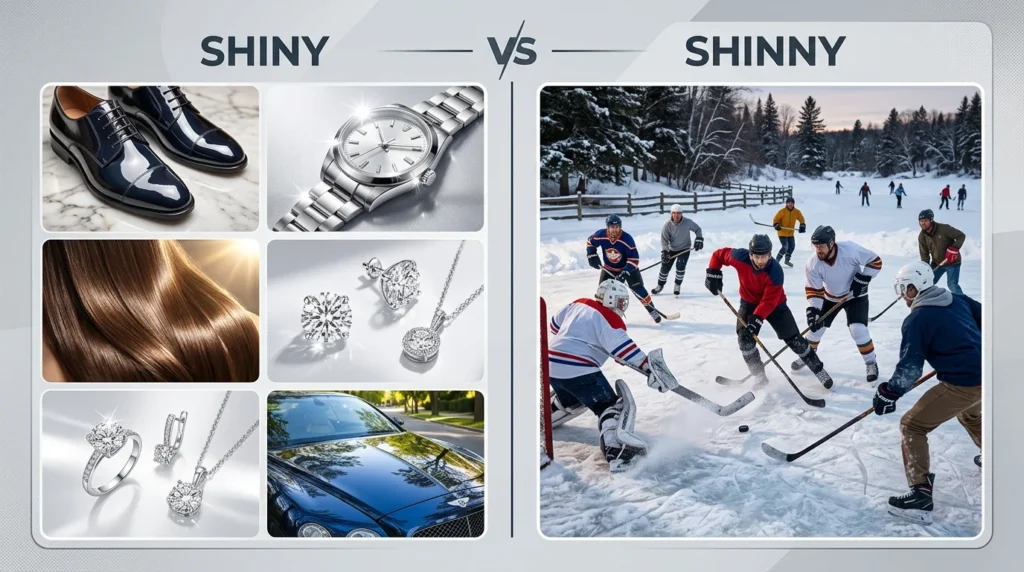
Shiny is the correct word when you mean something that reflects light or has a bright, polished appearance. Shinny is also a real English word, but it has a different meaning. It is mainly used as a noun or verb for an informal game of ice hockey, especially in Canadian English. Therefore, “shiny” describes appearance, while “shinny” refers to a type of hockey or the action of playing it.
Quick Answer
Use shiny when describing something bright, glossy, polished, or reflective: “She bought a shiny new car.” Use shinny when referring to the informal game of hockey or, as a verb, climbing or moving by gripping and pulling oneself upward. The two words are spelled similarly and sound similar, but they are not interchangeable. For ordinary descriptions of objects, surfaces, hair, clothing, or anything that looks bright or polished, shiny is the correct choice.
What Is the Difference Between Shinny and Shiny?
Shiny is an adjective. It describes something that reflects light, looks bright, or has a smooth and polished appearance.
Shinny has different uses. As a noun, it can refer to an informal form of ice hockey. As a verb, shinny can mean to climb or move upward by holding onto something and pulling yourself up.
The simplest distinction is:
- Shiny = bright, glossy, or reflective.
- Shinny = an informal hockey game or a climbing/moving action.
So if you are describing a new phone, polished shoes, clean hair, or a bright surface, you want shiny.
What Does “Shiny” Mean?
Shiny is an adjective formed from the verb shine. It describes something that reflects light or has a bright, smooth, or polished appearance.
For example:
- a shiny car
- shiny shoes
- shiny hair
- a shiny table
- shiny jewelry
- a shiny new phone
The word can describe both physical surfaces and, in some contexts, something that appears attractive or new.
For example, you might say:
“He bought a shiny new laptop.”
Here, shiny describes the laptop’s appearance.
What Does “Shinny” Mean?
Shinny is a separate word from shiny. One important meaning is an informal form of ice hockey. The term is particularly associated with Canadian English and informal hockey played without the full equipment or formal structure of organized hockey.
For example:
“The children played shinny on the frozen pond.”
Shinny can also be used as a verb meaning to climb or move by gripping something with the hands and using the arms and legs.
For example:
“He shinnyed up the pole.”
Because these meanings are unrelated to brightness or glossiness, shinny should not normally be used as a spelling of shiny.
The Core Rule
Use “shiny” for something that shines or reflects light. Use “shinny” for the separate word associated with informal hockey or climbing.
A useful memory trick is:
Shiny → shine → light
Shinny → shinny → hockey/climbing
If your sentence is about how something looks, especially if it is bright, glossy, or reflective, shiny is almost certainly the word you need.
How to Use “Shiny” Correctly
Use Shiny for Reflective Surfaces
Use shiny when something reflects light because of its surface.
Example: “The kitchen has shiny metal appliances.”
Use Shiny for Polished Objects
The word commonly describes objects that have been polished.
Example: “He wore a pair of shiny black shoes.”
Use Shiny for Hair
Shiny can describe hair that looks glossy or reflects light.
Example: “Her hair looked shiny after she washed it.”
Use Shiny for Something New or Attractive
In informal English, shiny can also be used more loosely for something new, attractive, or appealing.
Example: “The company gave us a shiny new website.”
How to Use “Shinny” Correctly
Shinny as a Noun
When used as a noun, shinny can refer to an informal game of hockey.
Example: “The kids went outside for a game of shinny.”
Shinny as a Verb
As a verb, shinny can describe climbing or moving upward by gripping a surface or object.
Example: “The boy shinnyed up the tree.”
This use is much less common in everyday international English than shiny.
Correct Examples of Shiny
- She bought a shiny new bicycle.
- The polished floor looked shiny in the sunlight.
- He cleaned his shiny black shoes.
- The cat has soft, shiny fur.
- We installed shiny new kitchen cabinets.
- Her hair looked healthy and shiny.
- The car had a shiny silver exterior.
- The teacher gave the student a shiny sticker.
- She wore a shiny necklace to the event.
- The new phone has a smooth, shiny surface.
- The freshly polished table was extremely shiny.
- The product comes in a shiny metallic finish.
Correct Examples of Shinny
- The children played shinny on the frozen pond.
- They organized a casual game of shinny after school.
- We used to play shinny during the winter.
- The boys went outside to play shinny.
- He shinnyed up the pole to reach the platform.
- The climber shinnyed up the narrow post.
Incorrect vs. Correct
| Incorrect | Correct | Why |
|---|---|---|
| She has shinny hair. | She has shiny hair. | Shiny describes hair that looks glossy or reflects light. |
| I bought a shinny car. | I bought a shiny car. | The intended meaning is that the car has a bright or polished appearance. |
| These shoes are very shinny. | These shoes are very shiny. | Shiny is the adjective for a glossy surface. |
| The table is shinny. | The table is shiny. | The sentence describes the table’s reflective surface. |
| She bought a shinny necklace. | She bought a shiny necklace. | The jewelry has a bright or reflective appearance. |
| He has shinny black hair. | He has shiny black hair. | Shiny is the appropriate adjective for glossy hair. |
| The floor looks shinny. | The floor looks shiny. | The intended meaning is polished or reflective. |
| She wore a shinny dress. | She wore a shiny dress. | The dress has a bright or reflective appearance. |
| We painted the door a shinny color. | We painted the door a shiny color. | The adjective refers to the finish or reflective appearance. |
| The new laptop has a shinny screen. | The new laptop has a shiny screen. | Shiny describes the screen’s surface. |
Why Do People Confuse Shinny and Shiny?
They Look Almost Identical
The only spelling difference is the extra n. This makes the words easy to confuse when typing quickly.
They Sound Similar
In many varieties of English, shinny and shiny sound very similar. This can make it difficult for learners to identify the correct spelling from pronunciation alone.
Shiny Comes From Shine
Because shiny is related to shine, some writers may incorrectly add another n when spelling it.
The useful connection is:
shine → shiny
Not:
shine → shinny
Spellcheck Does Not Replace Meaning
A spelling checker may identify shinny as a valid word because it actually is one. However, that does not mean it fits your sentence. Context matters.
Common Mistakes Checklist
Writing Shinny When You Mean Glossy
This is the most common mistake. If you are describing hair, shoes, metal, glass, jewelry, or another bright surface, use shiny.
Thinking Shinny Is Just a Misspelling
Shinny is a real word. It has meanings that are different from shiny, including an informal hockey game and a climbing action.
Adding an Extra N to Shiny
The adjective is spelled shiny, not shinny. Remember that it comes directly from shine.
Using Shinny to Describe a New Product
If you say “a shiny new phone,” shiny describes its appearance. Shinny cannot replace it.
Shinny vs Shiny in Real English
Grammatically Correct
Shiny is the natural adjective when describing something that reflects light or has a glossy appearance. Shinny is also grammatically correct, but it belongs to different meanings and grammatical uses. For example, “a shiny car” and “a game of shinny” are both correct, but replacing one word with the other changes or breaks the intended meaning.
Grammatically Possible but Unnatural
Using shinny in a sentence such as “She has shinny hair” is not a natural alternative to shiny. The problem is not simply style. The word has a different meaning. A reader familiar with shinny may interpret it as the hockey term or climbing verb rather than as a description of appearance.
Natural Everyday English
For everyday descriptions, shiny is the normal word: shiny shoes, shiny hair, shiny cars, shiny floors, and shiny objects. Shinny is much more specialized and is most likely to appear when discussing the informal hockey game or the verb meaning to climb or move by gripping something.
American vs. British English
There is no general American-versus-British spelling difference between shiny and shinny.
Shiny has the same basic spelling and meaning in both major varieties of English. Shinny is also a separate word rather than a British or American spelling of shiny.
The hockey sense of shinny is particularly associated with Canadian English, but the distinction from shiny remains the same.
Formal vs. Informal Usage
Shiny is suitable in both formal and informal English when its literal meaning is needed.
For example:
“The sample had a shiny surface.”
This is appropriate for technical or academic writing.
Shinny is less common and is more likely to appear in informal or specialized contexts, especially when referring to informal hockey.
Shinny vs Shiny Comparison Table
| Feature | Shiny | Shinny |
|---|---|---|
| Part of speech | Adjective | Noun and verb |
| Main meaning | Bright, glossy, reflective | Informal hockey; climb or move by gripping |
| Describes appearance? | Yes | No |
| Describes hair? | Yes | No |
| Related to “shine”? | Yes | No |
| Common in everyday English? | Yes | Much less common |
| Example | Shiny shoes | Play shinny |
Real-Life Situations
Shopping
If you are describing the finish of a phone, car, watch, or pair of shoes, use shiny.
“I like the shiny black finish.”
Beauty and Hair
Use shiny when describing glossy-looking hair.
“This conditioner leaves my hair shiny.”
School Writing
If you describe a polished surface in a science assignment, use shiny.
“The metal had a shiny surface.”
Sports Discussion
If you are discussing informal hockey, shinny may be the correct word.
“The students played shinny after school.”
Climbing
If someone climbs upward by gripping a pole or similar object, shinny can function as a verb.
“He shinnyed up the pole.”
The Easiest Way to Remember Shinny vs Shiny

Remember the word shine.
Shine → shiny
If something shines, it can be shiny.
So:
- Shiny shoes ✓
- Shiny hair ✓
- Shiny car ✓
- Shiny table ✓
- Shiny jewelry ✓
For shinny, remember the separate word associated with informal hockey.
Frequently asked questions
Is shinny a correct word?
Yes. Shinny is a real English word. It can refer to an informal form of hockey and can also function as a verb meaning to climb or move by gripping something.
Is shiny the correct spelling for something that reflects light?
Yes. Shiny is the correct adjective for something that reflects light or has a glossy, polished, or bright appearance.
Is shinny a misspelling of shiny?
Not technically. Shinny is a legitimate word with different meanings. However, using it when you mean “bright or glossy” is incorrect.
What is the difference between shiny and shinny?
Shiny describes appearance, especially something bright, glossy, or reflective. Shinny refers to an informal hockey game or can describe climbing or moving upward by gripping something.
Can I say “shinny hair”?
No, not if you mean hair that looks glossy. The natural expression is shiny hair.
Is “shiny” an adjective?
Yes. Shiny is an adjective because it describes a noun, such as shiny shoes, shiny hair, or a shiny surface.
What does shinny mean in hockey?
Shinny can refer to an informal form of hockey, especially a casual game played without the full rules and equipment of organized hockey.
What does “shinny up” mean?
To shinny up something means to climb or move upward by gripping it and pulling yourself along.
Why do people spell shiny as shinny?
The words look and sound similar, and the extra n is an easy typing or spelling mistake. Remembering the connection shine → shiny helps prevent the error.
Which spelling should I use in everyday writing?
Use shiny when describing something that looks bright, glossy, polished, or reflective. It is the normal everyday word for that meaning.
Quick Summary
Shiny and shinny are both real English words, but they do not mean the same thing. Shiny is an adjective meaning bright, glossy, polished, or reflective, so it is the correct word for shiny hair, shiny shoes, shiny cars, and shiny surfaces. Shinny has separate meanings. It can be a noun for an informal hockey game, particularly in Canadian English, or a verb meaning to climb or move by gripping something. The easiest way to remember the common spelling is shine → shiny. If you are describing how something looks, especially when it reflects light, choose shiny, not shinny.
See Also:
BBC Meaning in Text: What Does BBC Mean?
MYH Meaning in Text: What Does MYH Mean?
ASF Meaning in Text: Most People Misunderstand This Popular Slang