
Immaculate is the correct modern English word when you mean perfectly clean, spotless, flawless, or free from defects. Emaculate is not the standard modern spelling for this meaning and is normally a misspelling of immaculate. Although emaculate has appeared in rare historical usage, it should not be used as a modern alternative to immaculate.
What Is the Difference Between Emaculate and Immaculate?
The main difference is simple: immaculate is the standard modern English adjective, while emaculate is not the normal modern word people use to mean “spotless” or “flawless.”
Immaculate can describe something that is extremely clean, free from visible flaws, or exceptionally well maintained. It can also describe something figuratively, such as a performance, record, presentation, or reputation.
For example:
- The hotel room was immaculate.
- She arrived in an immaculate suit.
- His presentation was immaculate.
- The car was kept in immaculate condition.
If you write emaculate in these sentences, most readers will understand that you intended immaculate, but the spelling will be considered an error in ordinary modern English.
Why It Matters
Using the wrong spelling can distract readers even when the meaning is obvious.
This matters especially when you are writing something that is supposed to look polished, such as a school assignment, professional email, résumé, business proposal, product description, or website.
The problem becomes particularly noticeable when immaculate is being used to describe something as perfect or flawless:
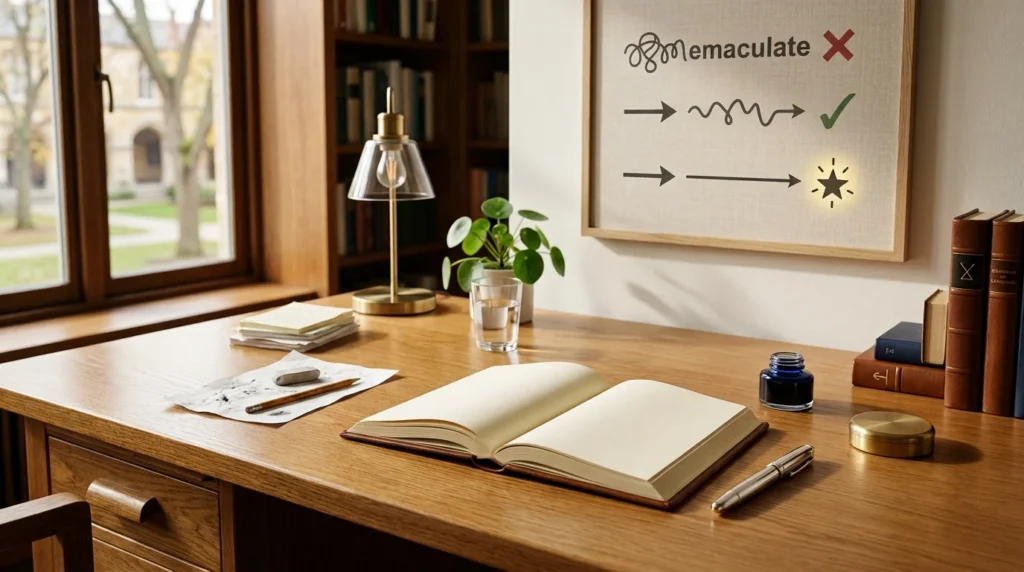
❌ The report was emaculate.
The sentence claims that the report was flawless, but the spelling itself contains an error.
The correct version is:
✅ The report was immaculate.
Correct spelling helps the reader focus on your message instead of stopping to interpret an unusual word.
The Core Rule
When you mean “spotless,” “flawless,” or “free from blemishes,” use immaculate — not emaculate.
The correct spelling is:
I-M-M-A-C-U-L-A-T-E
Remember the opening:
IM + MACULATE
Not:
EM + ACULATE
For normal modern English, there is no American-versus-British spelling choice here. Immaculate is the standard form in both varieties.
What Does Immaculate Mean?
Immaculate is an adjective. An adjective is a word that describes a person, place, thing, condition, or quality.
Its most common meanings include:
- perfectly clean
- spotless
- free from flaws or defects
- exceptionally neat or well maintained
- free from mistakes in some contexts
- pure or without blemish in certain contexts
The exact meaning depends on what the adjective describes.
Immaculate for Physical Cleanliness
The most direct use refers to something that is extremely clean.
For example:
The kitchen was immaculate.
This means the kitchen was exceptionally clean and showed no noticeable dirt or disorder.
Other natural examples include:
Her apartment is always immaculate.
The hotel kept every room immaculate.
His car was in immaculate condition.
Immaculate for Appearance
The word can also describe someone’s clothing, grooming, or overall appearance.
For example:
He arrived at the interview looking immaculate.
Here, immaculate suggests that his appearance was exceptionally neat, clean, and well presented.
You might also say:
She wore an immaculate white suit.
The word emphasizes the condition and neatness of the suit.
Immaculate for Work or Performance
Immaculate can be used figuratively to suggest that something was exceptionally good or free from mistakes.
For example:
She delivered an immaculate presentation.
The goalkeeper had an immaculate performance.
His record remained immaculate throughout the season.
In these examples, the word is not describing physical cleanliness. It is describing an absence of noticeable faults, mistakes, or blemishes.
Is Emaculate a Word?
There is an important distinction here.
If you are trying to write the modern adjective meaning spotless, flawless, or perfectly clean, emaculate is not the standard word. In ordinary modern writing, it should be treated as a misspelling of immaculate.
However, saying that the sequence of letters has never existed anywhere in English would be too broad. Historical sources contain rare or obsolete uses of emaculate as a verb related to removing stains or imperfections. That historical usage is not the normal meaning people have in mind today.
So for modern everyday and professional English:
Immaculate = use this.
Emaculate = avoid this when you mean spotless or flawless.
Correct Examples
Conversation
“I just cleaned the kitchen, so it looks immaculate now.”
“The office was left immaculate after the event.”
School Writing
“The author presents the character as having an immaculate reputation.”
Workplace
“The manager expects the showroom to remain immaculate throughout the day.”
Academic Writing
“The specimen was preserved in immaculate condition.”
Social Media
“Your new car looks immaculate!”
Property Description
“The apartment features an immaculate interior.”
Fashion
“She arrived wearing an immaculate black suit.”
Sports
“The goalkeeper maintained an immaculate record during the tournament.”
General Description
“The antique table remains in immaculate condition despite its age.”
Incorrect vs. Correct
| Incorrect | Correct | Why |
|---|---|---|
| The room was emaculate. | The room was immaculate. | Immaculate is the standard modern adjective meaning perfectly clean. |
| Her car is emaculate. | Her car is immaculate. | The intended adjective is immaculate. |
| He looked emaculate at the interview. | He looked immaculate at the interview. | Immaculate can describe an exceptionally neat appearance. |
| The hotel was emaculate. | The hotel was immaculate. | Emaculate is not the standard modern spelling for this meaning. |
| She gave an emaculate performance. | She gave an immaculate performance. | Immaculate can be used figuratively for something free from noticeable flaws. |
| The report was emaculate. | The report was immaculate. | The standard spelling contains imm- at the beginning. |
| The garden looked emaculate. | The garden looked immaculate. | The correct adjective is immaculate. |
| His handwriting is emaculate. | His handwriting is immaculate. | Immaculate can describe exceptionally neat work or presentation. |
| The apartment was kept emaculate. | The apartment was kept immaculate. | Immaculate is the standard modern form. |
| The dress was emaculate and perfectly pressed. | The dress was immaculate and perfectly pressed. | The intended meaning is exceptionally clean and neat. |
Why People Make This Mistake

Pronunciation Makes the First Sound Easy to Mishear
One major reason for the mistake is that the beginning of immaculate can be difficult to identify when the word is spoken quickly.
The standard pronunciation begins with an im- sound, but listeners who have mostly encountered the word through speech may not clearly connect that sound with the spelling imm-.
That can lead someone to guess:
emaculate ❌
instead of:
immaculate ✅
See Also: LOL Meaning in Text: What It Means & How to Use It
The Spelling Looks Unfamiliar
Immaculate is not a word most beginners spell naturally from pronunciation.
The unusual combination of imm + aculate makes it easy to hesitate over the first few letters.
English has many words whose spelling cannot be predicted perfectly from sound alone, so relying entirely on pronunciation is risky.
People Drop the Second M
Another common error is:
imaculate ❌
The writer remembers that the word begins with im-, but forgets the second m.
The correct form is:
immaculate ✅
The two m’s at the beginning are part of the established spelling.
Fast Typing
Typing quickly can turn a word you know into a spelling error.
Someone may type:
The room was emaculate.
without noticing that the first syllable has been changed.
This is particularly easy to miss when writing messages, emails, notes, or social media posts.
Spellcheck Can Create False Confidence
A writer may rely on autocomplete rather than remembering the spelling.
If a device does not immediately flag a variation, that does not necessarily mean the spelling is correct. Spellcheck tools can have incomplete dictionaries, custom word lists, or different correction behavior.
For a word you already suspect is confusing, checking a reliable dictionary is safer than trusting autocomplete alone.
Common Mistakes Checklist
Writing “Emaculate”
Mistake: Using emaculate when you mean spotless or flawless.
Why it happens: The spelling seems plausible because the beginning can sound like “em.”
Fix: Remember that the standard word begins with imm-.
Writing “Imaculate”
Mistake: Leaving out one of the two m’s.
Why it happens: The writer remembers the sound but not the full spelling.
Fix: Break it into:
IM + MACULATE
Writing “Emmaculate”
Mistake: Adding an extra m after choosing the wrong beginning.
Why it happens: The writer knows that the correct word has two m’s but places them incorrectly.
Fix: Memorize the exact opening:
IMMA…
Using Emaculate as an Alternative Spelling
Mistake: Assuming emaculate is simply another spelling of immaculate.
Why it happens: English contains many words with spelling variants, so the assumption can seem reasonable.
Fix: Treat immaculate as the standard modern spelling for the meaning you normally intend.
See Also: DWBI Meaning in Text: What It Means & How to Use It
Assuming It Is an American/British Difference
Mistake: Thinking Americans use immaculate while British speakers use emaculate.
Why it happens: Some spelling differences really do vary between English varieties.
Fix: This is not one of those standard regional spelling differences. Immaculate is the normal form in both American and British English.
Immaculate vs. Emaculate in Real English
Grammatically Correct and Natural
Immaculate is a normal adjective in modern English. It works naturally when describing cleanliness, appearance, condition, or something figuratively free from flaws.
For example, “The hotel room was immaculate” sounds completely natural. So does “The car is in immaculate condition.” The word is especially useful when ordinary words such as clean or neat do not feel strong enough to express an exceptionally well-maintained condition.
Grammatically Possible but Not Standard Modern Usage
Emaculate requires more care because it has appeared in rare historical usage, including an obsolete verb sense related to removing stains or imperfections. That does not make it a normal modern alternative to immaculate.
If you are writing modern English and want to describe something as spotless or flawless, using emaculate will almost certainly be interpreted as a spelling mistake.
Natural Everyday English
In everyday English, immaculate is the word you should choose when the intended meaning is exceptionally clean, neat, flawless, or well maintained.
Common natural phrases include immaculate condition, immaculate appearance, immaculate room, and immaculate record.
You do not need to use immaculate every time you mean “clean.” Words such as clean, neat, and tidy may be more natural for ordinary situations. Immaculate is stronger and often suggests an unusually high level of cleanliness, order, or perfection.
American vs. British English
There is no meaningful standard American-versus-British spelling difference between these two forms.
American English uses:
immaculate ✅
British English also uses:
immaculate ✅
The incorrect modern spelling emaculate does not become correct simply because the audience is British or American.
So unlike pairs such as color/colour or organize/organise, there is no normal regional spelling choice here.
Formal vs. Informal Usage
Immaculate works in both formal and informal English.
In formal writing, it can describe a carefully maintained condition:
The laboratory was maintained in immaculate condition.
In everyday conversation, it can be more expressive:
Your room is immaculate!
The word is not restricted to one register. The main difference is that it can sound stronger or more polished than simpler words such as clean, neat, or tidy.
Comparison Table
| Feature | Immaculate | Emaculate |
|---|---|---|
| Standard modern spelling | ✅ Yes | ❌ No for the usual meaning |
| Part of speech in normal modern use | Adjective | Not normally used as this adjective |
| Meaning “spotless” | ✅ Yes | ❌ No |
| Meaning “flawless” | ✅ Yes | ❌ No |
| American English | Standard | Avoid |
| British English | Standard | Avoid |
| Formal writing | Appropriate | Avoid |
| Everyday writing | Appropriate | Avoid |
| Common spelling mistake | No | Yes |
| Historical/obsolete usage | Standard modern word | Rare historical usage exists |
Real-Life Situations
In an Interview
If you are describing how you maintain a professional workplace, you could say:
“I always make sure my workspace is immaculate before clients arrive.”
Here, immaculate means exceptionally clean and orderly.
In a Meeting
A manager might say:
“The showroom needs to remain immaculate during the product launch.”
The word emphasizes a very high standard of cleanliness and presentation.
In an Email
A professional email could say:
“Thank you for leaving the conference room in immaculate condition.”
This is appropriate formal usage.
In a Text Message
A friend might write:
“Your new apartment looks immaculate!”
The word works perfectly well in casual conversation too.
In an Exam
If a student writes:
“The laboratory was immaculate.”
the spelling and grammar are correct.
Writing emaculate instead would be a spelling error if the intended meaning is “spotless.”
How to Remember the Correct Spelling

The easiest method is to focus on the first four letters:
IMMA
Not:
EMA
Not:
IMAC
You can also connect the word to its meaning.
Immaculate → no stain → spotless.
The word has historical roots connected with the idea of being unstained or without blemish. That meaning developed into the modern senses of being perfectly clean, free from flaws, or exceptionally pure.
A simple visual memory aid is:
IM + MACULATE = IMMACULATE
If you remember the IM at the beginning and the double M, the most common spelling mistakes become much easier to avoid.
Is Immaculate Always the Best Word?
Immaculate is the correct choice when you want to describe something as exceptionally clean, neat, flawless, or free from blemishes. However, it does not always mean exactly the same thing as simpler words such as clean, tidy, or perfect.
For example, “The room is clean” only tells the reader that the room is not dirty. “The room is immaculate” gives a stronger impression that it is exceptionally clean and carefully maintained.
Choosing the right word therefore depends on the level of meaning you want to express.
Immaculate vs. Clean
Clean is a broad, everyday word. Immaculate is stronger and can suggest an unusually high standard of cleanliness or perfection.
Compare:
The kitchen is clean.
This simply says there is no significant dirt.
The kitchen is immaculate.
This suggests the kitchen is exceptionally clean, neat, and well maintained.
For ordinary conversations, clean may be enough. When you want to emphasize an exceptionally polished condition, immaculate can be more precise.
Immaculate vs. Perfect
These words can overlap, but they are not interchangeable in every sentence.
Perfect means having no faults or defects, while immaculate can suggest being free from stains, flaws, or imperfections.
For example:
She gave a perfect answer.
This focuses on correctness.
She wore an immaculate dress.
This focuses more on the dress being exceptionally clean, neat, or flawless in appearance.
The context determines which adjective communicates the intended idea more naturally.
Immaculate vs. Pristine
Pristine and immaculate are sometimes close in meaning, particularly when describing something that is extremely clean or in excellent condition.
However, pristine often emphasizes something that remains in an original, untouched, or unspoiled state.
For example:
The beach remained pristine.
This can suggest that the beach is natural and unspoiled.
The hotel room was immaculate.
This emphasizes exceptional cleanliness and order.
The words can overlap, but they do not always create exactly the same image.
Is Immaculate a Positive Word?
Yes. Immaculate is generally positive when used to describe cleanliness, appearance, condition, or performance.
For example:
The restaurant was immaculate.
This gives a favorable impression of the restaurant’s cleanliness.
Likewise:
His presentation was immaculate.
This suggests that the presentation was exceptionally polished or free from noticeable problems.
However, the exact tone depends on context. In some situations, describing something as immaculate may suggest an extremely high or demanding standard.
Can Immaculate Describe a Person?
Yes, but the meaning depends on what aspect of the person is being described.
For example:
She looked immaculate at the ceremony.
Here, immaculate describes her appearance, suggesting that she looked exceptionally neat, polished, and well dressed.
It can also describe clothing associated with a person:
He arrived in an immaculate suit.
The adjective does not normally mean that the entire person is literally “perfect.” The surrounding context determines whether it refers to appearance, clothing, reputation, performance, or another quality.
Can Immaculate Describe a Place?
Yes. This is one of its most common modern uses.
You can describe a:
- room
- house
- apartment
- office
- hotel
- kitchen
- garden
- showroom
- vehicle interior
For example:
The hotel lobby was immaculate.
This tells the reader that the lobby was exceptionally clean and well maintained.
Can Immaculate Describe Work?
Yes. Immaculate can be used figuratively for work, performance, records, or results when the intended idea is that they are exceptionally good or free from noticeable flaws.
For example:
The designer’s work was immaculate.
The meaning here is not that the work was physically clean. It suggests a very high level of quality and precision.
Similarly:
She maintained an immaculate academic record.
Here, immaculate suggests that the record was free from failures, serious problems, or blemishes.
Can You Say “Immaculate Condition”?
Yes. Immaculate condition is a natural and widely understood phrase.
It means that something is in exceptionally good, clean, or well-maintained condition.
For example:
The vintage car is still in immaculate condition.
This is stronger than simply saying:
The vintage car is in good condition.
The phrase is especially useful in descriptions of vehicles, properties, furniture, clothing, and valuable objects.
Common Spelling Forms to Avoid
When trying to spell immaculate, writers sometimes produce several incorrect forms.
Emaculate
❌ emaculate
✅ immaculate
The first syllable should begin with imm-, not em-.
Imaculate
❌ imaculate
✅ immaculate
This version is missing one of the two m’s.
Immaculant
❌ immaculant
✅ immaculate
The ending should be -ate, not -ant.
Immaculate
✅ immaculate
This is the standard modern spelling.
A Quick Spelling Test
If you are unsure whether to write emaculate or immaculate, complete this sentence:
The hotel room was ______.
The correct answer is:
The hotel room was immaculate.
Now remember the first four letters:
IMMA
Once you remember IMMA, the rest of the spelling becomes easier:
IMMA + CULATE
→ IMMACULATE
Frequently Asked Questions
What does immaculate mean in simple English?
Immaculate means extremely clean, spotless, neat, or free from noticeable flaws. Depending on context, it can also mean exceptionally well maintained or flawless.
Why do people spell immaculate as emaculate?
The mistake usually happens because the beginning of the word can be difficult to identify from pronunciation. Writers may hear or remember an “em” sound and leave out the two m’s in the standard spelling.
Is emaculate ever a valid English word?
The form emaculate has appeared in rare historical or obsolete usage, including a verb sense associated with removing stains or imperfections. It is not the standard modern adjective used to mean spotless or flawless.
Is immaculate an adjective?
Yes. Immaculate is an adjective because it describes a noun, such as an immaculate room, immaculate clothing, or immaculate condition.
Can immaculate mean perfect?
It can mean flawless or without blemish in some contexts, so it may overlap with perfect. However, the two words are not interchangeable in every sentence.
Can immaculate mean very clean?
Yes. This is one of its most common meanings. An immaculate room, house, office, or car is exceptionally clean and well maintained.
Is immaculate formal or informal?
Immaculate can be used in both formal and informal English. It is appropriate in professional writing as well as everyday conversation.
Is immaculate used in both American and British English?
Yes. Immaculate is a standard word in both American and British English. There is no normal regional spelling difference in which British English uses emaculate.
What is the opposite of immaculate?
Depending on the context, possible opposites include dirty, stained, messy, flawed, imperfect, or blemished. The best opposite depends on what immaculate is describing.
What is the easiest way to remember immaculate?
Remember the opening letters IMMA. The correct spelling starts with imm-, giving you immaculate, not emaculate or imaculate.
Can immaculate describe a person’s appearance?
Yes. For example, “He looked immaculate” means he looked exceptionally neat, clean, polished, or well presented.
Is emaculate the opposite of immaculate?
No. Emaculate is not the standard modern opposite of immaculate. If you mean something that is dirty, stained, or imperfect, use a word such as dirty, blemished, or flawed, depending on the context.
Quick Summary
Immaculate is the standard modern English spelling when you mean extremely clean, spotless, flawless, neat, or free from blemishes. Emaculate should not be used as a modern alternative to immaculate, even though rare historical uses of emaculate can be found. The two spellings are not a normal American-versus-British English difference; immaculate is standard in both varieties. Common mistakes include writing emaculate or dropping one of the two m’s in imaculate. The easiest way to remember the correct spelling is IMMA-CULATE. Use immaculate for exceptionally clean rooms, polished appearances, excellent condition, or figuratively flawless work and records. When you simply mean “not dirty,” the everyday word clean may be more natural.