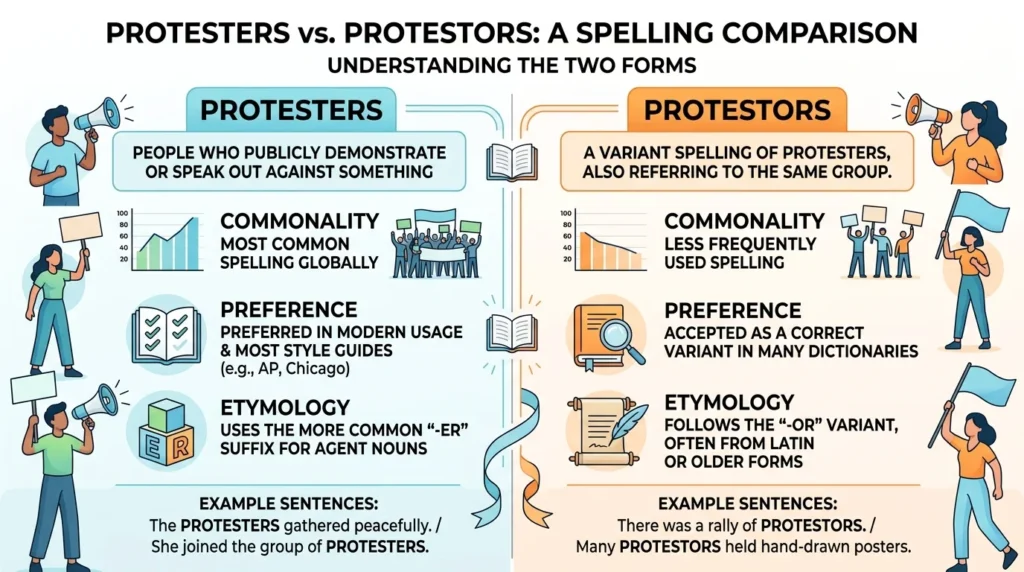

“Protestors” and “protesters” are both correct spellings. They refer to people who take part in a protest or publicly express opposition to something. “Protesters” is generally the more common spelling in American English, while “protestors” is also standard and appears frequently, especially in formal and journalistic writing. Neither spelling is grammatically wrong.
What Is the Difference Between Protestors and Protesters?
The difference between protestors and protesters is mainly a matter of spelling, not meaning.
Both words are plural nouns formed from protest, meaning people who protest. The singular forms are protestor and protester.
- Protester = a person who protests
- Protesters = more than one person who protests
- Protestor = a person who protests
- Protestors = more than one person who protests
The two forms have the same basic meaning. You can use either one when referring to people participating in a protest.
Why Does the Difference Matter?
This distinction matters because writers sometimes assume that one spelling is correct and the other is a spelling mistake. That is not the case.
For example, both of these sentences are grammatically correct:
The protesters gathered outside the building.
The protestors gathered outside the building.
The more important issue is consistency. If you choose “protesters” in an article, report, or essay, it is usually better to keep using that spelling rather than switching randomly between “protesters” and “protestors.”
The Core Rule
Rule: “Protesters” and “protestors” are both correct nouns with the same meaning. “Protesters” is generally the more common form, but “protestors” is not incorrect.
The ending -er is a very common way of forming a noun for a person who performs an action:
- teach → teacher
- write → writer
- run → runner
- protest → protester
The -or spelling also occurs in English, especially in words derived through Latin or French patterns:
- act → actor
- inspect → inspector
- operate → operator
Because both spelling patterns are established in English, protester and protestor can coexist.
How to Use Protesters and Protestors
Use protesters or protestors when you mean people who are participating in or engaging in a protest.
Singular
A protester spoke to the reporter.
A protestor spoke to the reporter.
Both sentences are correct.
Plural
Hundreds of protesters filled the street.
Hundreds of protestors filled the street.
Again, both are correct.
Possessive Form
When one person is being discussed:
The protester’s sign was easy to read.
When several people are being discussed:
The protesters’ signs covered the sidewalk.
The same possessive rules apply to protestor:
The protestor’s sign was easy to read.
The protestors’ signs covered the sidewalk.
As an Adjective
The noun can also modify another noun:
Protesters’ demands were discussed at the meeting.
Protestors’ demands were discussed at the meeting.
The choice of spelling does not change the meaning.
Correct Examples
Here are examples showing both spellings in natural contexts.
- Conversation: “The protesters are gathering near the entrance.”
- News writing: “Several protesters were interviewed after the demonstration.”
- Email: “The organizers asked protesters to remain in the designated area.”
- School writing: “The protesters wanted lawmakers to reconsider the proposal.”
- Workplace discussion: “Employees discussed how the protestors might affect traffic.”
- Social media: “Photos showed thousands of protesters in the city center.”
- Academic writing: “The study examined the motivations of political protesters.”
- Formal report: “Police officers spoke with several protestors before the event.”
- Everyday English: “The protesters moved toward the main square.”
- Headline-style writing: “Protesters Gather Outside Government Building.”
Incorrect vs. Correct
| ❌ Incorrect | ✅ Correct | Why |
|---|---|---|
| The protester’s were outside. | The protesters were outside. | “Protesters” is plural; the apostrophe is unnecessary. |
| Several protestor gathered there. | Several protestors gathered there. | A plural noun is required after “several.” |
| The protesters sign was large. | The protester’s sign was large. | A singular possessive needs an apostrophe. |
| The protestors was arrested. | The protestors were arrested. | A plural subject takes “were.” |
| One protesters spoke first. | One protester spoke first. | “One” requires the singular noun. |
| Many protester attended. | Many protesters attended. | “Many” requires a plural noun. |
| The protestors’s signs were removed. | The protestors’ signs were removed. | A plural noun ending in s takes only an apostrophe. |
| Two protester were interviewed. | Two protesters were interviewed. | “Two” requires the plural form. |
| A group of protestors were visible. | A group of protestors was visible. | “Group” is the grammatical subject in this construction. |
| The protesters are a person who complained. | The protester is a person who complained. | Singular and plural forms must agree. |
Why People Make This Mistake
The confusion usually comes from the fact that English has more than one common pattern for creating nouns that describe people who perform an action.
The -er ending is extremely productive. English speakers see forms such as “worker,” “teacher,” and “runner,” so protester follows a familiar pattern.
At the same time, English contains many established -or nouns, including “actor,” “creator,” “administrator,” and “operator.” This makes protestor look equally plausible—and in fact, it is an established spelling.
Spellcheck can also contribute to confusion. Depending on the dictionary installed in a particular program, one spelling may be flagged while another is accepted. That does not necessarily mean the flagged spelling is incorrect.
Common Mistakes Checklist
Assuming “Protestor” Is Wrong
Some writers think the -or spelling is automatically a mistake.
It is not. Protestor is a legitimate English word.
Assuming “Protester” Is the Only Correct Form
The opposite mistake also occurs. Because “protester” is very common, writers sometimes believe “protestor” must be an error.
Both forms are established.
Mixing the Spellings Randomly
Using both spellings in the same document can make your writing look inconsistent.
Choose one spelling and use it consistently unless you have a specific reason to reproduce another source’s spelling.
Confusing Plural and Possessive Forms
Remember:
- protesters = more than one protester
- protester’s = belonging to one protester
- protesters’ = belonging to multiple protesters
The same pattern applies to “protestors.”
Treating Spellcheck as the Final Authority
A spellcheck program does not contain every accepted English word. A red underline is not always proof that a word is wrong.
Protestors vs. Protesters in Real English
“Protesters” is generally the more familiar and more commonly encountered form in contemporary American English. It is therefore a straightforward choice when you want the spelling most readers are likely to recognize immediately. This is a usage preference rather than a grammatical rule: “protestors” remains a valid spelling, so choosing it does not make a sentence grammatically incorrect.
“Protestors” can sound or look somewhat more formal to some writers because the -or ending appears in many nouns describing people who perform actions. However, it should not be treated as a different category of person. The two words do not identify different types of protesters, and the spelling alone does not communicate a different attitude or role.
In ordinary conversation, both forms are understandable and grammatical. If you are writing for a broad American audience and simply want the most familiar option, “protesters” is a natural choice. If a publication, organization, or house style uses “protestors,” following that established style is also perfectly reasonable.
American vs. British English
There is no major American-versus-British grammatical distinction between “protesters” and “protestors.”
Both spellings can be found in English-language writing on both sides of the Atlantic. The difference is primarily one of spelling preference and frequency rather than a rule that assigns one form exclusively to American English and the other exclusively to British English.
If you are following a particular publication’s style guide, use the spelling specified by that guide.
Formal vs. Informal Usage
Both protesters and protestors can appear in formal and informal writing.
For general-purpose writing, protesters is often the simpler choice because it is highly familiar to readers.
In formal reports, academic writing, journalism, or legal documents, either spelling can be appropriate. The key considerations are accuracy and consistency.
For example:
The protesters assembled peacefully outside the courthouse.
There is nothing informal about this sentence simply because it uses protesters.
See Also: DWBI Meaning in Text: What It Means & How to Use It
Comparison Table
| Feature | Protesters | Protestors |
|---|---|---|
| Part of speech | Noun | Noun |
| Singular | Protester | Protestor |
| Plural | Protesters | Protestors |
| Meaning | People who protest | People who protest |
| Correct spelling | Yes | Yes |
| Common in American English | Yes | Yes |
| Can be used in formal writing | Yes | Yes |
| Can be used in casual writing | Yes | Yes |
| Meaning difference | None | None |
| Main difference | Spelling | Spelling |
Real-Life Situations
Writing a News Report
If you are writing a news report, either spelling can be used:
Protesters gathered outside the courthouse on Tuesday.
The important point is to describe the event accurately rather than treating one spelling as grammatically superior.
Writing an Academic Essay
In an academic essay, consistency matters:
The researchers examined how protesters communicated their demands.
If you begin with “protesters,” continue using that form throughout the paper unless you are quoting a source that uses “protestors.”
Sending an Email
A workplace email might say:
The protesters have moved away from the building entrance.
There is no need to replace “protesters” with “protestors” simply to make the sentence more formal.
Posting on Social Media
For a social media post:
Thousands of protesters gathered in the city today.
“Protestors” would also be grammatically acceptable.
Taking an English Exam
If an exam asks whether “protesters” or “protestors” is correct, both can be correct when the question is simply about spelling. If the exercise provides a specific style guide or context, follow its instructions.
An Easy Way to Remember
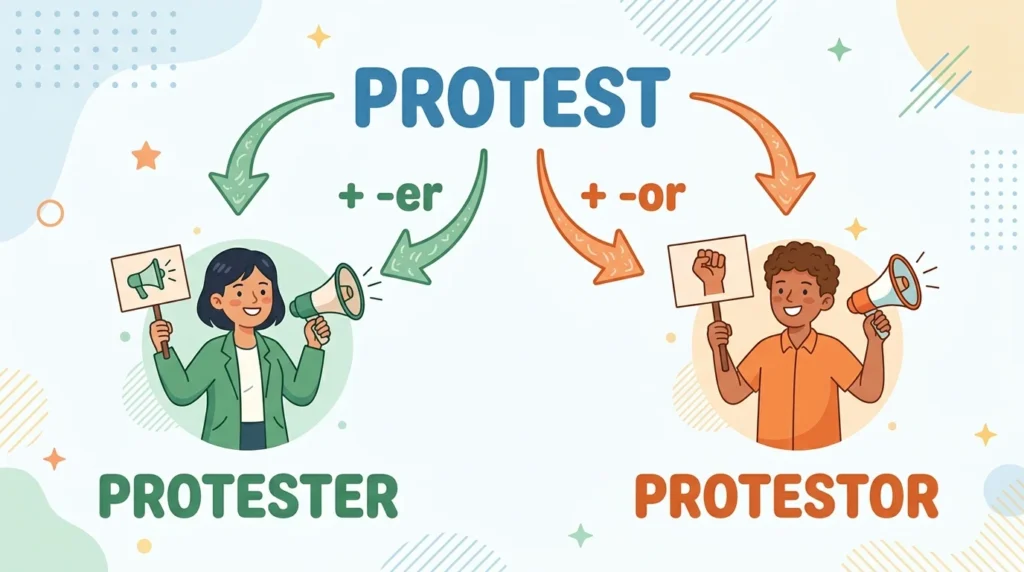
Think of the two forms as two spelling paths to the same noun:
protest → protester
protest → protestor
Neither path changes the meaning.
If you want the form that is generally more familiar in American English, remember:
When in doubt, “protester” is a simple default.
But do not “correct” protestor just because it uses -or.
Frequently Asked Questions
Is “protestors” a real word?
Yes. Protestors is a standard plural noun meaning people who protest. It is not simply a misspelling of “protesters.”
Is “protesters” more correct than “protestors”?
No. “Protesters” is generally more common, but “protestors” is also correct. The difference is primarily spelling preference.
Which spelling is more common: protesters or protestors?
Protesters is generally the more common spelling, particularly in American English. Frequency can vary by publication, region, and style.
Can I use both spellings in the same article?
You can, but it is usually better to choose one and use it consistently. Switching between them without a reason can make the article look poorly edited.
What is the singular of protesters?
The singular form is protester.
For example:
One protester spoke to the reporter.
What is the singular of protestors?
The singular form is protestor.
For example:
One protestor spoke to the reporter.
Are protesters and protestors pronounced differently?
They are generally pronounced essentially the same way. The spelling difference does not normally create a meaningful difference in pronunciation.
Should I use protesters in American English?
“Protesters” is a good general-purpose choice for American English because it is widely familiar and commonly used. However, “protestors” is also acceptable.
Is “protester” formal or informal?
“Protester” is neutral. It can be used in casual conversation as well as formal journalism, academic writing, reports, and professional communication.
Is “protestor” outdated?
No. Although “protestor” may be less common in some contexts, it remains an established spelling and should not automatically be treated as outdated or incorrect.
Quick Summary
Protesters and protestors have the same meaning: people who take part in a protest or express opposition publicly. Both are grammatically correct spellings. Protesters is generally the more common form, especially in American English, while protestors is also widely recognized. The choice does not change the meaning, pronunciation, or grammatical role of the word. For most general writing, “protesters” is a simple default, but there is no grammatical need to replace “protestors.” The most important writing rule is consistency: choose one spelling and use it throughout your document unless you are deliberately preserving another source’s spelling.
See Also: PPL Meaning in Text: What Does PPL Mean?