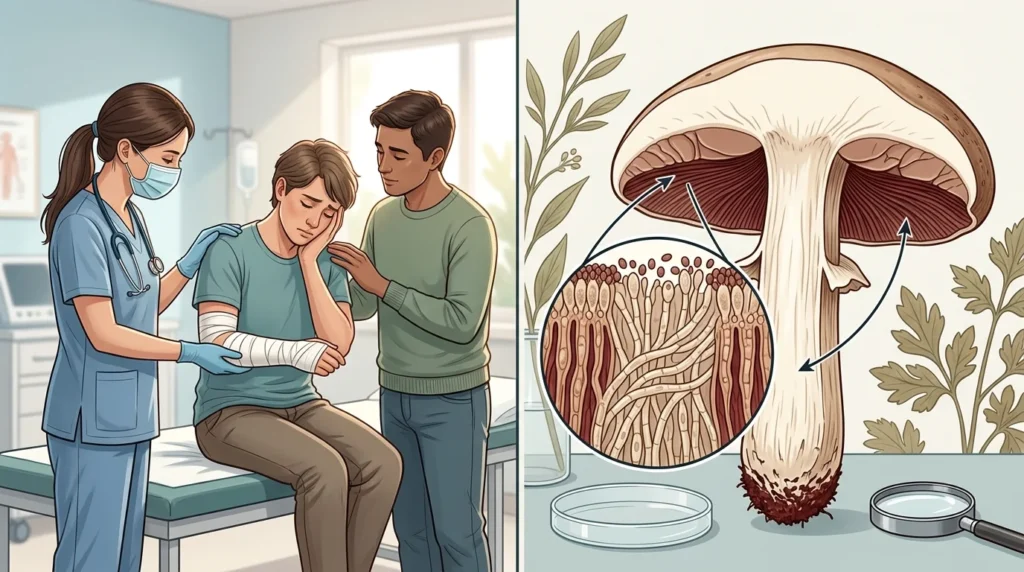

Trauma is the correct word when you mean physical injury, severe emotional shock, or psychological distress. Trama is not an alternative spelling of trauma. In ordinary English writing, using trama when you mean injury or emotional distress is a spelling error. However, trama is also a rare technical English noun in mycology, where it refers to specialized internal tissue in parts of mushrooms.
Quick Answer
Trauma is the word you want when talking about physical injury, emotional shock, or psychological distress. Trama is not a spelling variant of trauma. In everyday English, trama is usually a misspelling of trauma. There is, however, a specialized English meaning of trama in mycology: the internal tissue of certain mushroom structures. So write childhood trauma, head trauma, and emotional trauma, not childhood trama, head trama, or emotional trama.
What Is Trauma?
Trauma is a noun with both psychological and medical uses. In psychological or everyday contexts, it can describe severe and lasting emotional shock and pain associated with an extremely upsetting experience. In medical language, trauma can refer to physical injury, especially injury caused by an accident or attack.
Because the word has more than one established meaning, its context matters. Childhood trauma refers to psychological or emotional harm associated with distressing experiences during childhood, while head trauma refers to a physical injury involving the head. Both are standard uses of the same word.
Trauma is also used as an uncountable noun in many contexts, such as “She is recovering from trauma,” but it can be countable when referring to particular experiences or instances, as in “They shared their childhood traumas.” Dictionary usage reflects both possibilities.
What Is Trama?
Trama needs a little more explanation than simply calling it “wrong.” In everyday English, if someone writes trama when discussing an accident, emotional distress, therapy, or psychological injury, they almost certainly mean trauma and have omitted the letter u.
However, trama is also a legitimate specialized English noun. In botany and mycology, it refers to specialized internal tissue that forms part of structures such as mushroom gills, pore tubes, or spines. This technical meaning is completely different from the common meaning of trauma.
Therefore, it would be inaccurate to say that trama is never an English word. The better rule is that trama is not the correct spelling of trauma, but it can be correct when used in its specialized biological meaning.
Why the Difference Matters
In most writing, confusing trama and trauma is a spelling problem because trauma is the word readers expect when the subject is injury or emotional distress.
The mistake can be especially noticeable in professional, academic, medical, or educational writing. Consider the sentence “The patient suffered severe head trama.” The intended meaning is understandable, but the spelling should be head trauma.
The distinction also matters because simply saying “trama is not a word” gives an incomplete explanation. Trama does have a specialized English meaning in mycology. Good usage advice should distinguish between an incorrect spelling and a legitimate technical term rather than treating every occurrence of trama as an error.
The Core Rule

If you mean physical injury, emotional shock, or psychological distress, use “trauma.”
Trauma: the standard English word for these meanings.
Trama: not an alternative spelling of trauma; in English, it is mainly encountered as a specialized mycology term.
A simple rule to remember is:
Injury or emotional shock → trauma.
Mushroom tissue → trama.
See Also: Comming vs Coming Differences: Which Spelling Is Correct?
How to Use Trauma Correctly
For physical injury
Use trauma when referring to physical injury, particularly in medical or health-related contexts.
- The patient was treated for head trauma.
- The accident caused serious physical trauma.
- The doctor examined him for signs of brain trauma.
- The athlete suffered repeated knee trauma.
This medical sense is established dictionary usage.
For emotional or psychological distress
Use trauma when discussing severe emotional shock or lasting distress connected with an extremely upsetting experience.
- She has been working through childhood trauma.
- The experience left him with lasting emotional trauma.
- The book explores the effects of generational trauma.
- They discussed how trauma can affect people differently.
The exact psychological meaning can depend on context, but trauma is the standard spelling.
For professional and academic writing
Trauma is appropriate in medical reports, academic research, psychology-related writing, journalism, workplace documents, and ordinary communication when the meaning requires it.
Examples include trauma-informed care, trauma recovery, trauma symptoms, and trauma treatment. The surrounding terminology should be chosen carefully according to the specific subject being discussed.
Correct Examples
In everyday conversation
“That accident caused a lot of trauma for the family.”
In an email
“The report describes the emotional trauma experienced by the affected employees.”
In a medical context
“The emergency team evaluated the patient for possible head trauma.”
In school writing
“The novel explores how childhood trauma can influence a character’s decisions.”
In academic writing
“The researchers examined the relationship between traumatic experiences and long-term emotional responses.”
In the workplace
“The organization provided support after employees experienced a traumatic event.”
On social media
“The documentary made me think about how people process trauma differently.”
In journalism
“The survivors described the trauma caused by the disaster.”
In healthcare writing
“Early assessment is important when serious physical trauma is suspected.”
In a personal statement
“The experience changed how I understood trauma and recovery.”
Incorrect vs. Correct
| ❌ Incorrect | ✅ Correct | Why |
|---|---|---|
| She experienced childhood trama. | She experienced childhood trauma. | Trauma is the standard word for severe emotional shock or distress. |
| The patient suffered head trama. | The patient suffered head trauma. | The medical term for physical injury is trauma. |
| He is dealing with emotional trama. | He is dealing with emotional trauma. | Trama is not an alternative spelling of trauma. |
| The accident caused serious trama. | The accident caused serious trauma. | The physical-injury meaning requires trauma. |
| They discussed generational trama. | They discussed generational trauma. | Trauma is the established spelling in this psychological context. |
| The therapist helped him process his trama. | The therapist helped him process his trauma. | The emotional or psychological meaning is spelled trauma. |
| The report mentions brain trama. | The report mentions brain trauma. | Brain trauma is a medical expression for physical injury. |
| The experience left lasting trama. | The experience left lasting trauma. | The intended meaning is severe emotional impact, so trauma is correct. |
| She wrote about the trama of war. | She wrote about the trauma of war. | When referring to the emotional impact of war, use trauma. |
| The victim suffered psychological trama. | The victim suffered psychological trauma. | Psychological trauma is the established phrase. |
| The doctor was concerned about physical trama. | The doctor was concerned about physical trauma. | The medical sense is spelled trauma. |
| He is recovering from the trama of the accident. | He is recovering from the trauma of the accident. | The sentence refers to the distress or injury caused by the accident. |
Why People Make This Mistake
Missing the letter U
The most direct reason for the error is that trama looks almost identical to trauma. When typing quickly, a writer can leave out the u without noticing.
Similar spelling patterns
The two forms differ by only one letter. Because the brain often recognizes familiar word shapes quickly, a writer may recognize the intended word while failing to notice that one letter has disappeared.
Pronunciation
Pronunciation does not always provide enough information to reconstruct English spelling. Depending on the variety of English and the speaker, trauma has different pronunciations. Cambridge lists different UK and US pronunciations, including /ˈtrɔː.mə/, /ˈtraʊ.mə/, and /ˈtrɑː.mə/.
This variation means learners should not rely only on sound when deciding how to spell the word.
Autocomplete and spellcheck
Digital writing tools can reduce spelling errors, but they are not a perfect substitute for knowing the word. A specialized term such as trama may exist in a dictionary or language database, particularly because it has a legitimate technical meaning. As a result, a writing tool may not always treat it as an impossible sequence of letters.
Translation interference
The word trama also exists independently in other languages. For example, in Spanish, trama can mean a plot, weave, web, or conspiracy depending on context.
A multilingual writer may therefore encounter trama as a legitimate word and accidentally carry that spelling into an English sentence where trauma is intended.
Common Mistakes Checklist
Writing trama for emotional trauma
Mistake: “She is dealing with childhood trama.”
Why it happens: The writer drops the u.
Fix: Write “She is dealing with childhood trauma.”
Writing trama for physical injury
Mistake: “The patient suffered severe head trama.”
Why it happens: The writer remembers the general sound and shape of the word but not its complete spelling.
Fix: Use head trauma.
Assuming trama is always meaningless
Mistake: Saying that trama can never be a real English word.
Why it happens: Most everyday uses of trama are spelling mistakes.
Fix: Remember that trama has a specialized mycological meaning involving internal mushroom tissue.
Assuming trauma only means psychological pain
Mistake: Using trauma only for emotional experiences.
Why it happens: Psychological discussions frequently use the word.
Fix: Remember that trauma also has an established medical meaning referring to physical injury.
Trauma vs. Trama in Real English
Grammatically correct and natural: “He suffered head trauma.”
This is a natural medical expression because trauma has an established meaning involving physical injury. The phrase commonly appears in discussions of accidents, falls, sports injuries, and other forms of bodily harm. The spelling trauma is essential here; trama would be a spelling error unless the sentence were specifically discussing the specialized biological term.
See Also: Encorporate vs Incorporate: Which Spelling Is Correct?
Grammatically correct and natural: “She is dealing with childhood trauma.”
This is a natural expression when discussing severe emotional or psychological effects associated with distressing experiences during childhood. Trauma can function as an uncountable noun in this kind of general statement. The word does not need to be replaced with trama, because trama does not carry this psychological meaning in English.
Grammatically possible but context-dependent: “They studied trama.”
This sentence can be grammatically valid if the subject is mycology or fungal biology and the writer is referring to the internal tissue of a mushroom structure. Without that specialized context, many readers will assume trama is a misspelling of trauma. The word therefore requires strong context to make its intended technical meaning clear.
Incorrect for injury: “The athlete suffered knee trama.”
In this sentence, trama does not work because the intended meaning is physical injury. The correct sentence is “The athlete suffered knee trauma.” The specialized mycological meaning of trama has no connection with an injured knee, so the context clearly requires trauma.
American vs. British English
There is no meaningful American-versus-British spelling difference between trauma and trama when discussing physical injury or emotional shock. Trauma is the standard spelling in both varieties.
There can be pronunciation differences. Cambridge gives different UK and US pronunciation entries for trauma, but these pronunciation differences do not change the spelling.
Formal vs. Informal Usage
Trauma is appropriate in both formal and informal English when the meaning is accurate. You may encounter it in medical reports, academic papers, professional communication, news writing, personal conversations, and social media.
Informal speech can sometimes use related words such as traumatic more broadly to describe something very upsetting or stressful. Dictionary usage recognizes an informal sense of traumatic meaning causing worry or upset, in addition to its more serious sense.
That does not change the spelling of the noun: when the noun is intended, write trauma.
Trauma vs. Trama Comparison Table

| Feature | Trauma | Trama |
|---|---|---|
| Standard English word? | Yes | Yes, but only in a specialized technical sense |
| Physical injury | Yes | No |
| Emotional shock | Yes | No |
| Psychological distress | Yes | No |
| Medical usage | Common | Not as an injury term |
| Mycology | Not the term for mushroom internal tissue | Yes |
| Common in everyday English | Yes | No |
| Correct in “childhood ___” | Trauma | No |
| Correct in “head ___” | Trauma | No |
| Contains the letter U? | Yes | No |
How to Remember Trauma vs. Trama
The easiest way to remember the difference is to connect trauma with injury or emotional shock.
Trauma = injury or severe emotional distress.
Notice the U in trauma. If you are writing about a person who has been injured, emotionally affected by a deeply distressing experience, or dealing with psychological trauma, keep the u.
For the rare word trama, remember the specialized context:
Trama = mushroom tissue in mycology.
This gives you two clear mental categories instead of treating the words as interchangeable spellings.
Real-Life Situations
Medical report
Correct: “The patient was admitted with severe head trauma.”
The sentence concerns physical injury, so trauma is required.
School assignment
Correct: “The novel examines the effects of childhood trauma.”
The sentence discusses emotional or psychological impact, so trauma is the correct spelling.
Workplace discussion
Correct: “The company offered support to employees affected by the traumatic event.”
The related adjective traumatic is used to describe something that causes severe emotional shock or, in medical contexts, relates to physical injury.
Text message
Correct: “That experience caused a lot of trauma.”
This is an informal but grammatically normal use of trauma when referring to emotional impact.
Academic biology writing
Correct: “The study describes the trama within the mushroom’s gill structure.”
Here, trama is appropriate because the subject is fungal anatomy rather than emotional or physical injury.
Related Forms You Should Know
| Word | Meaning | Example |
|---|---|---|
| trauma | Physical injury or severe emotional shock | The accident caused serious trauma. |
| traumatic | Causing or relating to trauma | It was a traumatic experience. |
| traumatize | To cause severe emotional distress | The experience traumatized him. |
| traumatized | Having experienced severe emotional distress | She felt traumatized after the event. |
| trama | Specialized fungal tissue | The researcher examined the mushroom’s trama. |
The first four forms belong to the trauma word family. Trama is a separate technical term and should not be treated as a shortened spelling of trauma.
Mini Quiz
Choose trauma or trama in each sentence.
- The patient suffered severe head ______ after the accident.
- The therapist helped her work through childhood ______.
- The biologist examined the ______ of the mushroom.
- The accident caused physical ______.
- The article discusses the effects of generational ______.
- The researcher described the internal ______ of the fungal structure.
Answers
1. trauma
2. trauma
3. trama
4. trauma
5. trauma
6. trama
The first, second, fourth, and fifth sentences involve injury or emotional impact. The third and sixth use trama in its specialized mycological sense.
Frequently Asked Questions
Is it trauma or trama?
For physical injury, emotional shock, or psychological distress, the correct word is trauma. Trama is not an alternative spelling of trauma. However, trama is a legitimate specialized English term in mycology.
Is trama a real English word?
Yes, but it is a rare and specialized English word. In mycology, trama refers to specialized internal tissue in structures such as mushroom gills, pore tubes, or spines. It is not the spelling used for physical or psychological trauma.
Is “trama” a misspelling of “trauma”?
Usually, yes, when the context is injury, emotional distress, psychology, or medicine. In those contexts, the missing u makes trama a spelling error. The word is only correct when it is being used in its separate specialized meaning.
What does trauma mean?
Trauma can refer to severe and lasting emotional shock or pain caused by an extremely upsetting experience. In medical usage, it can also mean physical injury, often caused by an accident or attack.
What does trama mean?
In specialized English biological terminology, trama refers to internal fungal tissue, particularly tissue associated with mushroom gills, pore tubes, or spines.
Can I use trama instead of trauma?
No. You should not use trama as a shortened spelling of trauma. Write trauma when referring to physical injury, emotional shock, or psychological distress.
Is trauma used for physical injury?
Yes. In medical English, trauma can refer to physical injury, including injuries caused by accidents or attacks. Common expressions include head trauma, brain trauma, and blunt trauma.
Is trauma only a psychological word?
No. Although trauma is widely used when discussing emotional or psychological effects, it also has an established medical meaning involving physical injury. Context determines which meaning is intended.
Are trauma and trama pronounced the same?
No. They are different words, and trauma has different pronunciations across English varieties. Trama has its own pronunciation in its specialized English use.
Is there an American and British spelling difference?
No significant spelling difference exists here. Trauma is the standard spelling in both American and British English. Pronunciation can vary, but the spelling remains the same.
How do I remember the spelling of trauma?
Connect trauma with injury or severe emotional distress and remember the u. A simple reminder is: injury or emotional shock = trauma; mushroom tissue = trama.
Quick Summary
Trauma is the correct word when you mean physical injury, severe emotional shock, or psychological distress. Trama is not an alternative spelling of trauma. In ordinary English writing, using trama for an accident, injury, childhood distress, or emotional suffering is a spelling mistake. However, trama is a legitimate but rare English technical term in mycology for specialized internal tissue in certain mushroom structures. The easiest rule is simple: use trauma for injury or emotional shock, and use trama only in its specialized fungal context. The words are not interchangeable, and the missing u changes the word completely.
See Also: WLW Meaning in Text: What It Means & How to Use It