

Seal and seel look and sound very similar, but they are not interchangeable. Seal is the standard modern English word used for closing or securing something, an official mark, and the marine animal. Seel is a rare, historical verb mainly associated with falconry, where it referred to sewing or closing the eyelids of a hawk or falcon. In ordinary modern writing, seal is almost always the word you need.
Quick Answer
Seal is the correct word in normal modern English when you mean to close, secure, or make something airtight, watertight, or final. It can also mean a marine animal or an official mark. Seel is a real but very uncommon historical verb associated mainly with falconry and the closing of a bird’s eyes. If you are writing about a package, envelope, container, agreement, document, or marine animal, use seal.
What Is the Difference Between Seal and Seel?
The main difference is meaning and modern usage.
Seal is a common noun and verb. As a verb, it can mean to close something securely, prevent air or liquid from passing through, confirm or finalize something, or make something official. As a noun, it can refer to a marine mammal, a closure, or an official mark or emblem.
Seel is a rare verb. Its most specific historical meaning is connected with falconry: to sew or close the eyelids of a hawk or falcon. Older dictionaries also record broader archaic meanings involving closing the eyes or blinding.
| Word | Main Meaning | Modern Usage |
|---|---|---|
| seal | Close, secure, authenticate, finalize, or a marine animal | Very common |
| seel | Historically, to close or sew shut a bird’s eyelids | Very rare and specialized |
Why It Matters
Choosing the wrong spelling can make an otherwise clear sentence look careless. This is especially noticeable in emails, school assignments, business documents, technical instructions, product descriptions, and professional communication.
For example, Please seal the package before shipping it is standard modern English. Writing Please seel the package changes the word to a rare historical term that does not fit the context.
The confusion is especially easy because seal and seel can be pronounced alike. The spelling therefore has to be learned from meaning and usage rather than sound alone.
The Core Rule
Use “seal” for normal modern meanings. Use “seel” only when you specifically mean the rare historical falconry term.
- Close an envelope → seal
- Close a package → seal
- Prevent a leak → seal
- Make an agreement final → seal
- Official emblem → seal
- Marine animal → seal
- Historical falconry term → seel
How to Use Seal
Seal as a verb meaning “close securely”
Use seal when something is closed in a way that prevents it from opening or allows it to remain protected.
For example:
Please seal the envelope before mailing it.
The technician sealed the container tightly.
Make sure the bag is properly sealed.
Cambridge defines this use of seal as closing an entrance or container so that air or liquid cannot enter or leave.
Seal as a noun meaning a closure
A seal can be something that closes an opening or prevents material from passing through it.
For example:
The bottle has a tight seal.
The rubber seal around the window needs replacing.
Check the seal before using the container.
Seal meaning an official mark
A seal can also be an official mark or symbol used by an organization, government, institution, or authority.
For example:
The document bears the official seal of the university.
Seal meaning a marine animal
A seal is also a marine mammal that lives partly in the sea and may come onto land or ice. This is one of the most familiar meanings of the word.
For example:
We saw a seal resting on the rocks.
Seal in the expression “seal the deal”
Seal can also be used figuratively to mean making an agreement, decision, or outcome final.
The final signature sealed the deal.
Here, seal does not mean physically closing anything. It means making the agreement final or certain.
How to Use Seel
Seel as a historical falconry term
Seel is a specialized historical verb. In falconry, it referred to sewing or closing the eyelids of a hawk or falcon. Historical dictionaries also record older meanings related to closing the eyes or blinding.
For example:
The historical text describes how a falconer would seel a hawk during training.
This is grammatically possible, but it is not normal everyday vocabulary.
Why most writers do not need seel
Modern readers are much more likely to encounter seal in ordinary writing. Seel mainly belongs to historical, literary, dictionary, or specialized discussions of falconry.
Therefore, do not choose seel simply because it looks like another possible spelling of seal.
Correct Examples
- Conversation: Can you seal this envelope for me?
- Email: Please seal the package securely before handing it to the courier.
- School: The experiment required us to seal the container before heating it.
- Workplace: The machine automatically seals each package.
- Business: The new contract helped seal the agreement between the companies.
- Academic writing: A tight seal prevented air from entering the chamber.
- Social media: We spotted a seal swimming close to the shore.
- Technical writing: Replace the damaged seal before operating the equipment.
- Government document: The certificate carries the official seal of the institution.
- History: The manuscript describes the old practice of seeling a bird’s eyes.
- Literary context: The historical passage uses the verb seel in its older falconry sense.
- Everyday writing: Make sure you seal the jar tightly.
Incorrect vs. Correct

| Incorrect | Correct | Why |
|---|---|---|
| Please seel the envelope. | Please seal the envelope. | The sentence describes closing an envelope, so the standard verb is seal. |
| Seel the package before shipping. | Seal the package before shipping. | A package is closed securely with seal, not the historical verb seel. |
| The bottle has a broken seel. | The bottle has a broken seal. | A closure or barrier is called a seal. |
| We saw a seel near the beach. | We saw a seal near the beach. | The marine animal is spelled seal. |
| The document has an official seel. | The document has an official seal. | An official mark or emblem is a seal. |
| The window needs a new seel. | The window needs a new seal. | A material that prevents air or water from passing through is a seal. |
| They sealed the agreement with a final signature. | They sealed the agreement with a final signature. | This sentence is already correct; sealed is the past tense of seal. |
| The falconer sealed the bird’s eyes in the historical account. | The falconer seeled the bird’s eyes in the historical account. | In the specialized historical falconry sense, seel is the relevant verb. |
| The machine seels every box. | The machine seals every box. | A machine that closes packages uses the ordinary verb seals. |
| The sea seel rested on the rocks. | The sea seal rested on the rocks. | The animal is a seal; seel does not mean the marine mammal. |
Why Do People Confuse Seal and Seel?
They sound alike
The biggest source of confusion is pronunciation. Seal is pronounced /siːl/, and seel is also recorded with a pronunciation of /siːl/ in English dictionaries. This makes them homophones: words that sound the same but have different spellings and meanings.
The spelling difference is only one letter
The two words differ only in the vowel letter a versus ee. When a writer knows a word mainly from speech, it is easy to choose the wrong spelling.
Seel is a genuine word
This creates an unusual spelling problem. Seel is not simply a meaningless spelling invented by mistake. It is a real historical English word. Because it exists, a dictionary or some spellcheck systems may recognize it even when it is wrong for the sentence.
People overgeneralize familiar spelling patterns
Once a learner notices that see, feel, and meet contain ee, it can seem reasonable to spell another /iː/ sound with ee. English spelling, however, does not follow one simple rule for every vowel sound.
Spellcheck cannot always understand context
A spelling checker can detect many misspellings, but it may not identify every wrong-word choice. Since seel is a legitimate dictionary word, software may not flag it simply because it is inappropriate in a particular sentence.
Translation can create additional confusion
English learners who first hear the word may attempt to spell it phonetically. If the word is not already familiar in written form, choosing seel can seem logical even though seal is required for the intended meaning.
Common Mistakes Checklist
- Writing seel for an envelope: Use seal because you are closing the envelope.
- Writing seel for a package: Use seal for closing or securing a package.
- Writing seel for the animal: The marine mammal is a seal.
- Using seel for an official emblem: The standard noun is seal.
- Using seel for a leak-proof closure: A rubber or mechanical closure is a seal.
- Assuming seel is always wrong: It is a genuine but rare historical word.
- Using seel simply because it contains “see”: Choose based on meaning, not visual spelling patterns.
- Ignoring context: Ask what the sentence actually means before selecting the spelling.
Seal vs Seel in Real English
Seal is the natural modern choice
In everyday English, seal is the natural word for closing an envelope, securing a package, preventing a leak, referring to an official mark, or describing the marine animal. These uses occur across conversation, business, technical writing, education, and general media. A sentence such as Please seal the container is completely ordinary modern English.
Seel is grammatically possible but highly specialized
Seel is grammatically possible when the historical falconry meaning is intended. A historian discussing traditional falconry could accurately write that a falconer seeled a bird’s eyes. The word is legitimate in that context, but it is not natural everyday vocabulary. Modern readers are likely to encounter it mainly in historical or specialized material.
Do not treat the two words as alternative spellings
Although seal and seel can sound alike, they are not two interchangeable spellings of the same modern word. Their meanings are different. Using seel for a package or envelope is not a stylistic variation; it is a word-choice error unless the sentence specifically refers to the historical meaning of seel.
American vs. British English
There is no useful modern American-versus-British spelling distinction that makes seel an alternative everyday spelling of seal. The ordinary modern word for closing, securing, the official mark, and the marine animal is seal in both varieties.
There can be differences in dictionary treatment of the historical word seel, including pronunciation details and wording of its historical senses, but this does not change the practical rule for ordinary writing.
Formal vs. Informal Usage
Seal is appropriate across both formal and informal English. You can use it in a text message, business email, technical report, academic paper, legal document, or everyday conversation.
Seel is not simply a formal alternative to seal. Its unusualness comes from its specialized historical meaning, not from a formal register. If you are discussing historical falconry, the word can be appropriate; otherwise, it will normally be out of place.
Comparison Table
| Feature | Seal | Seel |
|---|---|---|
| Part of speech | Noun and verb | Verb |
| Common in modern English | Yes | No |
| Marine animal | Yes | No |
| Close an envelope | Yes | No |
| Secure a package | Yes | No |
| Prevent a leak | Yes | No |
| Official mark | Yes | No |
| Finalize an agreement | Yes | No |
| Historical falconry | No | Yes |
| Normal everyday choice | Yes | Almost never |
| Past tense | sealed | seeled |
| Present participle | sealing | seeling |
Seal vs. Seel: Related Forms You Should Know
Seal → sealed → sealing
The ordinary verb seal follows a regular pattern:
- Base form: seal
- Third-person singular: seals
- Past tense: sealed
- Present participle: sealing
Examples:
She seals every package herself.
He sealed the box yesterday.
They are sealing the containers now.
Seel → seeled → seeling
The rare verb seel can also take regular verb endings:
- Base form: seel
- Third-person singular: seels
- Past tense: seeled
- Present participle: seeling
These forms are mainly relevant when discussing the historical falconry sense.
Real-Life Situations
In an email
Please seal the documents in the envelope before sending them.
Why: The writer means “close securely,” so seal is required.
In a workplace meeting
The new gasket should create a tighter seal around the opening.
Why: Here, seal is a noun referring to a barrier or closure.
In a text message
We saw a seal near the harbor this morning.
Why: The sentence refers to the marine animal.
In an academic paper
The container was sealed before the sample was heated.
Why: Sealed is the past participle of the standard verb seal.
In a history assignment
The historical source describes the practice of seeling a falcon’s eyelids.
Why: The unusual word is appropriate because the subject is historical falconry.
In an exam
If a sentence says, Please ___ the envelope, choose seal. If a question discusses the historical practice of closing a hawk’s or falcon’s eyelids, seel may be the intended word.
The Easiest Way to Remember Seal vs Seel
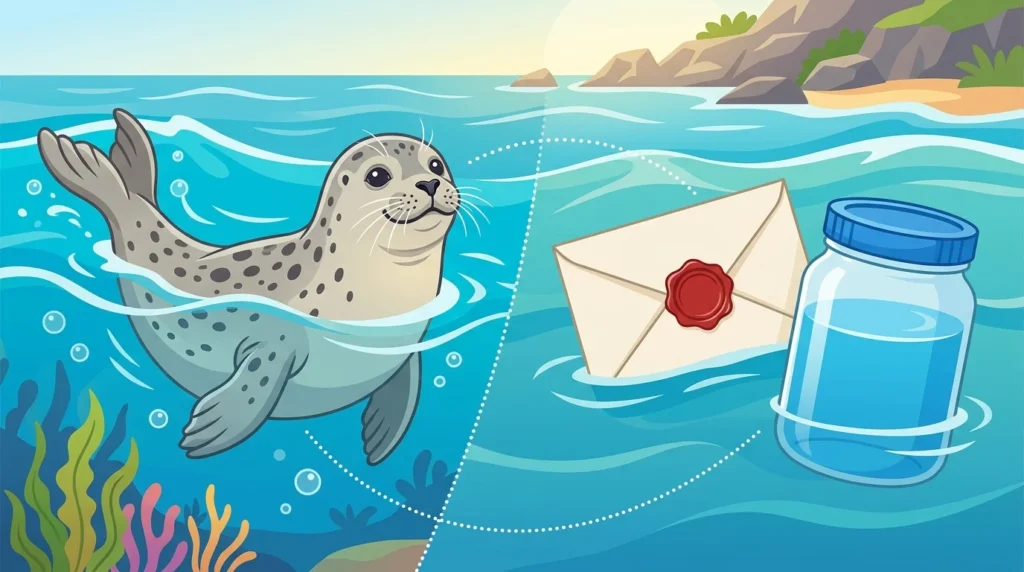
Use this simple memory trick:
Seal has “sea” in it.
A seal is a marine animal, so connecting seal with sea helps you remember the spelling.
Then extend the same spelling to the other common meanings:
- seal an envelope
- seal a package
- a tight seal
- an official seal
- a marine seal
For seel, remember the opposite idea: it is the unusual historical word you are likely to encounter only when reading about old falconry or related historical language.
Quiz: Seal or Seel?
Choose the correct word for each sentence.
- Please ______ the envelope before mailing it.
- The bottle needs a new rubber ______.
- We saw a ______ swimming near the shore.
- The university document carries its official ______.
- Make sure you ______ the package properly.
- The historical text describes how a falconer would ______ the bird’s eyelids.
- The technician replaced the damaged ______ around the pipe.
- The final signature helped ______ the agreement.
- The machine is ______ each box automatically.
- The historian studied the old practice of ______ falcons.
Answers
- seal
- seal
- seal
- seal
- seal
- seel
- seal
- seal
- sealing
- seeling
Frequently Asked Questions
Is “seel” a real English word?
Yes. Seel is a real but rare English verb. It is mainly associated with historical falconry, where it referred to sewing or closing the eyelids of a hawk or falcon. It also has older, obsolete meanings related to closing the eyes or blinding.
Which is correct: seal or seel?
For almost all ordinary modern writing, seal is correct. Use seel only when its specialized historical meaning is intended.
Is “seel” a misspelling of “seal”?
Not always. If someone writes seel the package, it is a wrong word choice for that context. However, seel itself is a legitimate historical English word.
Which is correct: seal an envelope or seel an envelope?
Seal an envelope is correct. The verb means to close the envelope securely. Seel an envelope is not the normal modern expression.
Which is correct: seal a package or seel a package?
Seal a package is correct. Use seal when you mean to close or secure something.
Does “seal” have more than one meaning?
Yes. Seal can refer to a marine animal, a closure or barrier, an official mark, or the act of closing or securing something. It can also be used figuratively, as in seal the deal.
Are seal and seel pronounced the same?
They can be pronounced alike as /siːl/. This makes them a pair of homophones in English, which is one reason the spellings are easy to confuse.
What does “seel” mean in falconry?
In historical falconry, seel meant to sew or close the eyelids of a hawk or falcon. The word is now rare and mainly appears in historical or specialized contexts.
What is the past tense of seal?
The past tense and past participle of seal are sealed. For example: The worker sealed the container yesterday.
What is the past tense of seel?
The historical verb seel has the past form seeled. This form is rare because the verb itself is rarely used in modern English.
How can I remember seal vs seel?
Remember that seal contains sea, which connects it to the marine animal. More broadly, use seal for closing, securing, official marks, agreements, and the animal. Reserve seel for its rare historical falconry meaning.
Quick Summary
Seal is the standard modern English word for closing or securing something, creating a barrier against air or liquid, referring to an official mark, finalizing something, or naming the marine animal. Seel is a real but rare historical verb mainly associated with falconry, where it meant to sew or close the eyelids of a hawk or falcon. The two words can sound alike, which explains the spelling confusion, but they are not interchangeable. For envelopes, packages, containers, leaks, documents, agreements, and marine animals, use seal. Use seel only when the specialized historical meaning is actually intended. In ordinary modern English, seal is the word you will need almost every time.
See Also: FRL Meaning in Text: What It Means & How to Use It