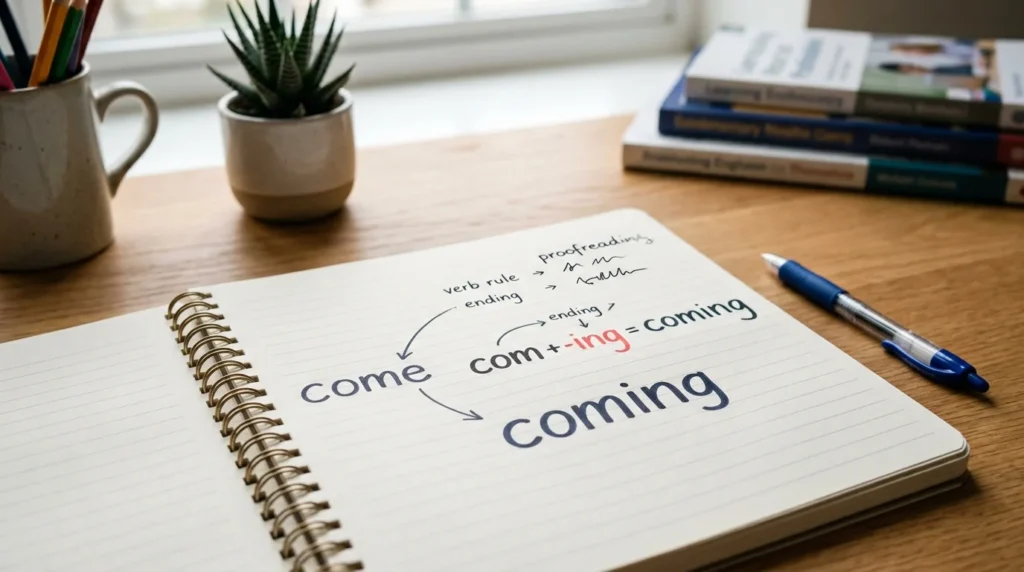

Coming is the correct spelling. Comming is a misspelling when you mean the -ing form of the verb come. The correct spelling is formed by removing the final silent e from come and adding -ing: come → coming. You do not double the m. This spelling is used in both American and British English and works in casual, professional, academic, and formal writing.
Quick Answer
Coming is the only standard spelling when you mean the -ing form of come. Comming is incorrect. The mistake usually happens because learners know that some verbs double their final consonant before adding -ing, such as run → running and stop → stopping. However, come follows the silent-e pattern: remove the final e, then add -ing. Therefore, come → coming, not comming.
What Is the Difference Between Comming and Coming?
The difference is mainly one of correct spelling. Coming is a standard English word derived from the verb come. It can describe movement toward someone or somewhere, arrival, an approaching event, or something that is about to happen.
Comming, when intended as the -ing form of come, is not a standard spelling. It is normally caused by adding an unnecessary second m. Standard English uses coming with only one m. Cambridge’s grammar guidance specifically identifies comming and comeing as incorrect forms and gives coming as the correct spelling.
| Form | Status | Example |
|---|---|---|
| coming | Correct | She is coming home. |
| comming | Incorrect | She is comming home. |
| comeing | Incorrect | She is comeing home. |
Why It Matters
A spelling error such as comming usually does not prevent a reader from understanding the sentence, but it can make writing look careless. This matters more in situations where written accuracy is important, such as job applications, school assignments, professional emails, websites, reports, and business communication.
The word coming is extremely common, so learning its spelling gives you a useful rule that can also help with other verbs. Once you recognize that come ends in a silent e, the spelling becomes easier to remember.
For example:
- come → coming
- make → making
- take → taking
- write → writing
- drive → driving
- give → giving
The Core Rule

Rule: When you form the -ing form of come, remove the final silent e and add -ing.
come − e + ing = coming
The important point is that removing the e does not mean that the remaining m should be doubled. The spelling operation is based on the original verb come.
So remember:
COME → COMING
Not:
COME → COMMING
Cambridge’s English Grammar Today gives the same spelling pattern and specifically states that the -ing form of come is coming, not comming or comeing.
How to Use Coming
Coming for an Action Happening Now
Coming is commonly used with a form of be to describe an action in progress.
Examples include:
- I am coming home now.
- She is coming to the office.
- They are coming with us.
Coming for Movement Toward a Place or Person
The word can describe movement toward a particular location or person.
For example, someone might say, “I am coming to your house.” The word indicates movement toward the person or place being discussed.
Coming for an Approaching Event
Coming can also describe something that is approaching in time.
- The weekend is coming.
- Winter is coming soon.
- The coming year may bring major changes.
Coming After a Preposition
Coming can also function as an -ing form after a preposition.
For example:
- Thank you for coming.
- We talked about coming back later.
- She is interested in coming to the event.
In all these situations, the spelling remains coming.
Correct Examples of Coming
Conversation
“Are you coming with us to the restaurant?”
Here, coming describes someone joining the speaker.
“Thank you for coming to the meeting this morning.”
The word describes attendance at an event.
School Writing
“The students are coming to the library after lunch.”
This uses coming as part of the present continuous tense.
Workplace Communication
“A new software update is coming next week.”
Here, coming describes something expected in the near future.
Social Media
“Something exciting is coming soon!”
The spelling remains the same even in short, informal online writing.
Academic Writing
“The coming decades may bring significant technological changes.”
Here, coming works as an adjective describing the approaching decades.
Everyday Conversation
“I’m coming downstairs now.”
The word describes movement toward another location.
Professional Email
“We appreciate you coming to discuss the proposal.”
The -ing form follows appreciate naturally in this sentence.
Announcement
“The new collection is coming this fall.”
The word indicates that something will become available in the future.
Personal Message
“I’m coming over after dinner.”
This is a natural everyday use of coming.
Formal Context
“The coming months will require careful planning.”
Here, coming refers to the months that will follow.
Academic Discussion
“The researchers expect further developments in the coming years.”
The word modifies years and refers to the future period.
Incorrect vs. Correct
| Incorrect | Correct | Why |
|---|---|---|
| ❌ I am comming home. | ✅ I am coming home. | Come drops its final silent e before -ing; the m is not doubled. |
| ❌ Are you comming with us? | ✅ Are you coming with us? | Coming is the standard -ing form of come. |
| ❌ Thank you for comming. | ✅ Thank you for coming. | The form after for is coming, not comming. |
| ❌ The train is comming. | ✅ The train is coming. | The correct spelling contains one m. |
| ❌ A new update is comming soon. | ✅ A new update is coming soon. | Coming can describe something expected in the near future. |
| ❌ She is comming to class. | ✅ She is coming to class. | Coming is formed from come + ing after dropping the e. |
| ❌ We are comming tomorrow. | ✅ We are coming tomorrow. | The double m in comming is unnecessary. |
| ❌ He talked about comming back. | ✅ He talked about coming back. | The gerund form is spelled coming. |
| ❌ The coming year is better than comming year. | ✅ The coming year is better than the previous year. | Coming is the correct adjective for an approaching period. |
| ❌ Thanks for comming to the event. | ✅ Thanks for coming to the event. | The correct spelling remains one m in every register. |
| ❌ I am comming over tonight. | ✅ I am coming over tonight. | The verb form is coming. |
| ❌ More changes are comming. | ✅ More changes are coming. | Coming is used for changes that are approaching or expected. |
Why Do People Make This Mistake?
Confusion With Double-Consonant Words
One major reason is that English contains many familiar words that double a final consonant before -ing.
For example:
- run → running
- sit → sitting
- stop → stopping
- plan → planning
- swim → swimming
A learner may see these patterns and assume that come should behave the same way. It does not. Come belongs to a different spelling pattern because its final e is dropped before -ing.
See Also: Conex vs Connex: What Is the Difference?
Spelling Does Not Always Follow Sound
English spelling cannot always be predicted directly from pronunciation. A writer may hear the word coming and focus on the consonant sound before the -ing ending, which can contribute to the mistaken spelling comming.
The safest approach is to remember the written base form: come → coming.
Overgeneralizing a Spelling Rule
Learning a rule is useful, but applying it to every similar-looking word can create mistakes. The consonant-doubling pattern has specific conditions and does not apply simply because a word ends with a consonant after removing another letter.
With come, the most useful learner rule is simpler: remove the silent e and add -ing.
Typing Too Quickly
Comming may also appear because someone types the same letter twice accidentally. This is especially possible when writing quickly in a message, comment, email, or social media post.
A quick proofreading pass can catch the error.
Translation or First-Language Interference
English learners may apply spelling patterns from their first language when forming English words. English spelling conventions are not always predictable from pronunciation or from rules used in another language.
For learners, memorizing the small transformation come → coming is more reliable than trying to reproduce the word from sound alone.
Common Mistakes Checklist
Writing Comming Instead of Coming
Mistake: Adding a second m.
Why it happens: The writer may be thinking about words such as running or stopping.
How to avoid it: Remember that come → coming.
Writing Comeing
Mistake: Keeping the final e and adding -ing.
Why it happens: The writer remembers the base word come but forgets the silent-e spelling rule.
How to avoid it: Remove the final e before adding -ing.
come → coming
Thinking Comming Is an Alternative Spelling
Mistake: Treating comming as another accepted version of coming.
Why it happens: Both forms may be recognizable to a reader, especially in online text.
How to avoid it: Use coming in standard English writing.
See Also: EVB Meaning in Text: What It Means & How to Use It
Applying the Double-Consonant Rule Automatically
Mistake: Assuming every verb gets a doubled consonant before -ing.
Why it happens: Words such as running and sitting are common.
How to avoid it: Check the actual spelling pattern of the base verb.
Ignoring the Base Word
Mistake: Trying to spell the word only from its sound.
Why it happens: English spelling and pronunciation do not always match perfectly.
How to avoid it: Start with come, remove e, and add ing.
Coming in Real English
Grammatically Correct and Natural
Coming is both grammatically correct and natural in ordinary English. Native and proficient English speakers routinely use it in expressions such as “I’m coming home,” “Are you coming with us?” and “Thank you for coming.” It also works naturally when describing future or approaching events, as in “the coming weeks.” There is no need to replace coming with another spelling.
Grammatically Possible but Unnatural
The issue with comming is not that it is an unusual or old-fashioned form of coming. When comming is intended as the -ing form of come, it is simply a spelling error. It may be understandable because readers can infer the intended word, but understanding does not make the spelling standard. Use coming instead.
Natural Everyday English
In everyday English, coming appears in many short expressions: “I’m coming,” “coming soon,” “Are you coming?” and “Thanks for coming.” These expressions are common across casual conversation, messages, workplace communication, and formal writing. The register may change, but the spelling does not. Whether the sentence is informal or highly professional, write coming with one m.
American vs. British English
There is no spelling difference between American and British English for this word.
| English Variety | Correct Form |
|---|---|
| American English | coming |
| British English | coming |
| International English | coming |
Words such as colour/color and centre/center have regional spelling differences, but coming does not.
Formal vs. Informal Usage
Coming is appropriate in both formal and informal English. You can use it in a text message, a school assignment, a professional email, an academic paper, or a business report.
| Context | Correct Example |
|---|---|
| Text message | I’m coming now. |
| Conversation | Are you coming with us? |
| Work email | Thank you for coming to the meeting. |
| Academic writing | The coming decades may bring further changes. |
| Business writing | The coming quarter will require careful planning. |
The spelling comming should not be used in formal or informal standard English simply because the context is casual.
Comparison Table
| Feature | Coming | Comming |
|---|---|---|
| Standard English | Yes | No |
| Base word | Come | Incorrect form of come |
| Spelling | One m | Two m’s |
| -ing form | Correct | Incorrect |
| American English | Correct | Incorrect |
| British English | Correct | Incorrect |
| Formal writing | Correct | Incorrect |
| Informal writing | Correct | Incorrect |
| Meaning | Movement, arrival, approach, or related meanings of come | No standard meaning as the -ing form of come |
| Correct formation | come − e + ing | Not a valid formation |
Related Forms of Come
Knowing the other forms of come can make the spelling easier to remember.
| Form | Example |
|---|---|
| Base form: come | I come here every Friday. |
| Third-person singular: comes | She comes here every Friday. |
| Past tense: came | She came yesterday. |
| Past participle: come | She has come home. |
| -ing form: coming | She is coming home. |
The key spelling change for this article is:
come → coming
Real-Life Situations
At an Interview
If an interviewer asks whether you can attend a second meeting, you might say:
“Yes, I can come on Thursday.”
If you are describing the action as it happens, you could say:
“I am coming to the office now.”
See Also: NSFW Meaning in Text: What It Means & How to Use It
In a Work Email
You might write:
“Thank you for coming to our office to discuss the project.”
The correct spelling is coming, even though the email is professional.
In a Text Message
A natural message is:
“I’m coming in five minutes.”
Casual writing does not change the spelling of the word.
In an Exam
If a spelling question asks for the correct -ing form of come, choose:
coming
Do not choose comming or comeing.
In an Advertisement
An announcement might say:
“A new collection is coming soon.”
This is a common use of coming to describe something that will become available in the future.
The Easiest Way to Remember Coming
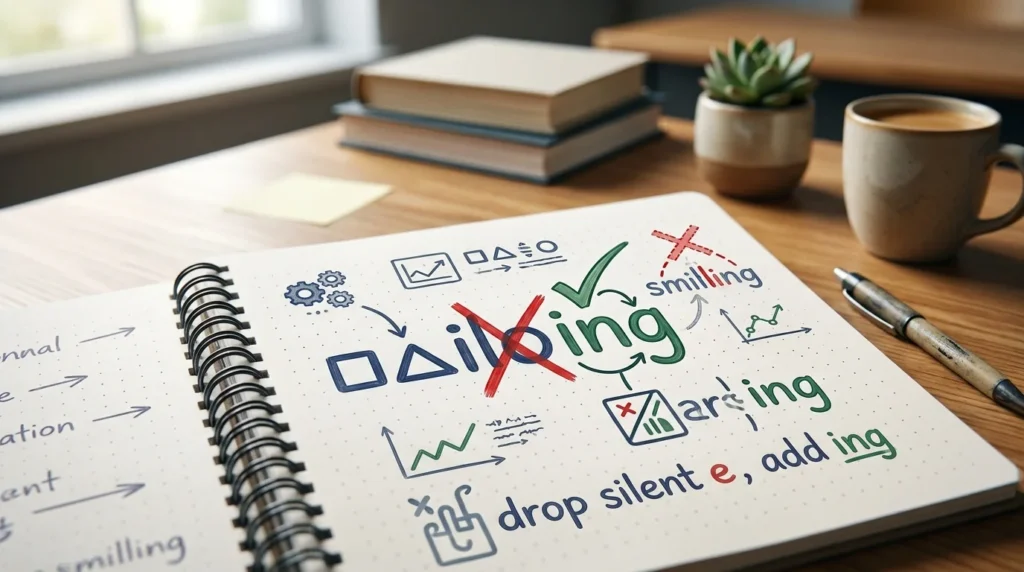
Use this three-step memory method:
- Start with the base verb: come.
- Remove the silent final e.
- Add -ing.
That gives you:
COME → COM → COMING
A simple memory sentence is:
“Come loses the e, not the m.”
This is a useful way to avoid both common errors: comming and comeing.
Quick Practice Quiz
Choose the Correct Spelling
1. Which sentence is correct?
A. She is comming home.
B. She is coming home.
C. She is comeing home.
Answer: B. She is coming home.
Complete the Word
2. Thank you for ______ to the meeting.
A. comming
B. comeing
C. coming
Answer: C. coming.
Apply the Rule
3. What happens when -ing is added to come?
A. The m is doubled.
B. The e is removed.
C. Nothing changes.
Answer: B. The final e is removed.
Check Your Understanding
4. Which spelling should you use in a professional email?
A. comming
B. coming
C. comeing
Answer: B. coming.
Frequently Asked Questions
Is comming or coming correct?
Coming is correct. Comming is a spelling mistake when you mean the -ing form of come.
Why is coming spelled with one m?
The base verb is come. Its final silent e is removed before -ing is added: come → coming. There is no spelling rule that requires the m to be doubled in this word.
Is comming a real English word?
Comming is not the standard spelling of the -ing form of come. If you intend to write about someone moving, arriving, or approaching, use coming.
Is coming correct in American English?
Yes. Coming is the standard spelling in American English.
Is coming correct in British English?
Yes. British English also uses coming. There is no British-American spelling difference for this word.
Can I write comming in informal messages?
It may appear as a typing or spelling mistake in informal messages, but it is not the standard spelling. Even in casual writing, use coming.
Is comeing also wrong?
Yes. Comeing is also incorrect. The final silent e is removed before -ing is added, giving coming.
What is the spelling rule for come and coming?
When come takes the -ing ending, remove the final silent e: come − e + ing = coming.
Why do people write comming?
The error often comes from confusion with verbs that double their final consonant before -ing, such as run → running and stop → stopping. That pattern does not apply to come.
Is coming a verb?
Coming is the present participle and -ing form of the verb come. Depending on how it is used in a sentence, it can also function as a gerund or adjective.
What is the easiest way to remember coming?
Remember: “Come loses the e, not the m.” Start with come, remove the final e, and add -ing: coming.
Should I use coming in formal writing?
Yes. Coming is standard and appropriate for formal, academic, professional, and everyday writing.
Quick Summary
Coming is the correct spelling of the -ing form of come, while comming is a spelling mistake. The correct formation is simple: remove the final silent e from come and add -ing, producing coming. Do not double the m. The confusion often comes from words such as running, stopping, and sitting, which do double a final consonant. That pattern does not apply to come. Coming is correct in American and British English and is suitable for casual messages, schoolwork, professional emails, business writing, and academic contexts. When in doubt, remember: come loses the e, not the m.
See Also: BMF Meaning in Text: What It Means & How to Use It