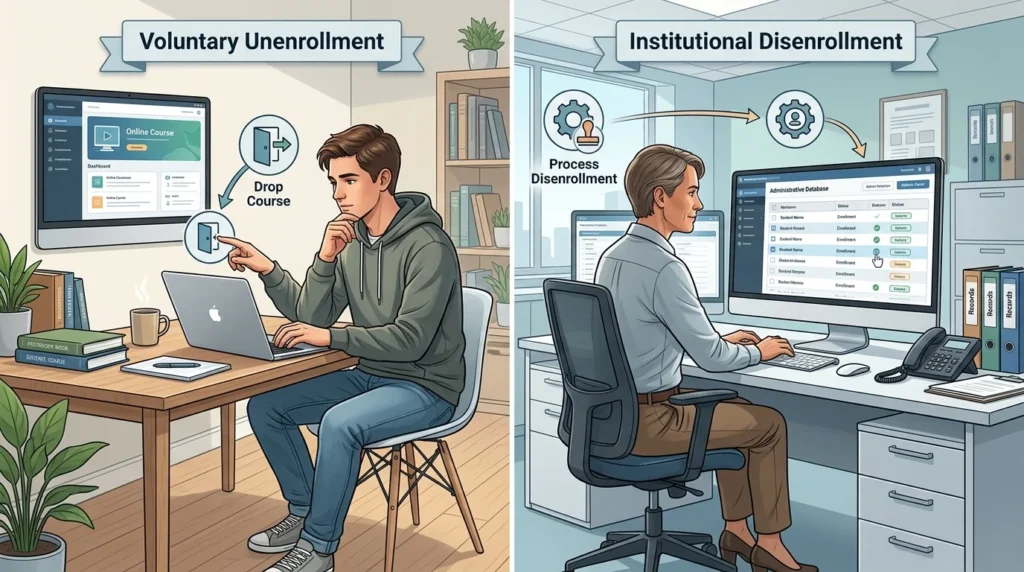

“Unenroll” and “disenroll” can both mean to remove someone from a course, program, school, or other enrollment. However, unenroll is the more straightforward and widely used choice in everyday American English. Disenroll is also a legitimate word, but it is less common and can sound more formal or administrative. In most general writing, unenroll is the safer choice when you mean to stop being enrolled.
What Is the Difference Between Unenroll and Disenroll?
Both unenroll and disenroll are verbs related to enrollment.
Unenroll means to stop being enrolled or to remove someone from an enrollment. It can describe a person voluntarily leaving a program or an institution removing that person.
Disenroll also means to remove someone from an enrollment or to cause someone to cease being enrolled. It is especially useful when the removal is carried out by an institution, organization, or administrator.
The words overlap substantially, so the surrounding context often determines which one sounds most natural.
Why It Matters
Choosing between these words can matter in school, workplace, healthcare, membership, and administrative communication.
For example, if a student is simply leaving an online course, “I need to unenroll from the course” sounds natural and direct.
If an administrator is formally removing someone from a program because they no longer meet its requirements, “The student was disenrolled from the program” can fit the administrative context.
The distinction is not an absolute grammar rule. It is mainly about meaning, perspective, and natural usage.
The Core Rule
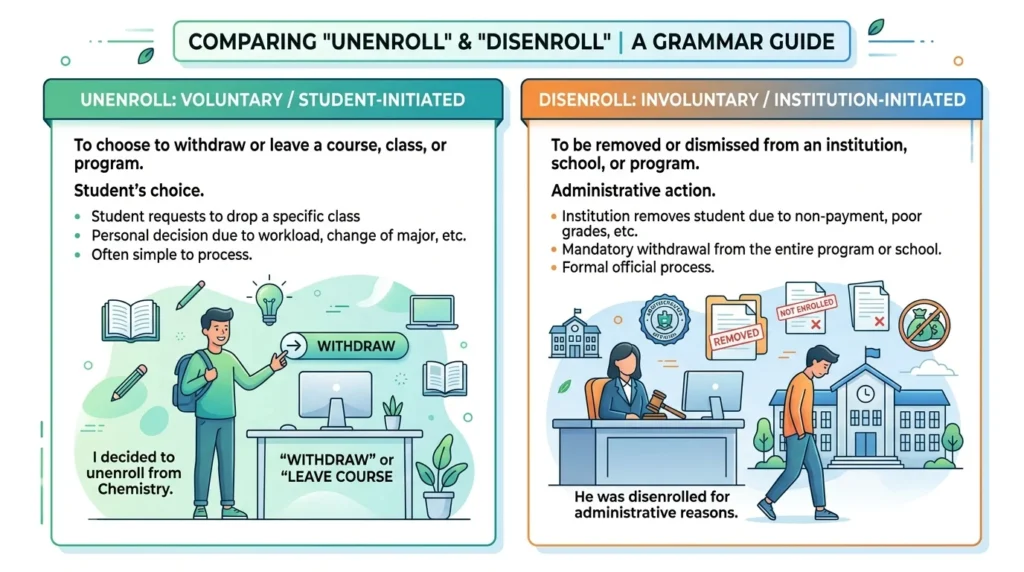
Rule: Use unenroll as the general, everyday verb for stopping enrollment or removing someone from enrollment. Use disenroll when you specifically want to emphasize formal or administrative removal.
A useful distinction is:
Unenroll = stop being enrolled / remove from enrollment
Disenroll = formally remove from enrollment
This is a useful guideline rather than a strict rule that makes the other word grammatically incorrect.
How to Use Unenroll
When You Leave Something Yourself
“Unenroll” is natural when the person taking the action is the student, participant, or member.
I decided to unenroll from the course.
She wants to unenroll from the training program.
You can unenroll from the class before the deadline.
When an Administrator Removes Someone
“Unenroll” can also describe an institution removing someone.
The school unenrolled the student after receiving the withdrawal request.
This construction is grammatically possible, although disenroll may sound more administrative in some contexts.
With “From”
Both words are commonly followed by from when identifying the program or course.
I unenrolled from the class.
The student was disenrolled from the program.
Avoid adding unnecessary words between the verb and “from.”
How to Use Disenroll
“Disenroll” generally focuses more strongly on removal from an enrollment status.
The university disenrolled the student after the payment deadline.
Participants who fail to meet the requirements may be disenrolled from the program.
It is especially suitable in institutional policies, administrative notices, and formal descriptions of enrollment status.
Passive Voice
“Disenroll” appears naturally in passive constructions:
The participant was disenrolled from the program.
Here, the focus is on the person who lost their enrollment rather than the administrator who performed the action.
Correct Examples
- Conversation: “I need to unenroll from this class.”
- Email: “Please let me know how I can unenroll from the training course.”
- School: “The student chose to unenroll before the semester began.”
- Workplace: “Employees can unenroll from optional training sessions.”
- Online learning: “You can unenroll from the course through your account settings.”
- Administration: “Students may be disenrolled if they fail to complete the required paperwork.”
- Formal policy: “Participants may be disenrolled from the program for failing to meet eligibility requirements.”
- Academic writing: “Some participants chose to unenroll before completing the study.”
- Social media: “I’m going to unenroll from the workshop because I can’t attend.”
- Customer support: “If you no longer want to participate, you can unenroll from the program.”
Incorrect vs. Correct
| ❌ Incorrect | ✅ Correct | Why |
|---|---|---|
| I need to disenroll myself from the class. | I need to unenroll from the class. | “Unenroll” is the more natural everyday choice for voluntarily leaving. |
| She unenrolled the program. | She unenrolled from the program. | When a person leaves a program, “from” normally identifies what they left. |
| He decided to disenroll himself the course. | He decided to unenroll from the course. | The construction needs “from.” |
| The school unenrolled him from the program. | The school disenrolled him from the program. | “Disenroll” can clearly express formal institutional removal. |
| I was unenroll from the class. | I was unenrolled from the class. | A passive construction requires the past participle “unenrolled.” |
| They were disenroll from the course. | They were disenrolled from the course. | “Disenrolled” is the correct past participle. |
| I will unenrolled tomorrow. | I will unenroll tomorrow. | A modal or auxiliary such as “will” takes the base form. |
| She has unenroll from school. | She has unenrolled from school. | “Has” requires the past participle. |
| The university disenrolled from the student. | The university disenrolled the student. | The institution removes the student; “student” is the direct object here. |
| He is going to disenrolled from the class. | He is going to disenroll from the class. | “Going to” is followed by the base form. |
Why People Make This Mistake
Similar Prefixes
Both words contain prefixes that suggest removal or reversal:
- un- often indicates reversal or removal.
- dis- can also indicate separation, reversal, or removal.
Because both prefixes can carry related meanings, it is easy to assume that the words must have exactly the same usage.
Overgeneralization
Learners sometimes believe that dis- automatically makes a word more formal or that un- always means voluntary action. Neither assumption is universally true.
English word formation does not always work through one simple rule.
Confusion About Who Takes the Action
A particularly common issue is confusing:
I unenrolled from the course.
with:
The school disenrolled me from the course.
The first sentence presents the person as leaving. The second presents the institution as removing the person.
That difference in perspective often makes one verb more natural than the other.
Spellcheck and Autocomplete
Digital tools may suggest one word over another because their dictionaries and language models differ. An autocomplete suggestion does not establish a grammatical rule.
Translation Interference
Learners translating directly from another language may expect one English verb to cover every situation involving withdrawal or removal. English instead uses several related constructions depending on context.
Common Mistakes Checklist
Using “Unenroll” Without “From”
When you mean that someone leaves a course or program, from is normally needed.
Better:
I unenrolled from the course.
Treating “Disenroll” as Wrong
“Disenroll” is a legitimate English verb. It should not automatically be corrected to “unenroll.”
Assuming the Words Are Always Interchangeable
The meanings overlap, but their typical contexts can differ. Unenroll is often more natural for a person’s own decision, while disenroll works particularly well for institutional removal.
Using the Wrong Verb Form
Remember the basic forms:
- unenroll
- unenrolled
- unenrolling
and:
- disenroll
- disenrolled
- disenrolling
Confusing “Unenrolled” and “Unenroll”
After will, use “unenroll”:
I will unenroll tomorrow.
After have/has/had, use “unenrolled”:
I have unenrolled from the course.
Unenroll vs. Disenroll in Real English
“Unenroll” is a natural everyday choice when someone talks about leaving a course, class, program, or service. For example, “I need to unenroll from this class” is direct and easy to understand. It does not necessarily imply that anyone forced the person to leave. The word can also be used when an organization removes someone, but the context determines the exact meaning.
“Disenroll” is grammatically correct and often fits administrative or institutional contexts. A sentence such as “The university disenrolled the student” clearly presents the university as the actor responsible for ending the enrollment. “Disenrolled from the program” is also common in formal descriptions of enrollment status. The word does not inherently mean that the removal was punitive.
The two words can sometimes describe the same event without changing the basic fact that enrollment ended. However, replacing one with the other can subtly change the emphasis. “Unenroll” often works naturally when discussing a person’s decision or action, whereas “disenroll” can foreground an institution’s administrative action.
Formal vs. Informal Usage
There is a useful register difference, although it is not absolute.
Unenroll is common in everyday communication, especially when websites or learning platforms tell users how to leave a course.
Click here to unenroll from the course.
Disenroll is often more administrative:
The institution may disenroll participants who fail to satisfy the eligibility requirements.
For a casual email or conversation, unenroll will often sound simpler. For a policy, official notice, or administrative document, disenroll may fit naturally.
See Also: SPWM Meaning in Text: What It Means & How to Use It
American vs. British English
There is no clear grammar rule dividing “unenroll” and “disenroll” between American and British English.
The spelling enrol is common in British English, while enroll is standard in American English. As a result, British English may also use forms such as unenrol and disenrol, while American English commonly uses unenroll and disenroll.
The underlying distinction remains the same: the words concern ending or removing enrollment.
Comparison Table
| Feature | Unenroll | Disenroll |
|---|---|---|
| Part of speech | Verb | Verb |
| Basic meaning | Stop or end enrollment | Remove from enrollment |
| Can describe voluntary withdrawal | Yes | Possible, but less typical |
| Can describe institutional removal | Yes | Yes |
| Everyday use | Very common | Less common |
| Administrative use | Common | Particularly suitable |
| Often followed by “from” | Yes | Yes |
| Past tense | Unenrolled | Disenrolled |
| Present participle | Unenrolling | Disenrolling |
| Always interchangeable? | No | No |
Real-Life Situations
In a Course
If you are leaving an online class yourself:
I want to unenroll from the course.
This is simple and natural.
In an Administrative Notice
If a school is explaining a policy:
Students may be disenrolled if they do not complete registration requirements.
The institutional perspective makes “disenrolled” especially suitable.
In an Email
Hello, I would like to unenroll from the training program. Please let me know if I need to complete a withdrawal form.
“Unenroll” works well because the writer is describing their own action.
In a Meeting
An administrator might say:
We may need to disenroll several participants who no longer meet the program requirements.
The word fits the formal administrative setting.
In a Text Message
I’m going to unenroll from the class. I have too much work this semester.
“Unenroll” is the natural straightforward choice.
In an Exam
If an exam asks you to choose between the two words, look at who is ending the enrollment and the context. If a student is describing their own decision, “unenroll” will often be the expected choice. If an institution is formally removing someone, “disenroll” may fit better.
See Also: BRB Meaning in Text: What It Means & How to Use It
The Easiest Way to Remember
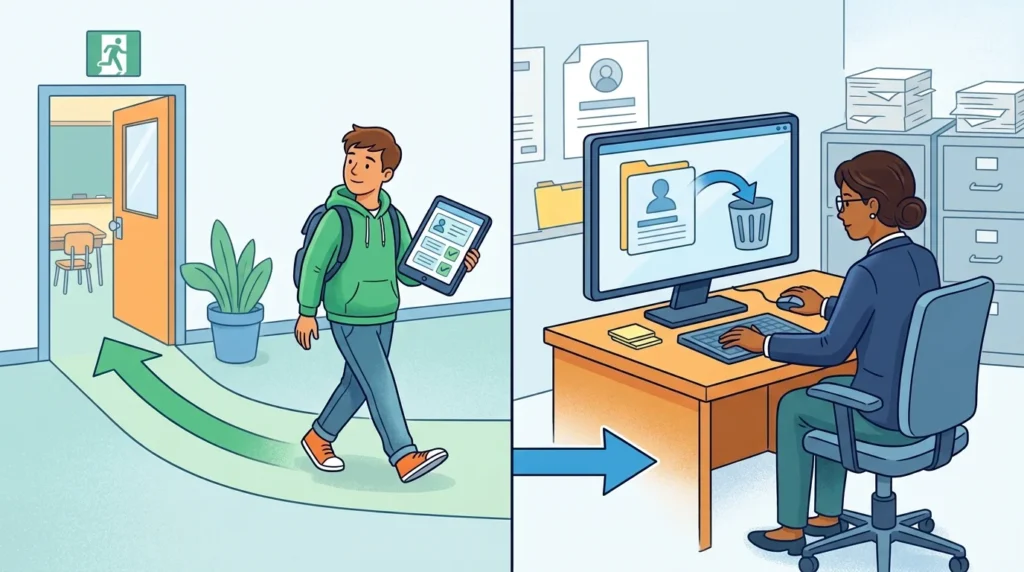
Think about perspective:
I leave → unenroll
An institution removes me → disenroll
For example:
I unenrolled from the course.
The school disenrolled me from the course.
This is not an unbreakable grammar rule, but it is a useful memory aid for choosing the more natural word in many situations.
Frequently Asked Questions
Is “unenroll” a real word?
Yes. “Unenroll” is a standard English verb meaning to stop being enrolled or to remove someone from enrollment.
Is “disenroll” a real word?
Yes. “Disenroll” is also a standard verb related to ending or removing enrollment.
Is it better to say “unenroll” or “disenroll”?
For general everyday writing, unenroll is usually the simpler choice. Disenroll can be especially appropriate when describing formal or institutional removal.
Can you unenroll yourself?
Yes. You can say:
I need to unenroll from the course.
This commonly describes a person’s own decision to stop participating.
Can a school disenroll a student?
Yes. A school or other institution can disenroll a student when its rules or procedures result in the student’s enrollment being ended.
Do you say “unenroll from” or “unenroll in”?
When referring to leaving a course, class, or program, “unenroll from” is the usual construction.
She unenrolled from the class.
What is the past tense of unenroll?
The past tense is unenrolled.
I unenrolled from the course yesterday.
What is the past tense of disenroll?
The past tense is disenrolled.
The student was disenrolled from the program.
Is “disenrollment” a word?
Yes. Disenrollment is the noun form associated with “disenroll,” especially in administrative contexts.
Is “unenrollment” a word?
Yes. Unenrollment can be used as the noun form of “unenroll,” particularly when discussing the process of ending enrollment.
Quick Summary
Unenroll and disenroll are both correct English verbs related to ending enrollment. The main difference is often one of perspective and register rather than strict grammar. Unenroll is a common, straightforward choice when someone leaves a course, class, or program, especially voluntarily. Disenroll is also correct and can sound particularly appropriate when an institution formally removes someone from an enrollment. Both can be followed by from, as in “unenroll from the course” and “disenroll from the program.” For everyday communication, “unenroll” is usually the easiest choice. In formal policies or administrative contexts, “disenroll” may fit especially well. Always choose the form that best matches the action and context.
See Also: FWIW Meaning in Text: What It Means & How to Use It