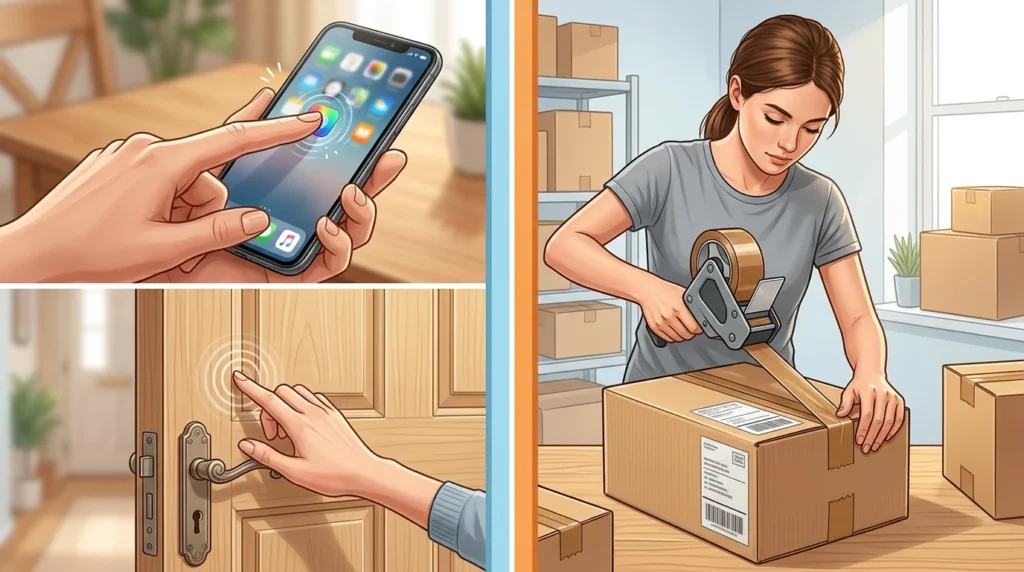

Tapping and taping are both correct English words, but they have completely different meanings. Tapping comes from the verb tap and means touching or striking something lightly, often repeatedly. Taping comes from tape and means attaching, covering, wrapping, or recording something using tape. The extra or missing p changes the word and its meaning.
Quick Answer
Use tapping when you mean lightly touching or striking something, such as “She was tapping her foot.” Use taping when you mean using tape, such as “He is taping the box shut.” Tapping comes from tap + -ing, where the final consonant is doubled. Taping comes from tape + -ing, where the silent final e is dropped. Both spellings are correct, but they describe different actions.
What Is the Difference Between Tapping and Taping?
The difference is mainly about the verbs they come from.
Tapping comes from tap. It means touching, hitting, or knocking something lightly, often more than once.
Taping comes from tape. It means using tape to attach, secure, cover, wrap, or sometimes record something.
Compare these two sentences:
“She was tapping on the window.”
“She was taping the poster to the wall.”
In the first sentence, she is making light contact with the window. In the second, she is using tape to attach a poster.
What Does “Tapping” Mean?
Tapping is the present participle or gerund form of tap. To tap something means to touch, hit, or strike it lightly.
The action may happen once or repeatedly, depending on the context.
- tapping a screen
- tapping a shoulder
- tapping a pencil on a desk
- tapping a foot
- tapping on a door
- tapping a microphone
For example:
“She kept tapping her fingers on the desk.”
Here, tapping describes repeated light contact.
What Does “Taping” Mean?
Taping is the present participle or gerund form of tape. It generally means using tape to attach, hold, cover, protect, or secure something.
For example:
“He is taping the package before shipping it.”
Here, taping means putting tape on the package to close or secure it.
Taping can also have a recording-related meaning. For example:
“The crew is taping the television program today.”
In this context, taping means recording the program.
The Core Rule
Tap → tapping
Tape → taping
The spelling difference comes from the way English forms the -ing form.
With tap, the final consonant is doubled:
tap + ing = tapping
With tape, the final silent e is removed before adding -ing:
tape − e + ing = taping
This gives you two different words with two different meanings.
How to Use Tapping
Tapping on a Surface
Use tapping when someone repeatedly makes light contact with a surface.
“I could hear someone tapping on the window.”
Tapping a Person
It can describe lightly touching someone to get their attention.
“She was tapping me on the shoulder.”
Tapping a Screen
In modern technology, tapping commonly describes touching a phone or tablet screen to activate something.
“Tap the icon to open the application.”
The -ing form would be:
“She is tapping the icon.”
Tapping Your Foot
People may tap their feet while listening to music, waiting, or feeling impatient.
“He was tapping his foot to the beat.”
How to Use Taping
Taping a Box
Use taping when applying tape to a package or container.
“She is taping the box shut.”
Taping a Poster
Use the word when tape is being used to attach something to another surface.
“We are taping the poster to the wall.”
Taping an Injury
Taping can describe applying medical or athletic tape to part of the body for support or protection.
“The trainer is taping his ankle.”
Taping a Program
In broadcasting, taping can mean recording a television or video program.
“The production team is taping the interview this afternoon.”
Correct Examples of Tapping
- She was tapping her fingers on the table.
- He kept tapping his foot during the meeting.
- I heard someone tapping on the window.
- She is tapping the screen to open the app.
- He gently tapped me on the shoulder.
- The child was tapping the glass with a spoon.
- She started tapping her pencil against the desk.
- He was tapping the microphone to check whether it worked.
- The musician was tapping his foot to the rhythm.
- She kept tapping on the door.
Correct Examples of Taping
- She is taping the package shut.
- He was taping a picture to the wall.
- The nurse is taping the injured finger.
- We spent the morning taping the boxes.
- They are taping the interview for later.
- He is taping the cable to the floor.
- She finished taping the poster to the door.
- The athlete’s ankle needs taping before the game.
- The crew is taping a new episode today.
- I was taping the edges to keep them secure.
Incorrect vs. Correct
| Incorrect | Correct | Why |
|---|---|---|
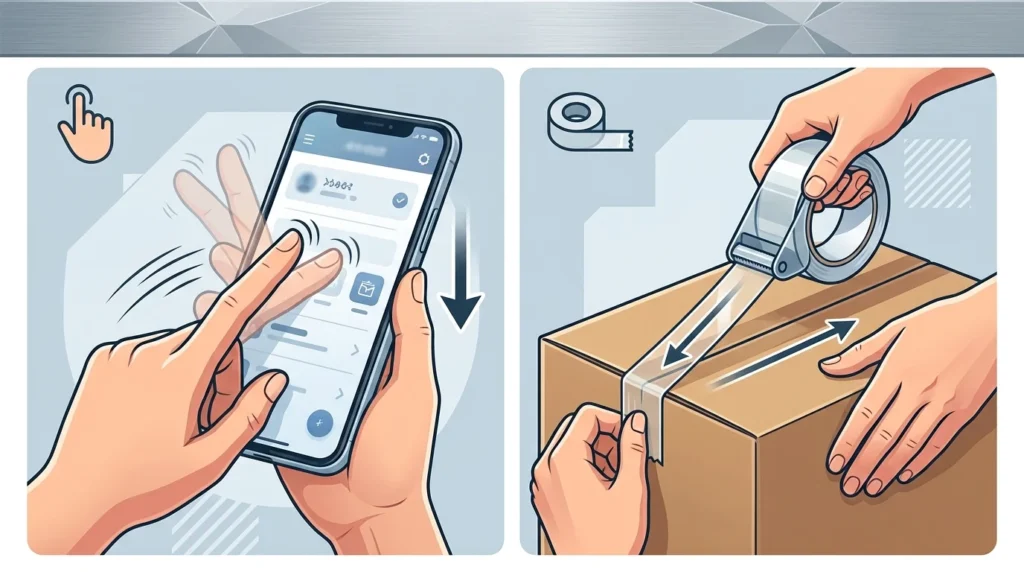
| She was taping her fingers on the desk. | She was tapping her fingers on the desk. | The action is light repeated contact, so the verb is tap. |
| He is tapping the box shut. | He is taping the box shut. | He is using tape, so the verb is tape. |
| She was taping her foot to the music. | She was tapping her foot to the music. | A foot makes repeated light movements or contacts; it is tapping. |
| We are tapping the poster to the wall. | We are taping the poster to the wall. | Tape is being used to attach the poster. |
| He kept taping on the window. | He kept tapping on the window. | The sentence describes repeated light knocking. |
| The nurse is tapping his ankle. | The nurse is taping his ankle. | The nurse is applying tape for support. |
| She is tapping the package for shipping. | She is taping the package for shipping. | The package is being secured with tape. |
| They are tapping the interview today. | They are taping the interview today. | Here, taping means recording the interview. |
| He was taping the screen with his finger. | He was tapping the screen with his finger. | The finger is making light contact with the screen. |
| She was tapping a label onto the box. | She was taping a label onto the box. | Tape is being used to attach the label. |
Why People Make This Mistake
The Words Sound Similar
Tapping and taping are pronounced similarly, especially when spoken quickly. This makes the difference easy to miss when learning English through conversation.
The Extra P Changes the Word
Many learners know the base words tap and tape but are unsure what happens when -ing is added.
The spelling rules are different:
tap → tapping
tape → taping
English Spelling Rules Are Not Always Obvious
The difference involves two common spelling patterns. A short vowel followed by a single consonant often leads to consonant doubling before -ing. A final silent e is usually removed before -ing.
Typing Quickly Causes Errors
Because the words differ by only one letter, writers can easily type the wrong form without noticing it.
Common Mistakes Checklist
Mistake 1: Using Taping for Touching
If someone is lightly hitting or touching something, use tapping.
Correct: “She was tapping on the door.”
Mistake 2: Using Tapping for Applying Tape
If tape is being used to attach or secure something, use taping.
Correct: “He is taping the box.”
Mistake 3: Forgetting to Double the P
The correct form of tap with -ing is tapping, not taping.
Mistake 4: Forgetting the Silent E Rule
The final e in tape disappears before -ing:
tape → taping
Mistake 5: Thinking the Words Are Variations of the Same Word
They are not spelling variants. Tap and tape are different verbs, so their -ing forms have different meanings.
Tapping vs Taping in Real English
Grammatically Correct
Both tapping and taping are grammatically correct forms. Their correctness depends on the base verb and intended meaning. Tapping comes from tap, while taping comes from tape. Because the base verbs have different meanings, the two -ing forms cannot normally replace one another.
Grammatically Possible but Unnatural
A sentence such as “She is taping her fingers on the desk” may be understood, but it does not naturally express repeated light contact. If that is the intended meaning, tapping is the appropriate word. Likewise, “He is tapping the box shut” does not naturally communicate that he is applying adhesive tape.
Natural Everyday English
In everyday English, tapping is natural for screens, doors, windows, fingers, feet, and shoulders. Taping is natural for boxes, posters, cables, injuries, and recorded programs. The surrounding noun or action usually makes the intended word easy to identify once the difference between tap and tape is understood.
American vs. British English
There is no major American-versus-British spelling difference between tapping and taping.
The same basic distinction applies in both varieties:
- tap → tapping
- tape → taping
Some meanings or technical uses of tap and tape can vary by context, but the spelling distinction discussed here remains the same.
Formal vs. Informal Usage
Both words are suitable for formal and informal English when used correctly.
Tapping can appear in everyday conversation, technical descriptions, academic writing, and workplace communication.
Taping is also used in casual and formal contexts, including medical, sports, construction, packaging, broadcasting, and workplace situations.
The key issue is not formality. It is choosing the word that matches the intended action.
Tapping vs Taping Comparison Table
| Feature | Tapping | Taping |
|---|---|---|
| Base verb | Tap | Tape |
| Meaning | Touching or striking lightly | Using tape or recording |
| Spelling | Double p | Drop final e |
| Formula | tap + ing = tapping | tape − e + ing = taping |
| Example | Tapping the screen | Taping the box |
| Common contexts | Doors, screens, fingers, feet | Boxes, posters, injuries, recordings |
Real-Life Situations
At Work
“Stop tapping your pen during the meeting.”
The person is repeatedly touching the pen against a surface.
While Packing
“I’m taping the box before we send it.”
The person is applying tape to secure the package.
Using a Smartphone
“Try tapping the button again.”
The person needs to touch the screen.
In Sports
“The trainer is taping the player’s ankle.”
The trainer is applying athletic tape.
In Broadcasting
“The crew is taping the interview this morning.”
Here, taping means recording.
At Home
“I heard someone tapping on the window.”
The person is making light repeated contact with the window.
The Easiest Way to Remember Tapping vs Taping
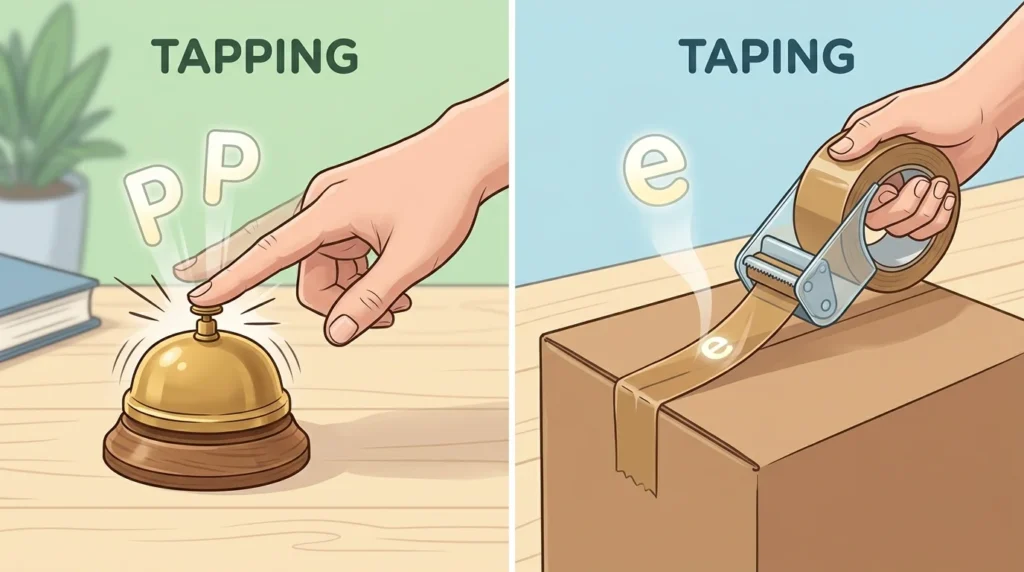
Use the base word as your memory trick.
Tap has no silent E → tapping doubles the P.
Tape has a silent E → taping drops the E.
Think of these two formulas:
- Tap → tapping = touch or strike lightly.
- Tape → taping = use tape or record.
A quick test can also help:
If you can replace the word with “touching lightly”, choose tapping.
If you can replace it with “using tape” or “recording”, choose taping.
Frequently asked question
What is the difference between tapping and taping?
Tapping means lightly touching, hitting, or knocking something and comes from tap. Taping means using tape or recording something and comes from tape.
Is tapping spelled with one p or two?
Tapping is spelled with two ps. The base verb is tap, and the final consonant is doubled before -ing.
Why is it tapping but taping?
Tap becomes tapping because its final consonant is doubled before -ing. Tape becomes taping because its final silent e is removed before -ing.
Is “taping” a correct word?
Yes. Taping is the correct -ing form of tape. It can mean applying tape or recording something.
Is “tapping” a correct word?
Yes. Tapping is the correct -ing form of tap. It describes light touching, striking, or knocking.
Is it tapping the screen or taping the screen?
If you mean touching the screen with your finger, it is tapping the screen. If you mean attaching tape to the screen, it would be taping the screen.
Is it tapping the box or taping the box?
If you are applying tape to the box, use taping the box. If you are lightly hitting the box, use tapping the box.
Is it tapping on the door or taping on the door?
For making light repeated knocks on a door, use tapping on the door.
Is “taping” used for recording?
Yes. Taping can mean recording a television program, interview, performance, or other media.
What is the easiest way to remember tapping?
Remember tap → tapping. The P is doubled. Think of a finger tapping repeatedly on a desk.
What is the easiest way to remember taping?
Remember tape → taping. The final silent E disappears before -ing. Think of putting tape on a box.
Quick Summary
Tapping and taping are both correct, but they come from different verbs. Tapping comes from tap and means touching, striking, or knocking something lightly. Its spelling doubles the final p: tap → tapping. Taping comes from tape and means applying tape, attaching something with tape, or sometimes recording something. Its final silent e is removed: tape → taping. Use tapping for fingers, feet, screens, doors, and light contact. Use taping for boxes, posters, injuries, cables, and recordings. The easiest memory trick is simple: tap doubles the P; tape drops the E.
See Also:
WTF Meaning in Text: What It Means & How to Use It