

Converter is the standard and much more commonly used spelling in modern English. Convertor is also a recognized variant, so it is not simply a spelling mistake. Both words can refer to a person, device, machine, or system that converts something from one form into another. For general writing, however, converter is the natural default.
Quick Answer: Convertor vs Converter
Converter is the spelling you should normally use in everyday, professional, academic, and technical writing. Convertor is a legitimate alternative spelling that appears less frequently and can occur in particular technical, historical, or established terminology. Cambridge lists convertor as an alternative form of converter, while Dictionary.com defines it as a variation of converter.
So, if you are writing about a currency converter, file converter, voltage converter, catalytic converter, or software tool, use converter. You may encounter convertor, but you do not need to treat it as the normal spelling.
What Is the Difference Between Convertor and Converter?
The main difference is not meaning but usage and frequency.
Converter is the established spelling used across ordinary English and many technical fields. It can describe something that changes one form, type, system, signal, file, measurement, or substance into another.
Convertor can carry the same basic meaning and is recognized as an alternative spelling. Cambridge gives “also convertor” under its entry for converter, and Dictionary.com describes convertor as a variation of converter.
Therefore, the simple rule is:
- Converter = standard and usual choice.
- Convertor = recognized alternative, but much less common.
- They generally refer to the same basic idea.
- Do not assume convertor is simply a spelling error.
What Does “Converter” Mean?
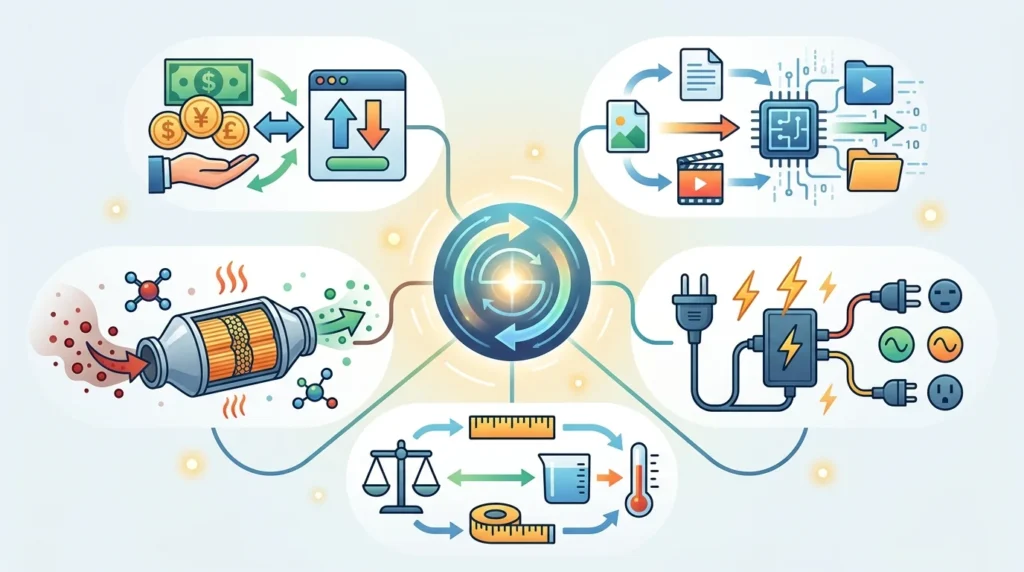
Converter is a noun for a person or thing that converts something. In technical contexts, it often refers to a machine or device that changes something into a different form. Cambridge gives this device-based meaning and provides examples such as frequency converters, currency converters, and digital-to-analog converters.
The word can apply to many different situations.
- A currency converter changes one currency value into another.
- A file converter changes a file from one format to another.
- A video converter changes a video into another file format.
- A power converter changes electrical power from one form to another.
- A catalytic converter is part of a vehicle’s exhaust system.
- An analog-to-digital converter changes an analog signal into digital data.
Dictionary.com also lists several technical meanings for converter, including electrical equipment, radio and television equipment, computing-related devices, and metallurgical equipment.
What Does “Convertor” Mean?
Convertor is a recognized alternative form of converter. It generally refers to something that converts. Dictionary.com specifically defines convertor as “a variation of converter,” while Cambridge includes convertor as an alternative form under its converter entry.
This means it is too strong to say that convertor is always incorrect.
The more accurate distinction is that converter is the normal modern choice, whereas convertor is an alternative that readers encounter much less often.
For example, a reader may understand both:
“The device contains a power converter.”
“The device contains a power convertor.”
The first sentence uses the form most readers would expect. The second uses a recognized variant.
Why Is Converter More Common?
English noun formation often uses both -er and -or endings. This can make words such as converter and convertor seem equally logical.
For example, English has:
- teach → teacher
- drive → driver
- write → writer
- operate → operator
- act → actor
- conduct → conductor
There is no single rule that lets you predict the correct ending for every English verb. Established usage determines which form becomes standard.
For convert, the -er form, converter, became the normal spelling. Dictionary.com’s entry gives the origin as convert + -er.
That is why it is better to learn converter as an established word rather than trying to decide between -er and -or from a universal spelling rule.
The Core Rule
Rule: Use “converter” as your default spelling. Treat “convertor” as a recognized alternative rather than an automatic spelling error.
This rule works well for general writing because converter is the form readers commonly encounter in phrases such as currency converter, file converter, catalytic converter, and digital converter. Cambridge’s dictionary examples also consistently use converter in these common technical combinations.
How to Use Converter and Convertor
Use Converter in General Writing
When you are choosing the spelling yourself, converter is normally the best choice.
Use it in:
- Emails and business communication
- School assignments
- Academic writing
- Website content
- Product descriptions
- Software documentation
- Technical explanations
- Everyday conversation
- Online tutorials
- Instructions and manuals
Convertor May Appear in Specialized or Established Usage
You may encounter convertor in technical documents, older material, quoted material, or established terminology. Dictionary.com provides real examples of the form in published British sources, including references to electrical infrastructure and automotive equipment.
That does not mean technical writers should generally replace converter with convertor. It simply means that the alternative spelling exists and can appear in real English.
See Also: Placque vs Plaque Differences: Meaning and Correct Usage
Preserve an Official Name When Necessary
If a product, organization, document, or technical designation officially uses convertor, preserve that spelling when referring to the official name.
Likewise, if you are reproducing an older quotation, changing convertor to converter would change the original spelling.
Correct Examples of Converter
Everyday Conversation
“I used a currency converter to check the exchange rate.”
Workplace Email
“Please install the new PDF converter before tomorrow’s meeting.”
School Writing
“The device works as a converter between the two electrical systems.”
Technology
“This video converter supports several common file formats.”
Travel
“I checked the amount with an online currency converter.”
Automotive Context
“The mechanic said the catalytic converter needs to be replaced.”
Academic Writing
“The experiment used an analog-to-digital converter to process the signal.”
Software Documentation
“The converter changes the source file into the required format.”
Business Communication
“The team needs a reliable unit converter for the new application.”
Social Media
“This image converter made the file much easier to upload.”
Engineering
“The power converter regulates the electrical output of the system.”
Education
“Students can use the online converter to change centimeters into inches.”
See Also: Togather vs Together Differences: Meaning, Spelling & Usage
Incorrect vs. Correct
| Incorrect or Less Preferred | Correct / Preferred | Why |
|---|---|---|
| Use a currency convertor. | Use a currency converter. | Converter is the usual spelling for this common tool. |
| I downloaded a PDF convertor. | I downloaded a PDF converter. | Converter is the established modern term for software that changes file formats. |
| The car needs a new catalytic convertor. | The car needs a new catalytic converter. | Catalytic converter is the familiar standard term. |
| We need a unit convertor. | We need a unit converter. | The standard compound is unit converter. |
| The image convertor is free. | The image converter is free. | Converter is the expected spelling for a digital conversion tool. |
| Install the video convertor. | Install the video converter. | The common technical term uses converter. |
| The signal convertor is damaged. | The signal converter is damaged. | Signal converter is the normal general term. |
| Open the online convertor. | Open the online converter. | The software/tool sense normally uses converter. |
| This convertor changes the file type. | This converter changes the file type. | The second form is more familiar and natural for general readers. |
| Connect the convertor to the system. | Connect the converter to the system. | Converter is the preferred default spelling. |
| The convertor was installed yesterday. | The converter was installed yesterday. | The sentence is clearer with the conventional form. |
| Our software includes a convertor. | Our software includes a converter. | Converter is the normal term for conversion software. |
Why People Confuse Convertor and Converter
The Pronunciation Is Almost Identical
When people hear the word rather than see it written, they cannot easily tell whether the final spelling should be -er or -or. The pronunciation does not provide a reliable spelling clue.
Both Spellings Exist
This is an important reason for the confusion. If convertor were completely nonexistent, the answer would be simple. Instead, dictionaries recognize it as a variant.
English Uses Both -er and -or
Words such as teacher, driver, operator, and actor make both endings familiar. Learners may therefore reasonably wonder which ending belongs to convert.
Spellcheck Does Not Always Settle the Question
A spelling checker may recognize both forms or may behave differently depending on its dictionary and language settings. A word being accepted by software does not necessarily mean it is the most natural choice for every audience.
Translation Can Cause Confusion
English learners may encounter different translated technical terms or forms in other languages. When returning to English, it can be tempting to reproduce a spelling pattern that does not match the most common English form.
Common Mistakes Checklist
Mistake 1: Saying Convertor Is Always Wrong
This is too absolute. Major dictionary references recognize convertor as an alternative form.
Mistake 2: Assuming Both Forms Are Equally Common
They are not. Converter is the much more familiar form in general English.
Mistake 3: Treating It as a US-UK Spelling Difference
Do not assume that American English uses converter while British English uses convertor. Cambridge presents convertor as an alternative form rather than establishing a simple regional split.
Mistake 4: Changing Established Technical Names
If a specific technical document or official name uses convertor, changing it automatically may make the terminology inaccurate.
Mistake 5: Switching Between the Two Forms
Using converter in one paragraph and convertor in another can make your writing appear inconsistent. Choose one form for your general writing and use it consistently.
Mistake 6: Confusing Converter With Conversion
A converter is the person, tool, device, or system that performs the change. A conversion is the process of changing something.
For example:
“The converter completed the conversion.”
Here, converter refers to the thing doing the work, while conversion refers to the process.
Convertor vs Converter in Real English
Grammatically Correct English
Both converter and convertor can function as nouns referring to something that converts. The grammatical structure itself is not the main problem. The important difference is conventional usage. Converter is the established form readers normally expect, while convertor is an alternative spelling that occurs less frequently.
Grammatically Possible but Less Natural
“I downloaded a video convertor” can be understood because convertor is a recognized word. However, many readers will expect “video converter” because that is the familiar form used for digital conversion software. The sentence is therefore better written with converter when you are choosing the wording yourself.
Natural Everyday English
Modern everyday and technical English strongly favors expressions such as currency converter, file converter, video converter, unit converter, and catalytic converter. These combinations are familiar because converter is the conventional form. Cambridge’s corpus examples also show widespread use of converter in technical compounds.
American vs. British English
There is no simple American-versus-British spelling rule in which Americans use converter and British speakers use convertor.
Cambridge lists converter as its main entry and identifies convertor as an alternative form. Its US and UK dictionary displays use the same basic relationship between the two spellings.
Therefore, do not learn this as another pair like color/colour or center/centre.
For both American and British audiences, converter is the safest general-purpose choice.
Formal vs. Informal Usage
The difference is not primarily one of formal versus informal English.
Converter works naturally in casual conversation, professional emails, academic writing, technical documents, websites, and formal reports.
Convertor is not simply an informal version. It is a recognized alternative spelling that may appear in particular technical, historical, or established contexts.
For a formal document that you are writing from scratch, converter is normally the clearer choice because it is the form most readers expect.
Convertor vs Converter Comparison Table
| Feature | Converter | Convertor |
|---|---|---|
| Part of speech | Noun | Noun |
| Basic meaning | Something or someone that converts | Generally the same |
| Dictionary status | Main dictionary form | Recognized alternative form |
| General usage | Very common | Much less common |
| Technical usage | Very common | May appear in specialized contexts |
| Everyday writing | Preferred | Uncommon |
| American English | Standard choice | Recognized variant |
| British English | Standard choice | Recognized alternative |
| Best default | Yes | No |
Real-Life Situations
Writing an Email
If you are telling a coworker about software, write:
“Please use the new file converter to prepare the documents.”
Writing a School Assignment
Use:
“The device acts as a converter between the two systems.”
See Also: SMFH Meaning in Text: What It Means & How to Use It
Writing a Product Description
Use:
“This compact power converter supports multiple input voltages.”
Talking About a Car
Use:
“The mechanic inspected the catalytic converter.”
Building a Website
If you are naming a tool that changes image formats, Image Converter is the familiar choice.
Writing Technical Documentation
Use converter unless the specific product, standard, or terminology you are documenting officially uses convertor.
Quoting an Older Source
If the original source says convertor, preserve the original spelling inside the quotation.
The Easiest Way to Remember Convertor vs Converter

Use this simple memory rule:
When you are unsure, choose CONVERTER.
Think of the common expressions you already know:
- currency converter
- unit converter
- file converter
- video converter
- catalytic converter
- power converter
- signal converter
If you are naming a general tool or device that changes one thing into another, converter will normally be the right choice.
Quick Practice Quiz
Choose the Better Spelling
- I need a currency ________ for this calculation. converter
- The mechanic replaced the catalytic ________. converter
- Download the new PDF ________. converter
- The device contains a power ________. converter
- This software includes an image ________. converter
- Is “convertor” a completely invalid English word? No.
- Are converter and convertor normally different in basic meaning? No.
- Is converter the usual general-purpose spelling? Yes.
- Should convertor automatically be called a spelling error? No.
- Should you use converter when writing for a broad audience unless a specific terminology requires otherwise? Yes.
Frequently Asked Questions
Is convertor a correct word?
Yes. Convertor is a recognized alternative spelling of converter. Cambridge lists it as an alternative form, and Dictionary.com defines it as a variation of converter.
Which is more common, convertor or converter?
Converter is much more common and is the normal spelling used in general English and many technical contexts.
Should I use converter or convertor?
Use converter when you are writing your own sentence and need the normal modern form. Use convertor when you have a specific reason to preserve an established spelling, such as an official name or quoted source.
Is convertor the British spelling of converter?
No. It is not a straightforward British-versus-American spelling difference. Converter is used in both American and British English, while convertor is recognized as an alternative form.
Does convertor have a different meaning from converter?
Generally, no. The two forms refer to the same basic concept: something that converts. The major distinction is spelling and conventional usage.
Is “currency convertor” correct?
It can be understood and reflects the recognized variant spelling, but currency converter is the standard and much more familiar expression.
Is “catalytic convertor” correct?
Convertor is a recognized variant, but catalytic converter is the established expression you should normally use.
Is converter one word or two words?
Converter is one word. It is formed from the verb convert with the noun-forming ending -er.
Why does English have both converter and convertor?
English has many nouns formed with both -er and -or. In this case, both forms have become established, but converter became the dominant general form.
Can I use convertor in formal writing?
Yes, if the context specifically supports that spelling. However, when you are choosing the word yourself for a formal document, converter is generally the safer and more familiar choice.
What is the easiest way to remember the correct spelling?
Remember the common phrase “currency converter.” Then connect the same spelling to other familiar compounds such as file converter, video converter, and catalytic converter.
Should I change every convertor to converter when editing a document?
Not automatically. First check whether convertor is part of an official name, quotation, established terminology, or source that intentionally uses the variant. Otherwise, converter is usually the better general form.
Quick Summary
Converter is the standard and preferred spelling for most modern English writing. It refers to a person, device, machine, program, or system that converts something from one form into another. Common examples include currency converter, file converter, video converter, power converter, and catalytic converter. Convertor is not simply an incorrect spelling. Major dictionary references recognize it as an alternative form, and it can appear in specialized, historical, or established terminology. This is not a simple American-versus-British spelling difference. When writing for a general audience, choose converter, keep your terminology consistent, and preserve convertor when a specific official or quoted source requires it.