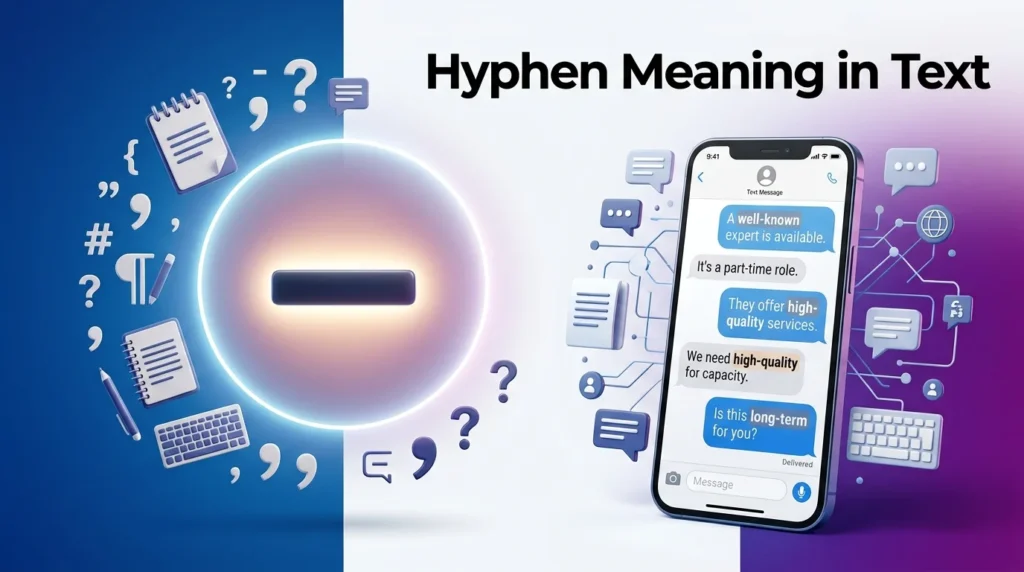

If you’ve come across a hyphen (-) in a text message, email, social media post, or online conversation, you may wonder what it means. Unlike internet abbreviations such as LOL or BRB, a hyphen is a punctuation mark rather than a slang term. However, it plays an important role in digital communication by connecting words, separating information, and improving readability. Understanding the hyphen meaning in text can help you write more clearly and avoid common grammar mistakes.
A hyphen is widely used in text messages, WhatsApp chats, emails, social media captions, blog posts, and professional writing. While many people use it correctly without thinking about it, others confuse it with the dash (– or —) because they look similar but serve different purposes. In this guide, you’ll learn what a hyphen means, how it’s used in text, where it came from, and why it remains an essential part of written communication.
Meaning & Definition
The hyphen meaning in text refers to the use of the hyphen (-) as a punctuation mark that joins two or more words to create a single meaning or separates parts of a word when needed.
A hyphen is shorter than an en dash (–) and an em dash (—). Its primary purpose is to improve clarity and make sentences easier to read.
For example:
- Well-known author
- Part-time job
- Twenty-one
- User-friendly website
In each example, the hyphen connects words that work together as a single idea.
Although the hyphen is not an internet abbreviation, it is one of the most frequently used punctuation marks in digital writing.
What Does a Hyphen Mean in Text?
The hyphen meaning in text depends on how it is used within a sentence. In most cases, it connects words that function together or prevents confusion between similar phrases.
For example:
- Small-business owner means the owner of a small business.
- Long-term goal refers to a goal planned for the future.
- High-quality product describes something of excellent quality.
People also use hyphens when writing certain numbers, compound adjectives, prefixes, and some compound nouns.
In text messages and online conversations, a hyphen can occasionally appear as part of an emoticon, such as 🙂 or 🙁, where it represents the nose in a smiley face.
Background / Origin
The hyphen has been part of written language for centuries. Its name comes from the Greek word hyphén, meaning “under one” or “together.” Originally, it was introduced to show that separate words should be read as a single unit.
As English writing evolved, the hyphen became an important punctuation mark for improving clarity and preventing ambiguity. Newspapers, books, dictionaries, and style guides established rules for when hyphens should and should not be used.
With the growth of computers, emails, websites, and social media, the hyphen became even more common. Today, it appears in URLs, usernames, hashtags, file names, domain names, email addresses, and everyday online writing.
Although modern writing styles sometimes remove hyphens from commonly used words, the hyphen remains an essential punctuation mark for clear communication.
Usage in Different Contexts
The hyphen meaning in text changes slightly depending on where it appears, but its main purpose is always to improve clarity and connect related words.
General Usage
In everyday writing, a hyphen joins words that work together to express one idea. It is especially common in compound adjectives placed before nouns.
Examples include:
- Well-written article
- High-speed internet
- Full-time employee
- Last-minute decision
- State-of-the-art technology
- Long-distance relationship
Using a hyphen in these examples helps readers understand that the connected words describe a single concept.
Formal Usage
In formal writing, hyphens follow grammar rules established by style guides such as APA, MLA, Chicago, and AP Style. Writers use hyphens to improve readability and prevent misunderstandings.
For example, “small business owner” and “small-business owner” can have slightly different meanings. Proper hyphenation ensures the intended meaning is clear.
Informal Usage
In casual texting and social media, people often use hyphens less strictly than in formal writing. However, they still appear in usernames, hashtags, compound words, and emoticons like 🙂 and 😀. Even in informal communication, using hyphens correctly can make messages easier to read and understand.
Hyphen Meaning on Social Media Platforms
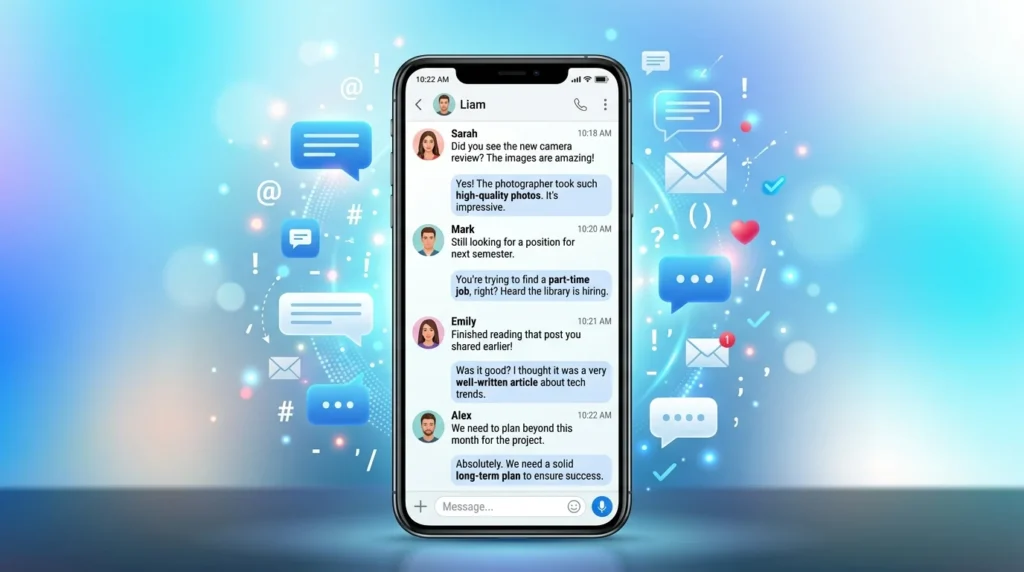
The hyphen meaning in text remains the same across most social media platforms. Unlike internet slang abbreviations, the hyphen (-) is a punctuation mark used to connect words, improve readability, and organize written content. It can also appear in usernames, hashtags, website addresses, and emoticons. Although many users type quickly and ignore punctuation, using hyphens correctly helps make messages clearer and easier to understand.
On WhatsApp, hyphens are commonly used when writing compound words such as long-term, well-known, or part-time. Some users also include hyphens in bullet-style lists or use them in emoticons like 🙂 and 🙁.
Snapchat
On Snapchat, hyphens may appear in captions, usernames, or quick messages. While punctuation is often kept to a minimum, hyphens are still useful for connecting compound words and making text more readable.
TikTok
On TikTok, hyphens are used in captions, video descriptions, and comments. Content creators may write phrases like step-by-step tutorial, behind-the-scenes, or high-quality content to make their writing more professional and easier to understand.
On Instagram, hyphens commonly appear in captions, bios, usernames, and comments. They are often used to join compound words, separate ideas, or create clean formatting in profile descriptions.
Other Meanings in Different Fields
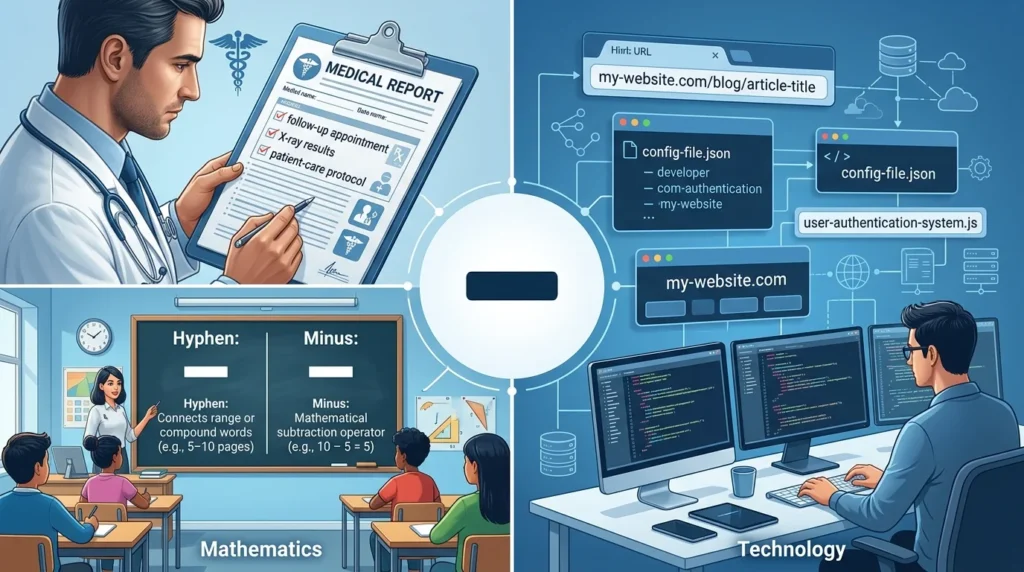
Although the hyphen meaning in text usually refers to a punctuation mark, the hyphen also serves important purposes in different academic and professional fields.
Medical
In medical writing, hyphens connect compound medical terms to improve clarity. Examples include X-ray, follow-up appointment, COVID-19-related symptoms, and life-threatening condition. Proper hyphenation helps healthcare professionals communicate accurately.
Mathematics
In mathematics, the hyphen itself is not a mathematical symbol. However, many people mistakenly confuse it with the minus sign (-) because they look similar. The minus sign is used for subtraction, while the hyphen is used in writing to connect words.
Technology
In technology, hyphens are widely used in domain names, URLs, file names, usernames, programming documentation, and command-line tools. They help separate words, improve readability, and create organized naming conventions. Many websites and software systems rely on hyphens for structured text and web addresses.
Examples of Hyphen Meaning in Text in Sentences
Example 1
Emma: I finally found a part-time job.
The hyphen joins two words to form a compound adjective.
Example 2
Jake: This is a high-quality camera.
The hyphen connects the descriptive words before the noun.
Example 3
Sophia: We watched a well-known documentary.
Here, the hyphen creates a single descriptive phrase.
Example 4
Chris: Visit our user-friendly website for more information.
Again, the hyphen improves clarity by linking related words.
Common Misconceptions
Misconception 1
Many people think a hyphen (-) and a dash (– or —) are the same. In reality, they are different punctuation marks with different purposes.
Misconception 2
Some users believe compound words should always include a hyphen. In fact, some words are written as one word (notebook), some as separate words (ice cream), and others with a hyphen (well-being).
Misconception 3
Another misunderstanding is that hyphens are unnecessary in digital communication. Proper hyphenation often improves readability and prevents confusion, especially in professional writing.
Similar Terms & Alternatives
- Dash (– or —) – Used to separate ideas or indicate pauses.
- Minus Sign (-) – A mathematical symbol used for subtraction.
- Slash (/) – Separates alternatives or parts of dates and URLs.
- Underscore (_) – Commonly used in usernames and programming.
- Colon (:) – Introduces lists, explanations, or quotations.
- Semicolon (;) – Connects closely related independent clauses.
- Parentheses ( ) – Add extra information.
- Quotation Marks (” “) – Indicate direct speech or quotations.
- Apostrophe (‘) – Shows possession or contractions.
How to Use a Hyphen Correctly in Text
Using a hyphen correctly helps make your writing clear and professional.
- Use it to join compound adjectives before a noun (e.g., high-speed train).
- Use it in certain compound nouns such as mother-in-law or editor-in-chief.
- Use it with some prefixes when required for clarity.
- Avoid unnecessary hyphens in words that dictionaries list as single words.
Difference Between a Hyphen and a Dash
Although they look similar, a hyphen (-) and a dash (– or —) serve different purposes. A hyphen joins words together to create compound terms, while an en dash (–) usually shows a range, such as 2024–2026, and an em dash (—) separates thoughts or adds emphasis within a sentence.
Understanding this difference helps improve both grammar and readability.
Relevance in Online Conversations & Digital Communication
The hyphen meaning in text remains important because clear writing improves communication across emails, blogs, social media posts, websites, and messaging apps. Even though many online conversations are informal, proper punctuation makes messages easier to understand.
Hyphens are especially valuable in content writing, SEO, technical documentation, journalism, and academic writing, where clarity and precision matter. Using them correctly can make your writing appear more professional and easier for readers to follow.
Hyphen Meaning in Text from a Girl
When a girl uses a hyphen in a message, it usually has no hidden emotional or romantic meaning. In most cases, she is simply using proper punctuation to connect words or improve the readability of her message.
The surrounding conversation—not the hyphen itself—determines the intended meaning.
Hyphen Meaning in Text from a Guy
When a guy uses a hyphen in text, it generally serves the same grammatical purpose. It connects compound words, improves sentence structure, or appears in emoticons such as 🙂.
Like all punctuation marks, the hyphen should be interpreted based on its grammatical function rather than as a hidden message.
Frequently Asked Questions
What does a hyphen mean in text?
The hyphen meaning in text refers to the hyphen (-) punctuation mark used to join words, create compound terms, and improve the clarity of writing. It is not an internet slang abbreviation but an important part of English grammar.
Is a hyphen the same as a dash?
No. A hyphen (-) is used to connect words, while an en dash (–) shows ranges (such as 2024–2026) and an em dash (—) separates thoughts or adds emphasis within a sentence.
Why is a hyphen used in text messages?
In text messages, a hyphen is used to write compound words like well-known, part-time, or high-quality. It may also appear in emoticons such as 🙂 or 🙁, where it represents the nose of the face.
Is a hyphen formal or informal?
A hyphen is used in both formal and informal writing. It follows grammatical rules in professional documents, books, academic writing, and journalism, but it also appears frequently in text messages, emails, and social media posts.
Does a hyphen have different meanings?
The hyphen itself does not have multiple meanings like internet abbreviations. Its purpose is grammatical—it joins words, improves readability, and helps avoid confusion. In mathematics, people sometimes mistake it for the minus sign because they look similar, but they serve different functions.
Conclusion
The hyphen meaning in text refers to the use of the hyphen (-) as a punctuation mark that connects words, forms compound expressions, and improves the clarity of written communication. Whether you’re writing text messages, emails, blog posts, social media captions, or professional documents, using hyphens correctly makes your writing easier to read and understand.
Although many people confuse the hyphen with the en dash, em dash, or minus sign, each punctuation mark has a different purpose. By understanding when and how to use a hyphen, you can communicate more effectively and avoid common grammar mistakes in both casual and formal writing.
See Also:
SM Meaning in Text: What It Really Means & How to Use It
STFU Meaning in Text: The Surprising Meaning Most People Get Wrong