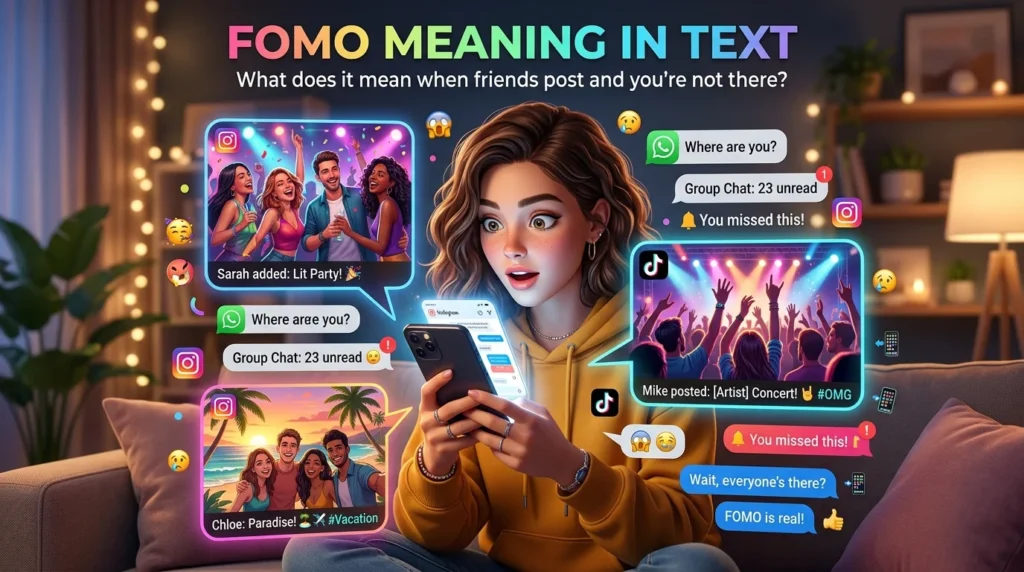

Have you ever seen someone text “I’ve got major FOMO right now” and wondered what they meant? If so, you’re not alone. Internet slang changes quickly, and new abbreviations appear every day across social media, messaging apps, and online communities. One of the most common terms you’ll encounter is FOMO. Understanding the FOMO meaning in text can help you follow conversations more easily and communicate like a native internet user.
Whether you’re chatting on WhatsApp, scrolling through Instagram, watching TikTok videos, or talking on a dating app, FOMO appears everywhere. The term describes a feeling that many people experience in today’s connected world. In this guide, you’ll learn the exact meaning of FOMO, where it came from, how people use it in text messages, what it means when a girl or guy says it, and how it compares to similar internet slang. By the end, you’ll know exactly how and when to use FOMO confidently.
Meaning & Definition
The FOMO meaning in text is “Fear of Missing Out.” It refers to the feeling that other people are having exciting experiences, opportunities, or fun activities without you being involved.
When someone says they have FOMO, they usually mean they feel left out or worried that they’re missing something important, enjoyable, or valuable. The term is commonly used in casual online conversations, text messages, social media posts, and group chats.
In simple words, FOMO is the anxiety or concern that others are experiencing something better while you’re not participating. It can relate to parties, trips, events, social gatherings, trends, online discussions, or even investment opportunities.
Definition:
FOMO stands for “Fear of Missing Out” and describes the feeling of being left out of experiences, events, opportunities, or activities that others are enjoying.
What Does FOMO Meaning in Text?
Featured Snippet Answer
In text messages, FOMO means “Fear of Missing Out.” People use it when they feel left out of an event, activity, trend, conversation, or experience. It expresses the worry that others are having fun or benefiting from something while they are not included.
Example:
“Everyone is going to the concert tonight and I’m stuck at home. I’ve got serious FOMO!”
Background / Origin
The concept behind FOMO has existed for centuries because people have always compared themselves to others. However, the actual acronym FOMO became popular during the early 2000s as internet usage and social media platforms grew rapidly.
As websites like Facebook, Twitter, Instagram, and later Snapchat and TikTok became part of everyday life, people gained constant access to updates about what others were doing. Friends shared vacation photos, party videos, achievements, and exciting moments in real time. Seeing these updates often caused viewers to feel as though they were missing important experiences.
Psychologists and researchers began studying this behavior and identified it as a common emotional response in the digital age. The abbreviation “FOMO” quickly spread online because it provided a simple way to describe a feeling that millions of people experienced.
Today, FOMO is recognized worldwide and is frequently used in texting, social media captions, online communities, marketing campaigns, and even business discussions. The term has become a permanent part of internet culture and modern communication.
Usage in Different Contexts
General Usage
In everyday conversations, FOMO is used whenever someone feels excluded from an experience, opportunity, or event. It can be related to social activities, travel plans, concerts, parties, shopping deals, online trends, gaming events, or even television shows. People often use FOMO humorously, but sometimes it genuinely reflects disappointment about missing something enjoyable.
For example, if a friend sees photos from a party they couldn’t attend, they might text, “Those pictures are giving me FOMO.” Similarly, someone who misses a limited-time sale may say they have FOMO because everyone else seems to be taking advantage of the discount. In general use, FOMO helps express feelings of exclusion, curiosity, and regret in a short and relatable way.
Formal Usage
Although FOMO is mostly informal slang, it is sometimes used in professional settings, especially in marketing, psychology, technology, and business discussions. Marketers often discuss FOMO as a strategy that encourages customers to take action quickly. Limited-time offers, exclusive memberships, and countdown timers are common examples of FOMO-based marketing techniques.
Researchers and mental health professionals also use the term when discussing social behavior and digital habits. In these situations, FOMO refers to a psychological phenomenon rather than casual slang. While acceptable in modern workplace discussions, it is generally best to avoid FOMO in highly formal academic papers unless it is clearly defined.
Informal Usage
Informal communication is where FOMO appears most often. Friends use it in text messages, social media comments, memes, and online chats. It helps people quickly express feelings without writing long explanations.
Examples include:
- “You’re all at the beach? FOMO!”
- “I missed the live stream and now I have FOMO.”
- “That food looks amazing. Instant FOMO.”
Because it is short, relatable, and widely understood, FOMO has become one of the most popular expressions in internet culture.
FOMO Meaning on Social Media Platforms
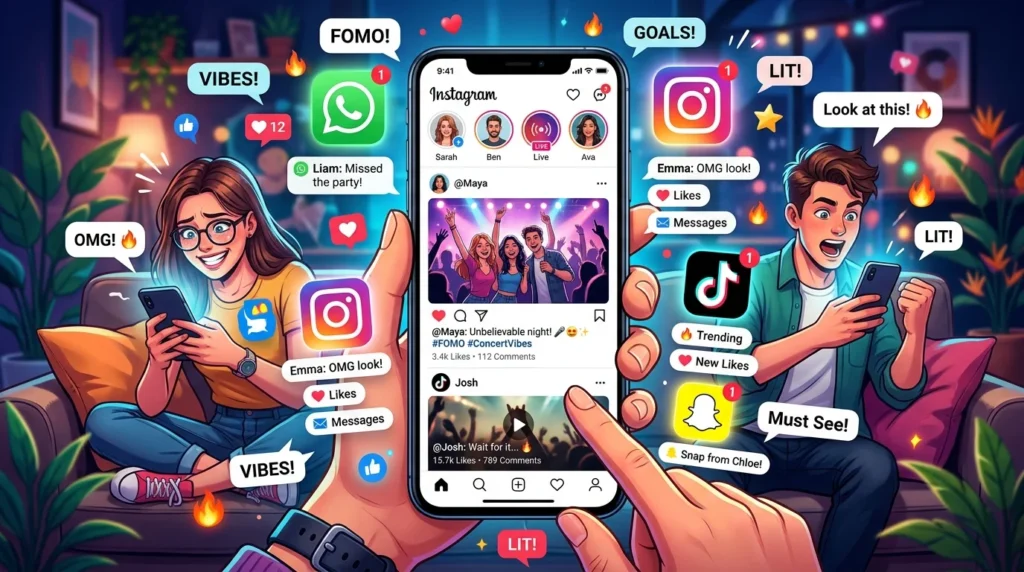
- On WhatsApp, FOMO usually appears in group chats when someone misses an outing, gathering, or event.
- Users may say they have FOMO after seeing photos or videos shared by friends.
- It often expresses playful jealousy rather than serious frustration.
Snapchat
- Snapchat stories frequently trigger FOMO because users share real-time moments.
- Someone viewing friends at a concert or party may respond with “I’ve got FOMO.”
- The term is commonly used among younger audiences on the platform.
TikTok
- TikTok users often mention FOMO when discussing viral trends or events.
- Missing a trend, challenge, or popular video can create feelings of FOMO.
- Creators sometimes use the term in captions to encourage engagement.
- Instagram is one of the biggest sources of FOMO.
- Users see vacation pictures, achievements, luxury lifestyles, and special events.
- FOMO is commonly used in comments, captions, and stories when viewers wish they were part of the experience.
Other Meanings in Different Fields
While “Fear of Missing Out” is the most common meaning, FOMO may occasionally have different meanings depending on the field.
Medical
- In healthcare discussions, FOMO still generally refers to Fear of Missing Out.
- Mental health professionals may discuss FOMO as a social or psychological concern linked to excessive social media use.
Physics
- FOMO is not a widely recognized standard physics acronym.
- In rare research contexts, the abbreviation may represent specialized project-specific terminology.
Technology
- Technology companies often use FOMO when discussing user engagement and marketing strategies.
- Businesses create urgency through limited offers, product launches, and exclusive access opportunities to trigger FOMO.
Examples of FOMO Meaning in Text in Sentences
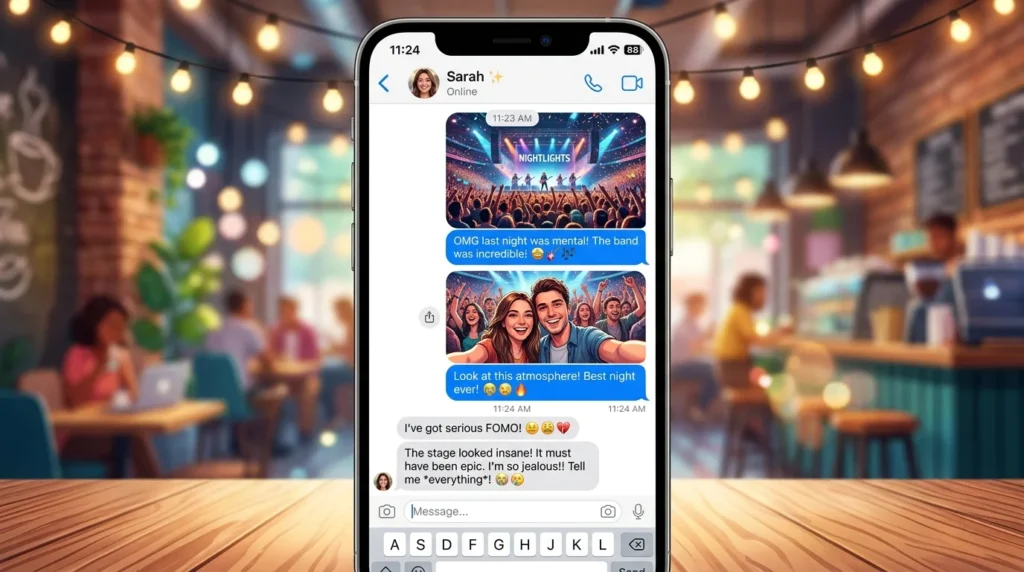
Example 1
- Friend: “We’re all going to the amusement park tomorrow.”
- You: “Seriously? I’ve got major FOMO already!”
Example 2
- Friend: “Did you watch the live concert stream?”
- You: “No, I missed it. The FOMO is real.”
Example 3
- Friend: “Everyone bought tickets before they sold out.”
- You: “Now I’m feeling FOMO because I waited too long.”
Example 4
- Friend: “Check out our vacation photos.”
- You: “Wow! Those pictures are giving me extreme FOMO.”
Common Misconceptions
Misconception 1
- FOMO only relates to parties.
- Reality: FOMO can apply to any experience, opportunity, event, trend, purchase, or social activity.
Misconception 2
- FOMO is always serious.
- Reality: Many people use it jokingly or casually in conversations.
Misconception 3
- Only young people experience FOMO.
- Reality: People of all ages can experience Fear of Missing Out.
Similar Terms & Alternatives
- YOLO – You Only Live Once; encourages taking opportunities.
- JOMO – Joy of Missing Out; enjoying staying away from events.
- OMO – Missing Out without emphasizing fear.
- FOBO – Fear of Better Options; difficulty making decisions.
- OMO Anxiety – Stress related to missing experiences.
- Peer Pressure – Influence from others that can contribute to FOMO.
- Social Comparison – Comparing your experiences with others.
How to Respond to FOMO Meaning in Text When Someone Uses It
When someone says they have FOMO, they’re usually expressing disappointment about missing an event or experience. Your response can be supportive, friendly, or humorous depending on the conversation.
Possible Replies
- “Don’t worry, we’ll invite you next time!”
- “You didn’t miss much, honestly.”
- “We’ll send you lots of pictures.”
- “Come join us if you can!”
- “The next event will be even better.”
- “Trust me, it’s not as exciting as it looks.”
Difference Between FOMO Meaning in Text and Similar Terms
Although FOMO is often grouped with other internet slang terms, it has a specific meaning. FOMO focuses on the fear or anxiety of missing experiences. YOLO encourages participation in experiences, while JOMO celebrates choosing not to participate.
For example, someone with FOMO may regret staying home because friends are at a concert. Someone practicing JOMO may happily stay home and enjoy a quiet evening. Meanwhile, YOLO might motivate someone to buy a ticket and attend the concert without overthinking.
Understanding these differences helps you interpret online conversations more accurately and use each term appropriately.
Relevance in Online Conversations & Dating Apps
The FOMO meaning in text has become increasingly important in modern digital communication because people are constantly connected through smartphones and social media platforms. Online conversations move quickly, and users often feel pressure to stay informed about trends, events, and discussions. As a result, FOMO has become a common way to describe the fear of being left behind.
On dating apps, FOMO can appear when users worry about missing potential matches or opportunities. Someone might continue swiping because they fear a better match could appear later. Others may experience FOMO when they see friends entering relationships while they remain single. The term is also used when discussing social events, travel experiences, and lifestyle choices shared online.
In group chats and online communities, FOMO helps people express curiosity and interest in activities they were unable to attend. Because modern communication is heavily influenced by social media updates, stories, reels, and live streams, FOMO remains one of the most relevant and frequently used expressions in digital culture. Understanding the term helps users better navigate today’s fast-paced online environment and communicate more naturally with others.
FOMO Meaning in Text From Girl
When a girl uses FOMO in a text message, it usually carries the same basic meaning: she feels like she’s missing out on something exciting, important, or enjoyable. However, the context can sometimes provide additional clues about her emotions or intentions.
For example, if she texts, “You all went out without me? Major FOMO!” she may simply be expressing disappointment about missing the event. In some situations, she might be indirectly showing interest in spending more time with a particular person or group.
Examples:
- “I saw your vacation photos and now I have FOMO.”
- “Everyone’s hanging out tonight except me. FOMO!”
- “Looks like you all had fun. Feeling serious FOMO right now.”
Generally, when a girl says FOMO, it means she wishes she could have participated in the experience she is seeing or hearing about.
FOMO Meaning in Text From a Guy
When a guy uses FOMO in a text, the meaning remains the same: Fear of Missing Out. He may be expressing regret, curiosity, disappointment, or playful jealousy about an event or opportunity he missed.
For example, if he sees friends attending a sports event, gaming tournament, concert, or social gathering, he may say he has FOMO. The term is commonly used casually among friends and is not usually meant to be overly emotional.
Examples:
- “You guys went gaming without me? FOMO!”
- “I missed the match last night and now I have FOMO.”
- “Everyone’s talking about that new show and I’ve got FOMO.”
In most cases, a guy using FOMO simply means he wishes he had been included or had experienced what others are discussing.
Frequently Asked Questions
What does FOMO stand for in texting?
FOMO stands for Fear of Missing Out, which describes the feeling of being left out of experiences or opportunities.
Is FOMO a positive or negative term?
It is generally considered negative because it refers to anxiety or concern about missing something important.
Do people still use FOMO in 2026?
Yes. FOMO remains one of the most commonly used internet slang terms across social media and messaging platforms.
What is the opposite of FOMO?
The opposite is JOMO, which means Joy of Missing Out.
Can FOMO be used in professional settings?
Yes, especially in marketing, psychology, and business discussions, though it is more common in informal communication.
Conclusion
Understanding the FOMO meaning in text is essential for anyone who regularly uses social media, messaging apps, or online communities. FOMO stands for Fear of Missing Out, a feeling that occurs when someone believes others are enjoying experiences, opportunities, or events without them.
The term has become a major part of internet culture because social media constantly exposes people to the activities and achievements of others. Whether it appears on WhatsApp, Snapchat, TikTok, Instagram, or dating apps, FOMO helps users quickly express feelings of exclusion, curiosity, or regret. While it is often used humorously among friends, it can also describe genuine emotional reactions to missing important moments.
Understanding how FOMO is used, its origins, related terms, and common contexts makes it easier to follow modern conversations and communicate naturally online. The next time someone texts “I’ve got FOMO,” you’ll know exactly what they mean and how to respond confidently.
See Also:
MHM Meaning in Text: Definition, Examples & Social Media Uses
HN Meaning in Text: What It Really Means in Messages
FT Meaning in Text: What Does FT Mean in Messages & Social Media?