
If you’ve come across “SMS” in a conversation or on your phone, you might be wondering what it means. While many texting abbreviations represent internet slang, SMS is actually a standard communication term used worldwide. It has been around since the early days of mobile phones and is still widely used today.
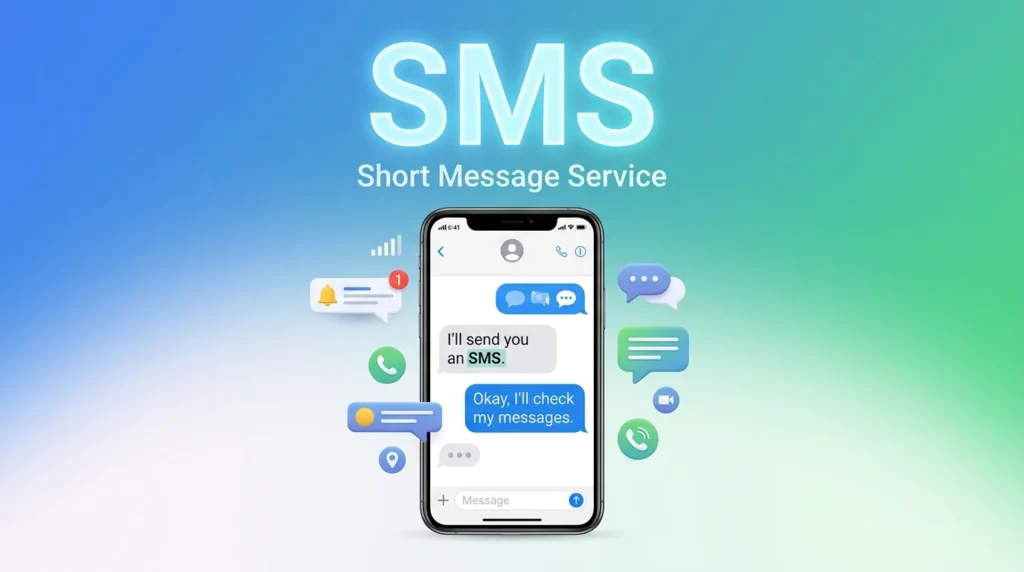
The SMS meaning in text most commonly stands for “Short Message Service.” It refers to the standard technology that allows people to send and receive text messages between mobile phones without using an internet connection.
For example:
Emma: I don’t have Wi-Fi right now. Just send me an SMS.
Olivia: Sure, I’ll text you instead.
Here, SMS means a regular text message sent through a mobile network.
Understanding the SMS meaning in text helps you distinguish between traditional text messaging and internet-based messaging apps like WhatsApp or Messenger. In this guide, you’ll learn what SMS means, where it came from, how it’s used, examples, and its other possible meanings.
Meaning & Definition
The SMS meaning in text usually stands for:
- SMS = Short Message Service
It is the standard technology used by mobile phones to send and receive text messages over a cellular network.
People commonly use SMS to:
- Send text messages without the internet.
- Receive verification codes (OTP).
- Communicate using mobile networks.
- Contact people who don’t use messaging apps.
- Receive alerts and notifications from businesses or banks.
For example:
Jake: Did you get my SMS?
Ryan: Yes, I just read it.
Meaning:
Ryan received Jake’s text message.
What Does SMS Mean in Text?
The SMS meaning in text refers to “Short Message Service.” Unlike apps such as WhatsApp, Telegram, or Messenger, SMS works through your phone’s cellular network and doesn’t require an internet connection.
Examples:
“I’ll send you an SMS.”
Meaning:
“I’ll send you a regular text message.”
Another example:
“The verification code was sent via SMS.”
Meaning:
The code was delivered through a standard text message.
Background / Origin
SMS (Short Message Service) was introduced in the early 1990s as part of the GSM mobile communication standard. It quickly became one of the most popular ways to communicate because users could send short text messages between mobile phones.
Originally, SMS messages were limited to 160 characters, encouraging people to create abbreviations like LOL, BRB, and TY to save space.
Today, SMS is still commonly used for:
- Personal text messages.
- One-Time Passwords (OTPs).
- Banking alerts.
- Appointment reminders.
- Delivery notifications.
- Two-factor authentication (2FA).
Although messaging apps have become more popular, SMS remains an essential communication technology worldwide.
Usage in Different Contexts
The SMS meaning in text almost always refers to Short Message Service.
General Usage
People commonly use SMS to:
- Refer to regular text messages.
- Distinguish texting from internet messaging.
- Receive verification codes.
- Get service notifications.
- Send quick messages without internet access.
Examples:
- Send me an SMS.
- I received an SMS from my bank.
- The code arrived by SMS.
- I’ll text you via SMS.
Formal Usage
Unlike many internet abbreviations, SMS is widely accepted in both formal and informal communication.
Businesses, schools, banks, hospitals, and government organizations regularly use the term SMS in official communications.
Examples:
- You’ll receive an SMS confirmation shortly.
- An SMS notification has been sent to your registered mobile number.
Informal Usage
In everyday conversations, people often use SMS when referring to traditional text messages instead of internet-based chats.
Whether you’re discussing mobile communication, phone plans, or messaging services, SMS almost always means Short Message Service.
Examples of SMS Meaning in Text
Example 1
Emma: Can you send me the address?
Olivia: I’ll send it by SMS.
Meaning:
Olivia will send a regular text message.
Example 2
Jake: Did you receive the verification code?
Ryan: Yes, it came through SMS.
Meaning:
Ryan received the code as a text message.
Example 3
Sophia: I don’t have internet right now.
Liam: No problem. I’ll send an SMS.
Meaning:
Liam will use a standard mobile text message.
Example 4
Chris: The bank sent me an SMS today.
Ava: Was it about your account?
Meaning:
Chris received a text message from the bank.
Why People Use SMS
People use SMS because it:
- Works without an internet connection.
- Is supported by almost every mobile phone.
- Is reliable for important notifications.
- Delivers verification codes securely.
- Allows communication even when messaging apps aren’t available.
Although apps like WhatsApp and Messenger are extremely popular, SMS remains one of the most trusted and widely used methods of mobile communication around the world.
SMS Meaning on Different Platforms and Devices
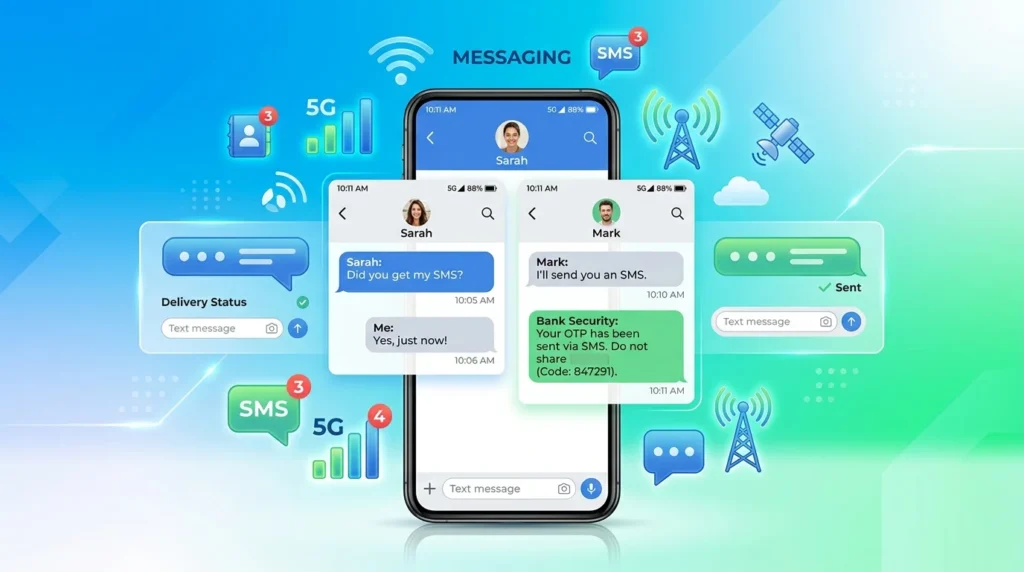
The SMS meaning in text remains the same across most phones and messaging services. SMS stands for “Short Message Service,” which refers to standard text messages sent through a mobile network rather than the internet.
Whether you’re using an Android phone, iPhone, or receiving verification codes from websites, SMS almost always means a regular text message delivered by your mobile carrier.
SMS on Different Platforms
Android
On Android devices, SMS refers to standard text messages sent through your cellular network.
Example:
Emma: I’ll send the address by SMS.
Olivia: Perfect, I’ll check my messages.
Meaning:
Emma will send a regular text message.
iPhone
On iPhones, SMS messages are usually shown as green message bubbles, while iMessages appear as blue bubbles.
Example:
Jake: My iMessage isn’t working.
Ryan: Send me an SMS instead.
Meaning:
Ryan is asking for a standard text message.
WhatsApp doesn’t use SMS for regular chats because it works through the internet. However, it often uses SMS to verify your phone number during account setup.
Example:
“Enter the SMS verification code.”
Meaning:
Use the code sent via a regular text message.
Banking & Online Services
Banks, shopping websites, and online services frequently use SMS for security and account notifications.
Example:
“Your OTP has been sent via SMS.”
Meaning:
The one-time password was sent as a text message.
Two-Factor Authentication (2FA)
Many websites use SMS to send security codes when you log in.
Example:
“Check your SMS for the verification code.”
Meaning:
The security code was delivered by text message.
Other Meanings of SMS
Although the SMS meaning in text almost always stands for Short Message Service, it can have other meanings in specialized fields.
1. Short Message Service
This is the standard and most common meaning.
Example:
“I sent you an SMS.”
Meaning:
A regular mobile text message.
2. School Management System
In education, SMS may stand for School Management System.
Example:
“Log in to the school’s SMS portal.”
Meaning:
The school’s management software.
3. Safety Management System
In aviation, construction, and other industries, SMS can mean Safety Management System.
Example:
“The company follows an SMS policy.”
Meaning:
A workplace safety management program.
Common SMS Conversation Examples
Example 1
Person A: Did you get my SMS?
Person B: Yes, I replied.
Meaning:
The message was sent as a regular text.
Example 2
Person A: The verification code isn’t here.
Person B: Check your SMS inbox.
Meaning:
Look at your text messages.
Example 3
Person A: WhatsApp isn’t working.
Person B: Just send an SMS.
Meaning:
Use a regular mobile text message.
Example 4
Person A: The bank contacted me.
Person B: By email?
Person A: No, by SMS.
Meaning:
The bank sent a text message.
Common Mistakes When Understanding SMS
Mistake 1: Thinking SMS Is the Same as WhatsApp
SMS uses a mobile network, while WhatsApp requires an internet connection.
Mistake 2: Confusing SMS with MMS
- SMS = Text-only messages.
- MMS = Messages that can include photos, videos, or audio.
Mistake 3: Assuming SMS Requires Wi-Fi
SMS works through your cellular network and does not require Wi-Fi or mobile data.
Similar Communication Terms
Here are terms related to SMS:
- MMS – Multimedia Messaging Service.
- OTP – One-Time Password.
- RCS – Rich Communication Services.
- iMessage – Apple’s internet messaging service.
- DM – Direct Message.
- PM – Private Message.
- Chat – Internet-based messaging.
- Email – Electronic mail.
- 2FA – Two-Factor Authentication.
How to Reply When Someone Mentions SMS
Your response depends on the conversation.
Example 1
Them: I’ll send you an SMS.
You: Great, I’ll keep an eye on my messages.
Example 2
Them: Did you receive the SMS?
You: Yes, I got it.
Example 3
Them: The OTP was sent via SMS.
You: Thanks, I’ll check my inbox.
SMS Meaning in Text from a Girl
When a girl mentions SMS, she is usually referring to a regular text message sent through a mobile network. It doesn’t carry any hidden or romantic meaning.
SMS Meaning in Text from a Guy
When a guy uses SMS, he is almost always talking about sending or receiving a standard text message. The meaning is purely literal and depends on the context of the conversation.
Frequently Asked Questions
What does SMS mean in text?
The SMS meaning in text stands for Short Message Service, the standard technology used to send regular text messages between mobile phones.
What is the difference between SMS and WhatsApp?
SMS uses your mobile carrier’s network, while WhatsApp requires an internet connection and sends messages over data or Wi-Fi.
Is SMS still used today?
Yes. SMS is still widely used for personal messages, banking alerts, verification codes, appointment reminders, and two-factor authentication.
Does SMS require the internet?
No. SMS works through your mobile network and does not require Wi-Fi or mobile data.
Can SMS send pictures?
Standard SMS only supports text. To send photos or videos, most phones use MMS or internet-based messaging apps.
Difference Between SMS and MMS
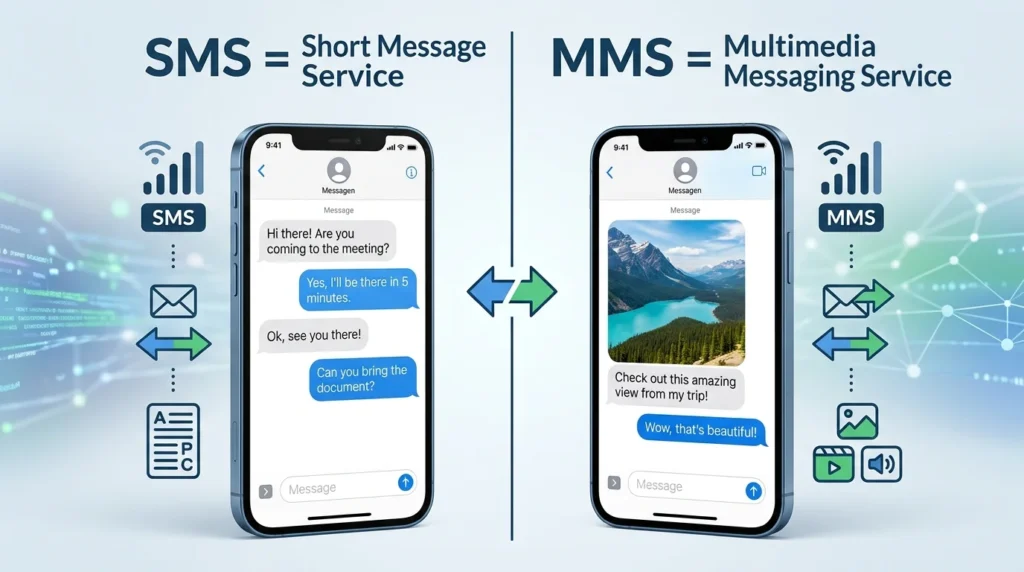
SMS
Meaning: Short Message Service.
Used for sending text-only messages.
Example:
“I’ll send you an SMS.”
MMS
Meaning: Multimedia Messaging Service.
Used for sending pictures, videos, audio, and other media files.
Example:
“I sent you the photo via MMS.”
Tips for Using SMS Correctly
- Use SMS when internet access isn’t available.
- Check your SMS inbox for OTPs and verification codes.
- Remember that standard SMS supports text only.
- Use MMS or messaging apps when sending photos and videos.
Conclusion
The SMS meaning in text stands for Short Message Service, the technology behind standard mobile text messages. Unlike internet-based messaging apps, SMS works through your cellular network and remains an essential communication method for personal messages, verification codes, banking alerts, and business notifications. Whether you’re using Android, iPhone, or another mobile device, understanding SMS helps you communicate more effectively and recognize the difference between traditional texting and modern messaging apps.
See Also:
KMS Meaning in Text: What It Means & When to Take It Seriously