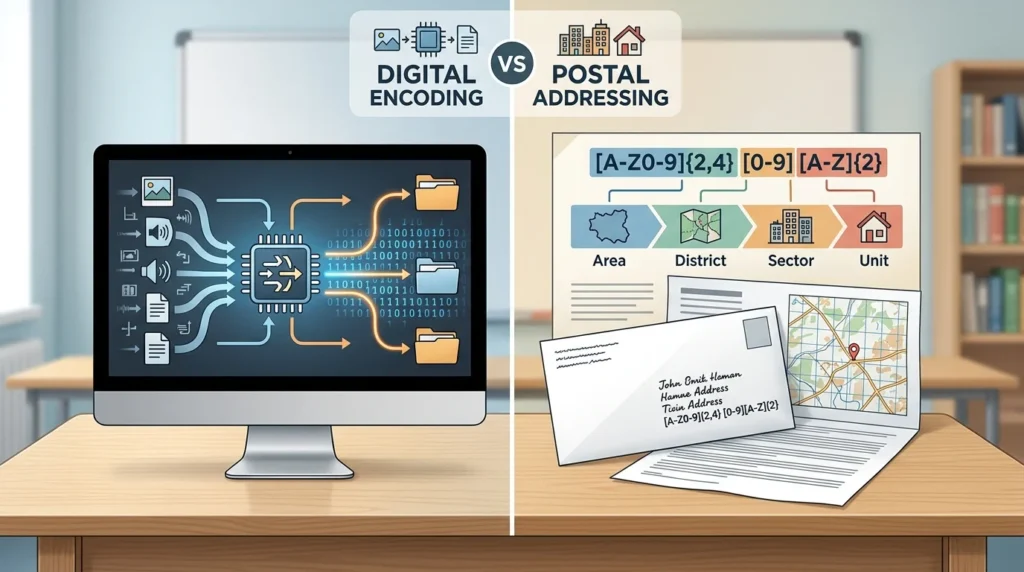

Encode is the standard English verb when you mean “to convert information into a code, format, or other representation.” Incode is not the standard spelling of this verb. However, incode is a real specialized noun in UK postal terminology: it refers to the inward part of a postcode.
Quick Answer
Use encode when you mean to convert information into a coded or structured form. For example, “The software will encode the data.” Incode should not be used as a spelling variant of encode. However, incode has a separate specialized meaning in the UK postal system, where it means the inward part of a postcode. So the correct choice depends on meaning: encode for the verb, and incode only in its specific postal sense.
What Does Encode Mean?
Encode is a verb meaning to convert information into a particular code, format, system, or representation. It is widely used in computing, communications, linguistics, biology, and everyday discussions about information.
For example, software may encode data so that it can be stored or processed. A communication system may encode a signal for transmission. In biology, a gene can encode a protein. The word therefore has a much broader meaning than simply “put something into code.”
Common forms of encode
- Base form: encode
- Third-person singular: encodes
- Past tense: encoded
- Past participle: encoded
- -ing form: encoding
- Noun: encoding
What Does Incode Mean?
There are two different issues with incode.
When someone writes incode because they mean “convert information into code,” it is not the standard English verb they should use. The correct verb is encode.
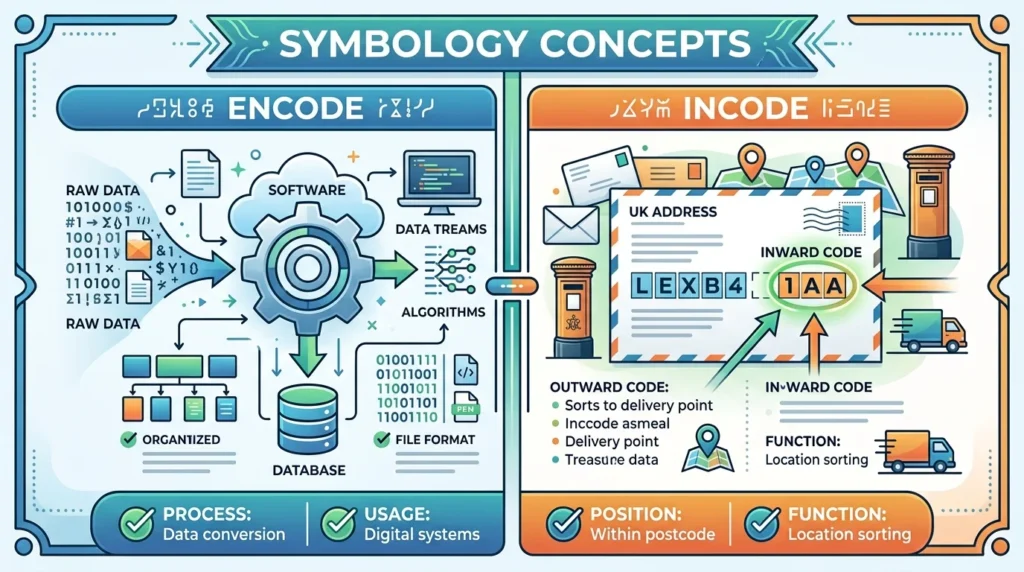
But incode does have a legitimate specialized meaning in UK postal terminology. An incode, also called an inward code, is the final three characters of a UK postcode. For example, in NW6 4DP, 4DP is the incode. Official Ordnance Survey documentation uses this terminology.
Why the Difference Matters
Using incode instead of encode can make a technical sentence confusing or incorrect because the two forms do not normally serve the same grammatical role.
This matters particularly in technical writing, programming documentation, academic work, business communication, and instructions involving data. Compare “The application will encode the file” with “The application will incode the file.” The first uses the standard verb; the second incorrectly treats the specialized postal noun as a verb.
The distinction also matters because in code is a separate two-word phrase. For example, “The value is stored in code” does not mean the same thing as “The program will encode the value.”
The Core Rule
Use “encode” as the verb meaning “convert information into a code or another representation.” Use “incode” only when referring to the specialized UK postal term for the inward part of a postcode.
Remember these three forms:
- Encode = convert information into a code or representation.
- Incode = the inward part of a UK postcode.
- In code = a two-word phrase meaning something is expressed or written in code.
How to Use Encode
The most common structure is encode + object.
Encode something
Use encode when an action changes information into a particular coded or structured form.
Example: The system will encode the message before transmission.
Encode something into something
You can specify the resulting form by using into.
Example: The application encodes the text into a digital format.
Be encoded
Because information is often the thing receiving the action, the passive form is common.
Example: The files are encoded before they are uploaded.
Encode in different fields
Encode is not limited to computer science. It can describe information represented through language, signals, biological processes, and other systems. Oxford lists computing, biology, and linguistics among its uses.
Correct Examples
- The software will encode the data before transmission.
- We need to encode the video in a compatible format.
- The system automatically encodes uploaded files.
- Please encode the message before sending it.
- The application encoded the information successfully.
- The researchers used a method to encode the signals.
- This gene encodes a protein involved in cell function.
- The document is encoded in a machine-readable format.
- The communication system encodes the signal before transmission.
- Students must encode the information using the required system.
- The browser can encode special characters for a URL.
- The message was encoded so that the intended recipient could interpret it.
Incorrect vs. Correct
| Incorrect | Correct | Why |
|---|---|---|
| Incode the data before sending it. | Encode the data before sending it. | Encode is the standard verb for converting data into a coded form. |
| The program will incode the file. | The program will encode the file. | Incode is not the standard verb for this technical action. |
| We incode the message first. | We encode the message first. | The intended meaning requires the verb encode. |
| The system incodes the information. | The system encodes the information. | The third-person form of encode is encodes. |
| The file was incoded yesterday. | The file was encoded yesterday. | The past form of encode is encoded. |
| We are incoding the video. | We are encoding the video. | The -ing form is encoding. |
| The tool incodes text into the required format. | The tool encodes text into the required format. | Encode is the correct verb for the conversion process. |
| Can you incode this file? | Can you encode this file? | The request needs the standard technical verb encode. |
| The developer incoded the user input. | The developer encoded the user input. | The past tense is formed with -ed: encoded. |
| The application is designed to incode data. | The application is designed to encode data. | Encode is the standard form in computing. |
Why People Confuse Encode and Incode
They sound very similar
Encode is pronounced with a sound that can make the spelling seem like it begins with in-. This can lead writers to spell it incode, especially when writing quickly.
See Also: Encorporate vs Incorporate: Which Spelling Is Correct?
The spelling pattern looks familiar
English has many words beginning with in-, including include, input, and insert. A learner may therefore assume that incode follows the same pattern.
“In code” is already a real phrase
The phrase in code is grammatically correct when written as two words. This can make the one-word form incode seem plausible even when the intended word is encode.
Autocorrect does not explain every spelling
Spellcheckers can catch many misspellings, but they do not understand every intended meaning. A specialized term, proper name, or unusual technical expression may sometimes pass through a spellchecker without being flagged.
Translation can add confusion
Learners who think in another language may map the idea of “put into code” directly onto a familiar word pattern. The safest approach is to learn encode as the established English verb rather than trying to build the spelling from the meaning.
Common Mistakes Checklist
- Writing incode as the verb: Use encode when you mean convert information into a coded form.
- Using incoded: The correct past tense is encoded.
- Writing incoding: The correct -ing form is encoding.
- Confusing encode with in code: In code is two words when it means something is expressed or written in code.
- Assuming incode never exists: It does exist as a specialized UK postal noun meaning the inward part of a postcode.
- Confusing encode with encrypt: Encoding changes representation; encryption is specifically associated with protecting information from unauthorized access.
Encode vs Incode in Real English
Encode in natural everyday and technical English
Encode is the natural and standard choice when discussing the conversion or representation of information. It is especially common in computing and technical writing, but it also appears in biology, linguistics, communication, and general descriptions of information. Expressions such as “encode the data,” “encode the message,” and “the gene encodes a protein” are established uses.
Incode as a specialized term
Incode is grammatically possible as a noun in the specialized context of UK postal terminology. It refers to the inward portion of a postcode, not to the general process of converting information into code. Ordnance Survey documentation explicitly uses incode as another name for the inward code. Outside that postal context, writers who mean the verb “convert into code” should use encode.
In code as a phrase
In code is also natural English, but it has a different grammatical structure. Here, in is a preposition and code is a noun. For example, “The message was written in code” describes the form in which the message was written. It should not be changed to the single word incode.
American vs. British English
There is no meaningful American-versus-British spelling difference between encode and incode when discussing the verb. Encode is the standard verb in both varieties.
The specialized postal use of incode is associated with the UK postcode system. Ordnance Survey documentation uses incode for the final three characters of a UK postcode.
Formal vs. Informal Usage
Encode is suitable for both formal and informal contexts. It is standard terminology in technical documentation, academic writing, workplace communication, and everyday discussion when the subject involves coded or represented information.
Incode should only be used when the context specifically calls for the UK postal meaning. In technical writing about data conversion, replacing encode with incode is not an informal alternative; it changes or obscures the intended meaning.
Encode vs Incode: Comparison Table
| Feature | Encode | Incode |
|---|---|---|
| Standard verb? | Yes | No, not as a synonym for encode |
| Main meaning | Convert information into a code or representation | In UK postal terminology, the inward part of a postcode |
| Part of speech | Verb | Noun in the postal sense |
| Common context | Computing, communication, biology, linguistics | UK postal and address data |
| Past tense | Encoded | Not used as a standard verb form for this meaning |
| -ing form | Encoding | Not used as the standard verb form for this meaning |
| Example | Encode the data. | The incode is the final three characters of the postcode. |
Related Terms You Should Not Confuse
Encode vs. encrypt
Encode means to convert information into another representation. Encrypt means to transform information using a method intended to prevent unauthorized access. Encoding does not automatically mean that information is secret or secure.
See Also: SPWM Meaning in Text: What It Means & How to Use It
Encode vs. decode
Encode changes information into a particular representation. Decode reverses or interprets that representation so the information can be understood or used. The two terms are often discussed together.
Encode vs. code
Code can mean to write instructions in a programming language or to represent something using a system of symbols. Encode emphasizes the act of converting information into a particular representation.
Encode vs. in code
Encode is one verb. In code is a two-word phrase.
Compare:
- The system will encode the message.
- The message is written in code.
Real-Life Situations
In a technical interview
Question: “Why would an application encode data?”
Natural answer: “It may encode data into a format that another system can store, process, or transmit.”
In a workplace meeting
Natural usage: “Before we send the file to the client, the system needs to encode it in the required format.”
In an email
Natural usage: “Please make sure the attachment is encoded correctly before uploading it.”
In a text message
Natural usage: “The app needs to encode the data before it sends it.”
In an exam
Natural usage: “Encoding is the process of representing information in a particular form or system.”
In UK postal data
Natural usage: “The incode is the final three characters of the postcode.”
The Easiest Way to Remember Encode vs Incode
Think of the e in encode as part of the established word encode, which means changing information into a coded representation.
Then remember the special exception:
Encode = action.
Incode = UK postcode part.
In code = two-word phrase.
If your sentence has a verb describing what software, a person, a system, or a gene does to information, encode is almost certainly the form you need.
Quiz
1. Which sentence is correct?
A. The program will incode the file.
B. The program will encode the file.
Answer: B. Encode is the standard verb.
2. What is the correct past tense?
A. Incoded
B. Encoded
Answer: B. The past tense of encode is encoded.
3. Which phrase uses two separate words?
A. incode
B. in code
Answer: B. “In code” is a normal two-word phrase.
4. What does incode mean in UK postal terminology?
A. A method of encrypting data
B. The inward part of a postcode
C. A programming language
D. A type of file encoding
Answer: B. Incode refers to the inward part of a UK postcode.
5. Complete the sentence:
“The application will _____ the information before transmission.”
Answer: encode.
Frequently Asked Questions
Is encode or incode correct?
Encode is correct when you mean the verb “to convert information into a code or representation.” Incode is not a standard alternative spelling of that verb.
Is incode a real English word?
Yes, but its recognized specialized use is different from encode. In UK postal terminology, an incode is the inward part of a postcode.
Is “incode” a spelling mistake?
If you are using incode to mean “convert information into code,” then yes, it is the wrong form. The correct verb is encode. It is not a mistake when it is being used correctly as the specialized postal noun.
What is the past tense of encode?
The past tense and past participle are both encoded.
What is the present participle of encode?
The -ing form is encoding, as in “The software is encoding the video.”
Is “in code” different from “encode”?
Yes. Encode is a verb meaning to convert information into a coded or represented form. In code is a phrase describing something that is expressed or written using code.
Is encode used only in computer science?
No. Encode is also used in communication, linguistics, biology, and other contexts involving the representation of information. For example, a gene can encode a protein.
Is encode the same as encrypt?
No. Encoding changes the representation of information, while encryption is used to protect information against unauthorized access. Encoding by itself does not necessarily provide security.
What does incode mean in a UK postcode?
The incode is the last three characters of a UK postcode. For example, in NW6 4DP, 4DP is the incode. It represents the inward part of the postcode.
What is the easiest way to remember encode?
Remember that encode is the verb for changing information into a code or another representation. If you are describing an action performed on data, messages, signals, or similar information, use encode.
Quick Summary
Encode is the standard English verb meaning to convert information into a code, format, or other representation. It is common in computing, communications, linguistics, biology, and technical writing. Incode should not replace encode when describing that action. However, incode is a legitimate specialized noun in UK postal terminology: it means the inward part of a postcode, such as “4DP” in “NW6 4DP.” Also remember that in code is a separate two-word phrase. The simplest rule is: use encode for the action, incode for the specialized UK postal term, and in code when the phrase requires two words.