


Offered is the correct spelling. Offerred is an incorrect spelling in standard English. The word offered is the simple past tense and past participle of offer, meaning to give, provide, suggest, or make something available. The correct formation is offer + ed = offered. You do not add another r.
Quick Answer
Use offered, not offerred. Offered is the correct past tense and past participle of offer. The spelling stays with one r before ed: offer → offered. The extra r in offerred is a spelling mistake. For example, “The company offered me a job” is correct, while “The company offerred me a job” is incorrect.
What Is the Difference Between Offered and Offerred?
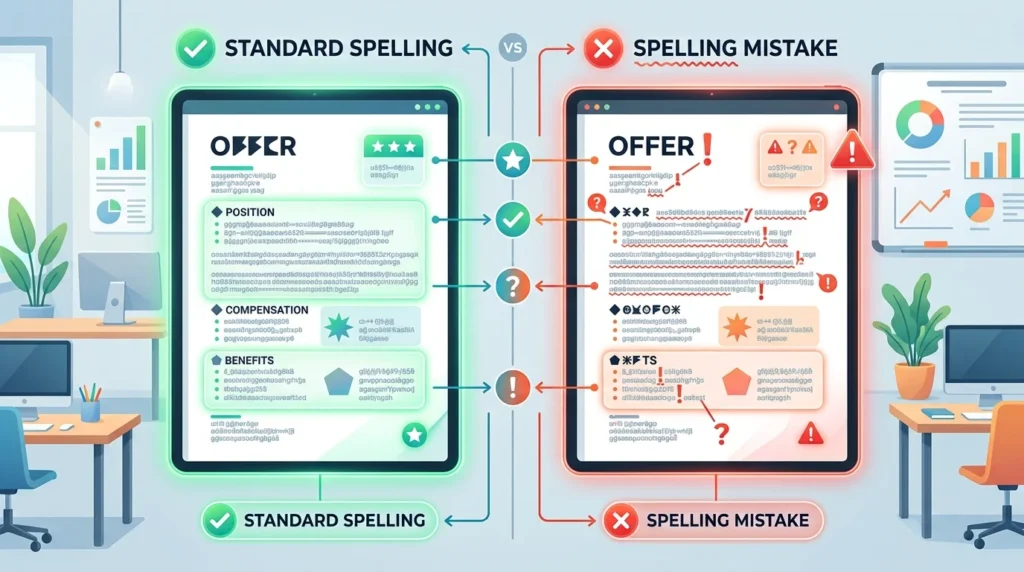
The difference is simple: offered is the standard English spelling, while offerred is a misspelling.
Offered comes from the verb offer. It can mean that someone gave something, suggested something, volunteered to do something, or made something available.
| Form | Correct? | Use |
|---|---|---|
| offer | ✅ Correct | Base form |
| offers | ✅ Correct | Present-tense form |
| offered | ✅ Correct | Past tense and past participle |
| offering | ✅ Correct | -ing form |
| offerred | ❌ Incorrect | Misspelling of offered |
Why Correct Spelling Matters
A spelling mistake does not usually change what the writer means, but it can make otherwise polished writing look less careful. This matters particularly in professional emails, job applications, school assignments, business documents, reports, and client communication.
For example:
❌ “We are pleased to inform you that you have been offerred the position.”
✅ “We are pleased to inform you that you have been offered the position.”
The second sentence uses the standard spelling and is appropriate in both formal and everyday English.
See Also: Copys or Copies: Which Is Correct?
The Core Rule
The easiest rule is:
offer + ed = offered
Do not add another r.
❌ offer + r + ed = offerred
✅ offer + ed = offered
The reason this can feel confusing is that English does have a consonant-doubling rule. Some verbs double their final consonant before adding -ed or -ing. For example, prefer → preferred and refer → referred. But offer does not follow that pattern because its final syllable is unstressed. The word is pronounced approximately OF-fer, with the main stress on the first syllable.
How to Use Offered
Offered as the Simple Past Tense
Use offered when an offer happened in the past.
Example: “The manager offered me a new position.”
Here, offered describes a completed action.
Offered as a Past Participle
Offered can also be used as a past participle with helping verbs such as has, have, and had.
Example: “The company has offered her a permanent contract.”
It can also appear in passive constructions:
“He was offered a scholarship.”
Offered to Do Something
When someone volunteers or agrees to do something, offered to + verb is common.
Example: “Maria offered to drive us home.”
Example: “He offered to help with the project.”
Offered Something to Someone
You can use offered + object when someone presents something for another person to accept or use.
Example: “She offered her friend some coffee.”
Example: “The restaurant offered customers a free dessert.”
Correct Examples of Offered
- The company offered me a full-time position.
- She offered to help with my homework.
- The teacher offered some useful advice.
- He offered his seat to an elderly passenger.
- The store offered a discount to new customers.
- They offered us several possible solutions.
- The university offered her a scholarship.
- Our manager offered to review the report.
- The seller offered a lower price for the car.
- My friend offered me a ride home.
- The organization offered financial assistance to families.
- The course offered students practical experience.
In every example, offered has the same standard spelling. Its meaning changes slightly according to the context, but the spelling does not.
Incorrect vs. Correct
| ❌ Incorrect | ✅ Correct | Why |
|---|---|---|
| The company offerred me a job. | The company offered me a job. | Offer takes -ed without another r. |
| She offerred to help. | She offered to help. | The past form is offered. |
| He offerred some advice. | He offered some advice. | The extra r is unnecessary. |
| They offerred us a discount. | They offered us a discount. | Offered is the standard past form. |
| I was offerred a position. | I was offered a position. | The passive form also uses offered. |
| The school offerred her a scholarship. | The school offered her a scholarship. | The spelling does not change in formal writing. |
| He had offerred his support. | He had offered his support. | The past participle is offered. |
| We were offerred free delivery. | We were offered free delivery. | Offerred is a misspelling. |
| The manager offerred a solution. | The manager offered a solution. | Use offer + ed. |
| She has offerred to pay. | She has offered to pay. | Has takes the past participle offered. |
Why Do People Write Offerred?
The mistake usually comes from a real English spelling pattern being applied too broadly.
English has verbs such as:
- stop → stopped
- plan → planned
- refer → referred
- prefer → preferred
- admit → admitted
Seeing these forms can make offerred look reasonable. However, consonant doubling does not happen automatically whenever a verb ends in a consonant.
With offer, the stress is on the first syllable: OF-fer. With words such as refer and prefer, the final syllable carries the main stress: re-FER and pre-FER. That difference helps explain why the forms are offered, referred, and preferred.
Common Mistakes Checklist
- Adding an unnecessary r: Writing offerred instead of offered.
- Applying the doubling rule everywhere: Assuming every verb ending in a consonant must double it before -ed.
- Spelling from sound: Trying to decide the spelling only from pronunciation.
- Confusing offer with refer: The similar ending does not mean the verbs form their past tense in the same way.
- Trusting visual patterns too much: Because referred and preferred are common, offerred can look familiar even though it is incorrect.
- Forgetting the base word: Starting with offer and simply adding -ed makes the correct spelling easier to remember.
Offered in Real English
Grammatically Correct and Natural
“The company offered me a better salary” is both grammatically correct and natural. English speakers commonly use offered when describing something given, proposed, or made available in the past. The same applies to expressions such as “offered to help,” “offered advice,” and “was offered a job.” These constructions work naturally in everyday conversation as well as professional writing.
See Also: WLW Meaning in Text: What It Means & How to Use It
Grammatically Possible but Different in Meaning
The word offer does not always refer to a physical object. Someone can offer an idea, solution, explanation, apology, opportunity, or suggestion. For example, “The report offered a useful explanation” is perfectly natural even though the report cannot physically hand something to a person. The verb can describe presenting something in an abstract sense.
Not Standard English
“The company offerred me a position” may be understandable to the reader, but offerred is not the standard spelling of the verb’s past form. The problem is spelling rather than meaning. Replacing it with offered fixes the sentence without changing what the writer wants to say.
American vs. British English
There is no standard American-versus-British spelling difference here. Offered is used in both American and British English. You do not need to change the spelling based on which variety of English you are writing.
Cambridge lists offered as the past simple and past participle of offer.
Formal vs. Informal Usage
Offered is appropriate in both formal and informal English.
| Context | Example |
|---|---|
| Casual conversation | “He offered to pick me up.” |
| Text message | “She offered to bring dinner.” |
| Business email | “We offered the client a revised proposal.” |
| Academic writing | “The study offered new evidence.” |
| Job application | “I was offered an interview.” |
| Professional report | “The report offered several possible explanations.” |
The spelling offered remains the same regardless of the level of formality.
Offered vs. Offerred: Comparison Table
| Feature | Offered | Offerred |
|---|---|---|
| Standard spelling | ✅ Yes | ❌ No |
| Base verb | Offer | Offer |
| Past tense | ✅ Yes | ❌ No |
| Past participle | ✅ Yes | ❌ No |
| Number of r’s before -ed | One | Two |
| Formal writing | ✅ Appropriate | ❌ Avoid |
| Informal writing | ✅ Appropriate | ❌ Avoid |
| American English | ✅ Used | ❌ Not standard |
| British English | ✅ Used | ❌ Not standard |
Offer, Offered, and Offering
It is also useful to distinguish offer, offered, and offering.
| Form | Example | Function |
|---|---|---|
| offer | I offer my help. | Base/present form |
| offers | She offers useful advice. | Third-person singular present |
| offered | She offered useful advice. | Past tense/past participle |
| offering | She is offering useful advice. | -ing form |
Notice that none of these forms contains offerr-. The correct forms are offer, offers, offered, and offering.
Be Careful With Did Offer
There is another useful grammar point to remember. After did, use the base form offer, not offered.
✅ “Did the company offer you a position?”
❌ “Did the company offered you a position?”
The auxiliary verb did already marks the past tense, so the main verb stays in its base form.
The same principle applies to negative sentences:
✅ “They did not offer us a discount.”
❌ “They did not offered us a discount.”
See Also: NTH Meaning in Text: What It Means & How to Use It
Be Careful With Has Offered
After has, have, or had, use offered when you need the past participle.
✅ “She has offered to help.”
✅ “They have offered a solution.”
✅ “He had offered his assistance.”
❌ “She has offer.”
❌ “They have offerred a solution.”
Real-Life Situations
In a Job Interview
“The company offered me the position after the second interview.”
In a Business Email
“We offered the customer a revised payment plan.”
In a Text Message
“Ali offered to pick us up at eight.”
In an Academic Essay
“The research offered a different explanation for the results.”
In a Workplace Meeting
“Sarah offered several suggestions during the meeting.”
In a Customer Service Conversation
“The representative offered me a replacement instead of a refund.”
Easy Way to Remember Offered

The simplest memory trick is:
Offer today → offered yesterday.
Start with the complete base word offer and add -ed:
offer + ed = offered
Do not insert another r.
You can also remember the stress:
- OF-fer → offered
- re-FER → referred
- pre-FER → preferred
The different stress patterns help explain why these verbs are spelled differently in the past tense.
See Also: SPWM Meaning in Text: What It Means & How to Use It
Quick Practice Quiz
Choose the correct form in each sentence.
- The company ________ me a new position. (offered / offerred)
- She ________ to help with the presentation. (offered / offerred)
- We were ________ a discount. (offered / offerred)
- He has ________ to pay for dinner. (offered / offerred)
- Did they ________ you a refund? (offer / offered)
Answers: 1. offered, 2. offered, 3. offered, 4. offered, 5. offer.
Frequently Asked Questions
Is offered or offerred correct?
Offered is correct. Offerred is an incorrect spelling in standard English.
Is offerred a word?
It is not the standard spelling of the past tense or past participle of offer. In ordinary English writing, use offered.
What is the past tense of offer?
The past tense is offered. For example: “The company offered me a position.”
What is the past participle of offer?
The past participle is also offered. For example: “They have offered us a better deal.”
Why is it offered and not offerred?
Offer forms its past tense by adding -ed: offer + ed = offered. The final r is not doubled because the final syllable of offer is unstressed.
Why is referred spelled with two r’s but offered has one?
Refer is stressed on its final syllable, while offer is stressed on its first syllable. This difference affects consonant doubling when the past-tense ending is added: refer → referred, but offer → offered.
Is offering correct?
Yes. Offering is the correct -ing form of offer. For example: “The company is offering free delivery.”
Can I use offered in formal writing?
Yes. Offered is completely standard and can be used in academic, business, professional, and other formal writing.
Is offered correct in American English?
Yes. Offered is the standard form in American English.
Is offered correct in British English?
Yes. Offered is also the standard form in British English.
Should I write “did offer” or “did offered”?
Use did offer. After did, the main verb stays in its base form. For example: “Did she offer you a position?”
Should I write “has offered” or “has offerred”?
Use has offered. Offered is the past participle, while offerred is a misspelling.
Quick Summary
Offered is the correct spelling, while offerred is a misspelling. Offered is the simple past tense and past participle of offer, which can mean to give, suggest, provide, volunteer, or make something available. The correct spelling is formed by adding -ed directly to offer: offer → offered. The extra r is unnecessary. The confusion often comes from words such as refer → referred and prefer → preferred, which do double the final consonant. Because offer is stressed on its first syllable, it does not follow that same pattern. Use offered in everyday, academic, business, American, and British English.
See Also: SMFH Meaning in Text: What It Means & How to Use It