

Protestors and protesters are both recognized English spellings for people who protest. The main difference is the spelling of the ending: protester uses -er, while protestor uses -or.
Both forms can be used to describe someone who publicly expresses disagreement or opposition, often through a demonstration, march, public statement, signs, or other forms of protest. Cambridge Dictionary lists protestor as another form of protester, confirming that the two forms can have the same meaning. :contentReference[oaicite:0]{index=0}
In most general writing, protester is the more familiar form. However, protestor is not automatically wrong. Both spellings occur in standard English.
Quick Answer: Protestors or Protesters?
| Word | Correct? | Meaning |
|---|---|---|
| Protester | Yes | A person who protests |
| Protestor | Yes | A person who protests |
If you are choosing one spelling for ordinary English writing, protester is a straightforward choice. But you do not need to treat protestor as a spelling error.
What Does Protester Mean?
Protester is a noun for someone who expresses disagreement or opposition, especially through public action. A protester may participate in a march, demonstration, rally, picket, public gathering, or another organized form of protest.
Cambridge Dictionary defines a protester as someone who shows disagreement by actions such as standing somewhere, shouting, or carrying signs. :contentReference[oaicite:1]{index=1}
Examples of Protester
- The protesters gathered outside the building.
- Several protesters carried signs during the march.
- The protesters remained peaceful throughout the demonstration.
- A protester spoke to reporters after the event.
- Thousands of protesters attended the rally.
What Does Protestor Mean?
Protestor has the same basic meaning as protester. It refers to a person who protests or publicly expresses disagreement.
Although the spelling is less familiar to some readers, dictionaries recognize protestor as an alternative form. Cambridge specifically lists “also protestor” under its entry for protester. :contentReference[oaicite:2]{index=2}
Examples of Protestor
- The protestors gathered in the city center.
- Several protestors marched toward the square.
- The protestors held signs during the demonstration.
- A protestor gave an interview after the event.
- Police spoke with the protestors outside the venue.
Protestors vs Protesters: The Main Difference
The main difference is not meaning. It is spelling.
| Feature | Protester | Protestor |
|---|---|---|
| Part of speech | Noun | Noun |
| Meaning | A person who protests | A person who protests |
| Ending | -er | -or |
| Plural | Protesters | Protestors |
| Standard English | Yes | Yes |
So, the difference between protesters and protestors is mainly the formation of the noun, not the person or activity being described.
Are Protester and Protestor Both Correct?
Yes. Both protester and protestor are used in English, and major dictionary evidence recognizes the two forms as referring to people who protest. Cambridge lists protestor as an alternative form of protester. :contentReference[oaicite:3]{index=3}
This means that writing “The protestors gathered outside” does not automatically make a sentence grammatically incorrect. Likewise, “The protesters gathered outside” is correct.
The important distinction is between a genuine alternative spelling and a simple misspelling. In this case, protestor is an established variant rather than merely a typographical error.
Why Are There Two Spellings?
English forms many nouns from verbs by adding endings such as -er or -or. For example, English has pairs and patterns involving words such as actor, editor, teacher, and driver.
The word protester follows the common pattern of adding -er to the verb protest. The alternative protestor uses -or.
English spelling does not always provide a simple rule that determines whether every person noun should end in -er or -or. Some forms become established through usage, history, or convention.
Protester vs Protestor in Everyday English
In everyday writing, both forms can communicate the same idea clearly. A reader who sees protester or protestor will generally understand that the word refers to someone participating in or expressing a protest.
For general audiences, protester may feel more immediately familiar because it follows a very common English noun-forming pattern. That does not make protestor meaningless or inherently incorrect.
Natural Examples
Protester: The protester stood near the entrance.
Protestor: The protestor stood near the entrance.
Both sentences communicate essentially the same information.
Protesters vs Protestors in Plural Form

The plural forms follow the spelling of their singular forms.
| Singular | Plural |
|---|---|
| Protester | Protesters |
| Protestor | Protestors |
Do not mix the two spellings within the same word. If you choose protester, the plural is protesters. If you choose protestor, the plural is protestors.
Protester or Protestor in Formal Writing?
Both forms can appear in formal English, but consistency matters. If you are writing an academic paper, report, article, or professional document, choose a spelling that fits your preferred style and use it consistently.
For general-purpose writing, protester is a clear and widely familiar option. If a publication, organization, or editorial style guide uses protestor, following that established style can also be appropriate.
In journalism, word choice can depend on the publication’s style and the specific facts being reported. The Associated Press, for example, emphasizes careful, factual terminology when describing protests and civil disturbances, including attention to the specific circumstances being reported. :contentReference[oaicite:4]{index=4}
Common Sentences With Protester
Here are some natural examples using the -er spelling:
- The protester spoke to a journalist.
- Police officers directed the protesters away from the entrance.
- The protesters gathered peacefully in the square.
- One protester held a large sign.
- The organizers asked protesters to remain together.
- Several protesters left the area before sunset.
- The protester explained why she joined the demonstration.
Common Sentences With Protestor
The -or spelling can also be used naturally:
- The protestor spoke to a journalist.
- Police officers directed the protestors away from the entrance.
- The protestors gathered in the square.
- One protestor held a sign.
- The organizers asked protestors to remain together.
- Several protestors left the area before sunset.
- The protestor explained why he joined the demonstration.
Incorrect vs Correct Examples
Because both forms are accepted, it is important not to label one as grammatically wrong simply because it looks less familiar.
| Sentence | Status | Reason |
|---|---|---|
| The protesters marched through the city. | Correct | Standard use of protesters |
| The protestors marched through the city. | Correct | Recognized alternative spelling |
| The protester’s sign was blue. | Correct | Singular possessive form |
| The protestors’ signs were blue. | Correct | Plural possessive form |
Protester’s vs Protesters vs Protestors
These forms can look confusing because apostrophes change the grammatical meaning.
| Form | Meaning | Example |
|---|---|---|
| Protester | One person | The protester spoke. |
| Protesters | More than one person | The protesters spoke. |
| Protester’s | Belonging to one protester | The protester’s sign was visible. |
| Protestors | More than one person | The protestors spoke. |
| Protestor’s | Belonging to one protestor | The protestor’s sign was visible. |
| Protestors’ | Belonging to multiple protestors | The protestors’ signs were visible. |
Protesters or Protestors: Which One Should You Use?
There is no need to treat this as a simple right-versus-wrong spelling question. Both forms are established. Your choice can depend on audience, publication style, and consistency.
If you want a familiar general-purpose form, protester is a natural choice. If your preferred style uses protestor, that form is also recognized.
The most important point is to avoid switching unnecessarily between the two spellings in the same piece of writing.
Is Protestors a Misspelling of Protesters?
No. Protestors is not simply a misspelling of protesters. It is the plural form of the recognized noun protestor.
Cambridge Dictionary explicitly gives “also protestor” under protester, showing that the -or form is recognized as an alternative. :contentReference[oaicite:5]{index=5}
Therefore, correcting every instance of protestors to protesters is not necessary solely for grammatical correctness. A writer may choose one form for consistency and style.
See Also:
Protestor vs Protester in American English
Both spellings can be encountered in American English. The choice is not a simple division where one spelling belongs exclusively to American English and the other belongs exclusively to British English.
Cambridge’s American English dictionary defines protester and its main entry identifies protestor as another form. :contentReference[oaicite:6]{index=6}
This is why it is better to understand the two spellings as variants rather than assuming that one represents a completely different dialect.
Protesters vs Protestors in British English
The same basic distinction applies in British English. Protester is widely used, while protestor is also recognized as an alternative form.
Cambridge’s British English entry lists protestor as an alternative under protester. :contentReference[oaicite:7]{index=7}
Therefore, neither spelling should be treated as exclusively British or exclusively American simply because of the ending.
See Also:
Protesters vs Protestors: Comparison Table
| Question | Protesters | Protestors |
|---|---|---|
| Is it a noun? | Yes | Yes |
| Does it describe people who protest? | Yes | Yes |
| Is the spelling recognized? | Yes | Yes |
| Singular form | Protester | Protestor |
| Ending | -ers | -ors |
| Meaning difference | None in the ordinary sense | None in the ordinary sense |
How to Remember Protester vs Protestor
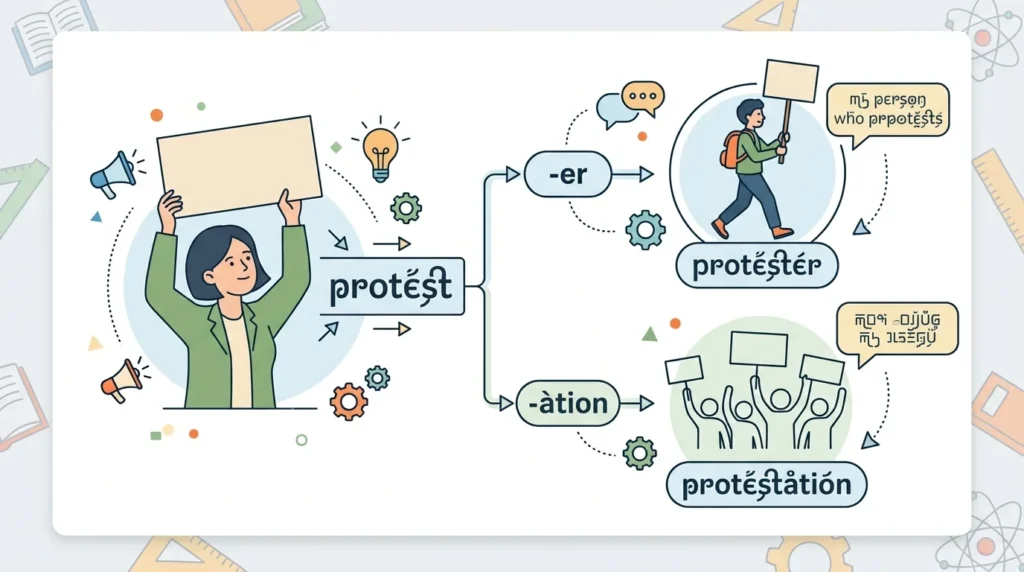
A simple way to remember the distinction is to connect both forms to the verb protest.
Protest + er = protester
Protest + or = protestor
Both forms identify a person who protests. The difference is the noun-forming ending.
If you want the spelling that will feel especially straightforward to many readers, remember protester. If you encounter protestor, remember that it is also a recognized variant rather than assuming that it is automatically an error.
When to Use Protester
Use protester when you want the familiar -er spelling in general writing.
- General articles
- School assignments
- Everyday communication
- Professional writing
- News-style writing when consistent with the publication’s style
Example: “The protesters gathered outside the building.”
See Also:
When to Use Protestor
Use protestor when that spelling fits the style or terminology you are following.
- Writing that consistently uses the -or form
- Editing that preserves an established house style
- Contexts where the source material uses “protestor”
- Any ordinary context where the recognized variant is appropriate
Example: “The protestors gathered outside the building.”
See Also:
Related Words: Protest, Protester, and Protestor
Protest
Protest can function as both a noun and a verb. As a noun, it can refer to an organized public expression of disagreement. As a verb, it means to express disagreement or objection.
Example: “Thousands joined the protest.”
Example: “Residents protested against the proposed change.”
Protester
Protester is the noun for a person who protests.
Example: “The protester spoke during the demonstration.”
Protestor
Protestor is an alternative noun form for a person who protests.
Example: “The protestor spoke during the demonstration.”
See Also:
Protester vs Demonstrator
Protester and demonstrator can sometimes refer to the same type of person, but their meanings are not identical in every context.
A demonstrator can mean someone who participates in a public demonstration to express support or disagreement. Cambridge also defines demonstrator in the protest sense as someone who marches or stands with a group to show disagreement or support. :contentReference[oaicite:8]{index=8}
However, demonstrator has another important meaning: a person who demonstrates how something works. For example, a product demonstrator may show customers how to use a machine.
Common Mistakes to Avoid
- Do not assume that protestors is automatically misspelled.
- Do not assume that protesters and protestors have different basic meanings.
- Do not switch between the two spellings randomly in one article.
- Remember that protester is singular and protesters is plural.
- Remember that protestor is singular and protestors is plural.
- Use the possessive apostrophe carefully: protester’s and protestors’ have different grammatical functions.
Frequently Asked Questions
Is protestors correct?
Yes. Protestors is a recognized plural form of protestor. Cambridge Dictionary lists “protestor” as an alternative form of “protester.” :contentReference[oaicite:9]{index=9}
Is protesters correct?
Yes. Protesters is the plural form of protester and is standard English.
What is the difference between protestors and protesters?
There is no basic meaning difference. Both refer to people who protest. The main difference is the spelling: protesters uses -ers, while protestors uses -ors.
Which is more common, protestors or protesters?
Protesters is a very familiar form and is widely used. Protestors is also recognized and used. The relative frequency can vary by publication, region, and writing context.
Is protestor a real word?
Yes. Protestor is an established variant. Cambridge Dictionary lists it as another form of protester. :contentReference[oaicite:10]{index=10}
Is protester grammatically correct?
Yes. Protester is a standard noun meaning someone who protests.
What is the singular of protesters?
The singular is protester.
What is the singular of protestors?
The singular is protestor.
Should I use protester or protestor in an article?
Both are recognized. For general-purpose writing, protester is a clear and familiar choice. If a particular publication or style guide uses protestor, consistency with that style may be more important.
Can protestor be considered wrong?
Not simply because it uses -or. The form is recognized as an alternative spelling of protester. :contentReference[oaicite:11]{index=11}
Are protesters and demonstrators the same?
They can overlap in meaning when referring to people taking part in public demonstrations, but demonstrator also has other meanings, including someone who shows how something works. :contentReference[oaicite:12]{index=12}
Final Answer: Protestors or Protesters
Protesters and protestors are both correct forms. Both refer to people who protest, and the main difference is their spelling rather than their basic meaning.
Protester → Protesters
Protestor → Protestors
For general writing, protesters is a familiar and straightforward choice. However, protestors is also a recognized English variant, so it should not automatically be treated as an error.
See Also:
TT Meaning in Text: What Does TT Really Mean?