

Have you ever received a message that simply says “YW” and wondered what it means? You’re not alone. Texting abbreviations have become a major part of online communication, making conversations quicker and easier. One of the most common abbreviations people use today is YW. Whether you’re chatting with friends, scrolling through social media, or talking to someone on a dating app, you’ve probably come across this short expression.
Understanding the YW meaning in text can help you avoid confusion and communicate more effectively. While it may look simple, its meaning can vary slightly depending on the situation, platform, and person using it. In this guide, you’ll learn exactly what YW means, where it came from, how people use it online, and how to respond when someone sends it to you.
Meaning & Definition
The YW meaning in text is most commonly “You’re Welcome.”
It is a short texting abbreviation used as a response when someone says “thank you” or expresses gratitude. Instead of typing the full phrase “You’re welcome,” many people simply type “YW” to save time.
This abbreviation is widely used in:
- Text messages
- Social media chats
- Online gaming
- Dating apps
- Instant messaging platforms
In most situations, YW is friendly, polite, and informal. It serves the same purpose as saying “You’re welcome” in everyday conversation.
What Does YW Mean in Text?
YW means “You’re Welcome.”
It is commonly used in text messages and online chats as a quick response to someone who says “thanks” or “thank you.” The abbreviation helps people communicate faster while still being polite.
Example:
Person A: Thanks for helping me!
Person B: YW 😊
In this example, YW simply means “You’re welcome.”
Background / Origin of YW
The abbreviation YW emerged during the early days of internet communication when people looked for ways to type faster. Before smartphones became popular, many users communicated through SMS messages that had strict character limits. To save time and space, people started shortening common phrases into abbreviations.
Expressions such as LOL (Laugh Out Loud), BRB (Be Right Back), and TY (Thank You) became extremely popular. Alongside these abbreviations, YW developed as a shortened form of “You’re Welcome.”
As instant messaging platforms expanded, YW became common on chat services, forums, and social networking sites. The rise of mobile texting further increased its popularity because users preferred quick responses rather than typing full sentences.
Today, YW remains one of the most recognized internet abbreviations. Although modern smartphones make typing easier, many people continue using it because it is fast, convenient, and widely understood. The meaning has remained consistent over time, making it a reliable shorthand expression across different digital platforms.
Usage in Different Contexts
General Usage
In everyday online communication, YW is mainly used as a polite response after someone expresses appreciation. It helps keep conversations flowing naturally without requiring lengthy replies. Friends, family members, coworkers, classmates, and online acquaintances commonly use YW when chatting through text messages or social media.
For example, if someone thanks you for sharing information, sending a helpful link, or giving advice, replying with YW quickly acknowledges their gratitude. It performs the same social function as saying “You’re welcome” in person.
Because it is simple and universally understood, YW has become a standard part of internet language. Most people interpret it positively and see it as a friendly acknowledgment rather than a cold or dismissive response.
Formal vs Informal Usage
YW is generally considered an informal abbreviation. It works well in casual conversations with friends, relatives, classmates, and people you know personally. In texting environments where abbreviations are common, using YW feels natural and efficient.
However, in formal communication, such as business emails, professional messages, customer support conversations, or academic correspondence, writing the complete phrase “You’re welcome” is usually a better choice. Full wording appears more professional and respectful.
For example:
Informal:
- Thanks for the ride.
- YW!
Formal:
- Thank you for your assistance.
- You’re welcome. I’m glad I could help.
Understanding the context helps determine whether YW is appropriate. Casual conversations typically welcome abbreviations, while professional settings often favor complete phrases.
YW Meaning on Social Media Platforms

- On WhatsApp, YW usually means “You’re Welcome.”
- It is commonly used in private chats and group conversations.
- Friends often use it after receiving a thank-you message.
- The abbreviation keeps conversations quick and casual.
Snapchat
- Snapchat users frequently communicate using short abbreviations.
- YW is commonly used after helping someone or responding to thanks.
- Since Snapchat conversations are fast-paced, abbreviations like YW fit naturally into the platform.
TikTok
- On TikTok, YW may appear in comments, direct messages, and replies.
- Creators often use it when followers thank them for recommendations, tutorials, or useful information.
- The meaning remains “You’re Welcome.”
- Instagram users commonly use YW in DMs and comment sections.
- It is often used after receiving compliments or appreciation.
- The abbreviation helps maintain friendly interactions while keeping responses short.
Other Meanings in Different Fields
Although “You’re Welcome” is the most common interpretation, YW can have different meanings in specialized industries and professional fields.
Medical
- In some medical records or internal communication systems, YW may be used as an abbreviation with organization-specific meanings.
- The exact definition depends on the healthcare institution.
Physics
- In scientific discussions, YW may occasionally represent initials, formulas, or researcher references.
- These uses are uncommon outside academic settings.
Technology
- In technology and software environments, YW may appear as a project code, system abbreviation, or company-specific acronym.
- The meaning depends entirely on the context in which it is used.
Examples of YW Meaning in Text in Sentences
Understanding the YW meaning in text becomes much easier when you see it used in real conversations. Since YW stands for “You’re Welcome,” it typically appears after someone expresses gratitude. Below are some common chat-style examples that show how people naturally use this abbreviation in everyday texting.
Example 1
- Person A: Thanks for helping me finish my project!
- Person B: YW! Glad I could help.
In this conversation, YW is used as a polite acknowledgment after receiving thanks.
Example 2
- Person A: Thanks for sending me the notes from class.
- Person B: YW. Hope they help you prepare for the exam.
Here, YW keeps the response short while still sounding friendly.
Example 3
- Person A: Thank you for recommending that movie.
- Person B: YW! It’s one of my favorites.
This example shows how YW can be combined with additional conversation.
Example 4
- Person A: Thanks for explaining that to me.
- Person B: YW 😊 Anytime!
Adding emojis often makes YW appear warmer and more personal.
Common Misconceptions
Even though the YW meaning in text is generally straightforward, many people misunderstand it when they first encounter the abbreviation. Here are some common misconceptions.
Misconception 1: YW Means “Yeah Whatever”
- Some people mistakenly assume YW means “Yeah Whatever.”
- In normal texting conversations, this interpretation is rarely correct.
- The most widely accepted meaning remains “You’re Welcome.”
Misconception 2: YW Is Rude
- Some users think YW sounds cold because it is short.
- In reality, most people use it simply to save time.
- The intention is usually polite rather than dismissive.
Misconception 3: YW Has the Same Meaning Everywhere
- While YW usually means “You’re Welcome,” context still matters.
- Certain organizations, industries, or online communities may use different meanings.
- Always consider the surrounding conversation before interpreting an abbreviation.
Similar Terms & Alternatives
People use many alternatives to YW when responding to gratitude online. These expressions have similar meanings but may vary in tone and formality.
- You’re Welcome – The complete phrase and most formal option.
- NP – No Problem.
- NPNP – No Problem, No Problem.
- Anytime – Indicates you’re happy to help whenever needed.
- Glad to Help – Friendly and supportive response.
- No Worries – Casual response commonly used in online conversations.
- Sure Thing – Informal way of saying you’re welcome.
- My Pleasure – More professional and courteous response.
- Of Course – Suggests helping was natural and expected.
- Happy to Help – Friendly phrase often used in customer support and professional communication.
How to Respond to YW Meaning in Text When Someone Uses It
When someone sends YW, they’re simply acknowledging your thanks. In most cases, you don’t need to continue the conversation unless you want to. However, if you’d like to respond politely, there are several natural options.
The best response depends on your relationship with the person and the tone of the conversation. Friends may use casual replies, while professional contacts may prefer more formal responses.
Response 1
- “Thanks again!”
- A great option when someone has helped you significantly.
Response 2
- “I appreciate it!”
- Shows continued gratitude and friendliness.
Response 3
- “You’re the best!”
- Casual, positive, and commonly used among friends.
Additional responses include:
- No problem!
- Glad we got it sorted.
- Thank you so much.
- I really appreciate your help.
- That means a lot.
Difference Between YW Meaning in Text and Similar Terms
Many internet abbreviations are used in conversations involving gratitude, but they serve different purposes. Understanding the differences helps prevent confusion.
| Term | Meaning | Purpose |
|---|---|---|
| YW | You’re Welcome | Response to thanks |
| TY | Thank You | Expressing gratitude |
| NP | No Problem | Alternative response to thanks |
| THX | Thanks | Informal appreciation |
| TYSM | Thank You So Much | Stronger expression of gratitude |
| NVM | Never Mind | Changes or dismisses a topic |
The biggest difference is that YW is a response, while abbreviations like TY or THX are expressions of gratitude themselves.
For example:
- TY = Thank you.
- YW = You’re welcome.
These abbreviations often appear together in online conversations because one naturally follows the other.
Relevance in Online Conversations & Dating Apps
The YW meaning in text remains highly relevant because modern communication increasingly relies on speed and convenience. People exchange hundreds of messages every week through texting apps, social media platforms, gaming communities, and dating apps. Short abbreviations help keep conversations moving quickly while maintaining politeness.
On dating apps, YW often appears after one person thanks another for a compliment, recommendation, or helpful suggestion. For example, if someone recommends a restaurant and receives appreciation, they may simply reply with “YW.” This keeps the interaction casual and comfortable without making the conversation feel overly formal.
In online friendships and group chats, YW serves as a quick acknowledgment that encourages positive interactions. Rather than ignoring someone’s thanks, users can respond instantly and courteously. This small gesture helps build rapport and maintain friendly communication.
The popularity of texting culture means abbreviations like YW are unlikely to disappear anytime soon. As communication becomes more mobile-focused, short responses continue to play an important role in how people interact online. Understanding these abbreviations helps users communicate confidently across different digital platforms and social situations.
YW Meaning in Text From Girl
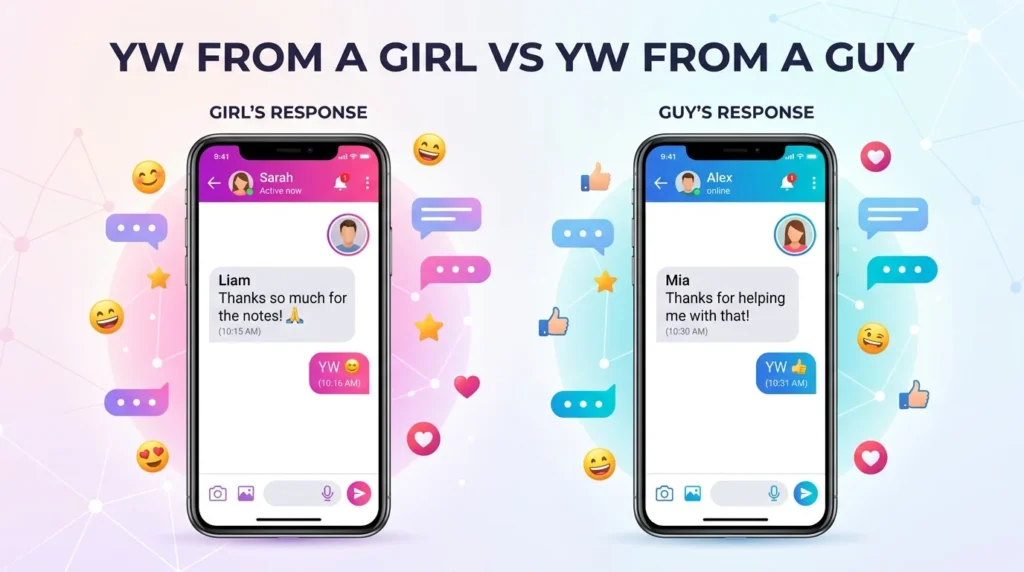
When a girl sends YW in a text message, it usually means exactly what it says: “You’re Welcome.” Most of the time, there is no hidden meaning attached to it.
The interpretation depends largely on the conversation’s tone. If she responds with “YW 😊” or “YW lol,” the message may feel warmer and friendlier. If she simply writes “YW,” she is likely acknowledging your thanks in a quick and casual manner.
Common situations include:
- You thanked her for advice.
- You appreciated a favor she did for you.
- She shared useful information.
- She helped solve a problem.
In some conversations, people try to overanalyze abbreviations and look for secret meanings. However, in the vast majority of cases, YW from a girl simply means “You’re Welcome” and nothing more.
The best way to understand the message is to consider the overall conversation rather than focusing solely on the abbreviation.
YW Meaning in Text From a Guy
When a guy sends YW, the meaning is generally the same: “You’re Welcome.”
Most men use YW as a quick response after receiving thanks. It is usually intended as a polite acknowledgment rather than a special signal or coded message.
For example:
- You thank him for helping with a task.
- You appreciate a recommendation.
- You thank him for answering a question.
- You acknowledge a favor he provided.
Depending on personality, some guys prefer short responses and may frequently use abbreviations such as YW, NP, LOL, or BRB. This does not necessarily indicate disinterest or lack of friendliness. Instead, it often reflects their texting style.
If a guy sends “YW!” with emojis or additional comments, the response may feel more enthusiastic. If he sends only “YW,” he is likely just keeping the conversation brief.
The key takeaway is that context matters more than the abbreviation itself. In nearly every situation, YW from a guy simply means “You’re Welcome.”
Frequently Asked Questions
What does YW stand for in text messages?
YW stands for “You’re Welcome.” It is commonly used as a response when someone says thank you.
Is YW rude in texting?
No. YW is generally considered polite and friendly. It is simply a shortened version of “You’re Welcome.”
What does YW mean on Snapchat?
On Snapchat, YW usually means “You’re Welcome.” The meaning is the same as in regular text messages.
What does YW mean from a girl?
When a girl sends YW, it most often means “You’re Welcome.” The exact tone depends on the context and overall conversation.
Can YW have other meanings?
Yes. In certain industries or organizations, YW may have specialized meanings. However, in everyday texting, it almost always means “You’re Welcome.”
Conclusion
The YW meaning in text is simple, practical, and widely understood across the internet. In most conversations, YW stands for “You’re Welcome,” making it one of the most common abbreviations used in texting, social media, online gaming, and messaging apps. Its popularity comes from its convenience, allowing people to respond politely without typing the full phrase every time.
While YW can occasionally have different meanings in specialized fields such as technology, medicine, or science, the context of everyday digital communication almost always points to “You’re Welcome.” Whether you see it on WhatsApp, Snapchat, Instagram, TikTok, or a dating app, understanding this abbreviation helps you communicate more confidently and avoid misunderstandings. It is also important to remember that YW from a girl or a guy generally carries the same meaning, and there is usually no hidden message behind it. By learning how YW is used, when to use it, and how to respond to it, you can navigate online conversations more naturally and stay up to date with modern texting language.
See Also:
MK Meaning in Text: The Real Meaning Behind This Common Text Slang
DW Meaning in Text: What It Really Means in Messages & Social Media
ISTG Meaning in Text: What It Really Means on Snapchat, TikTok & WhatsApp