
If you spend time texting friends, scrolling through social media, or chatting online, you’ve probably come across the abbreviation DW and wondered what it means. Internet slang changes quickly, and understanding these short forms can help you communicate more effectively in today’s digital world. The phrase DW meaning in text is commonly searched because people often see it in messages but are unsure how to interpret it correctly.
In most situations, DW is a friendly and reassuring abbreviation that helps keep conversations short and casual. Whether you’re chatting on WhatsApp, Snapchat, Instagram, TikTok, or a dating app, understanding DW can help you avoid confusion and respond appropriately. This guide explains everything you need to know about DW, including its definition, origin, usage, examples, alternative meanings, and how people use it in modern online communication.
Meaning & Definition
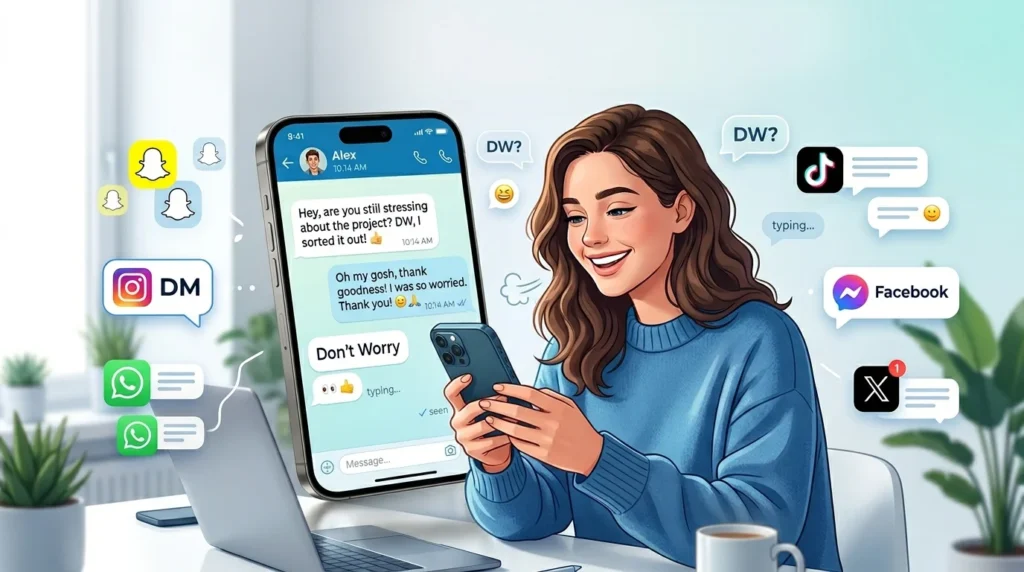
The most common DW meaning in text is “Don’t Worry.”
People use DW when they want to reassure someone, reduce concern, or let another person know that a situation is okay. It is a simple and friendly abbreviation that saves time while typing.
For example, if someone apologizes for replying late, the other person may respond with “DW” to show that there is no problem. The expression creates a relaxed and positive tone in conversations.
Definition:
DW = Don’t Worry
It is commonly used in:
- Text messages
- Social media chats
- Online gaming
- Group conversations
- Dating apps
- Messaging platforms
Because it expresses reassurance, DW is considered one of the most positive abbreviations used in online communication.
What Does DW Mean in Text?
DW means “Don’t Worry.”
It is an abbreviation used in text messages and online conversations to reassure someone or tell them not to be concerned about something. People often use DW when responding to apologies, mistakes, delays, or situations that might cause stress.
Example:
Person A: “Sorry for being late.”
Person B: “DW, it’s fine.”
In this example, DW means that the person is not upset and wants to make the other person feel comfortable.
Background / Origin
The abbreviation DW became popular during the rise of internet messaging, chat rooms, and SMS texting. In the early days of mobile phones, people had limited characters available in text messages. To save space and type faster, users began shortening common phrases into abbreviations.
Just as LOL became short for “Laugh Out Loud” and BRB became short for “Be Right Back,” the phrase “Don’t Worry” was shortened to DW. Over time, the abbreviation spread across instant messaging services, online forums, gaming communities, and eventually social media platforms.
As smartphones became more common, DW remained popular because it is quick, easy to understand, and useful in everyday conversations. Today, millions of people use it daily when texting friends, family members, coworkers, and romantic partners.
The phrase has survived many changes in internet culture because its purpose is universal. People often want to comfort others, reduce tension, or reassure someone after a mistake. DW allows them to do that with just two letters.
Because of its simplicity and positive meaning, DW continues to be one of the most recognized abbreviations in digital communication worldwide.
Usage in Different Contexts
General Usage
In everyday conversations, DW is primarily used to reassure someone. It can be used after an apology, during a stressful situation, or whenever someone expresses concern. The abbreviation helps create a relaxed atmosphere and shows understanding. Friends frequently use DW when they want to tell someone that a mistake is not a big deal.
For example, if a friend forgets to send information or arrives late to a meeting, another friend may reply with DW. This instantly communicates patience and understanding. Because of its friendly tone, DW is especially common among younger internet users and people who frequently communicate through messaging apps.
The abbreviation also works well in group chats because it is short and easy to read. Instead of writing a longer sentence such as “Don’t worry about it, everything is okay,” people can simply type DW and achieve the same effect.
Formal vs Informal Usage
DW is considered an informal abbreviation. It is most appropriate in casual conversations with friends, family members, classmates, teammates, and online communities. In these settings, using DW feels natural and helps conversations move quickly.
In professional environments, however, writing the full phrase “Don’t worry” is usually more appropriate. Business emails, official communications, academic messages, and workplace discussions often require a more professional tone. While some coworkers may use DW in internal chats, it is generally safer to avoid abbreviations when communicating formally.
Understanding the audience is important. If the conversation is casual, DW works perfectly. If the conversation involves clients, managers, professors, or professional contacts, using the complete phrase demonstrates professionalism and clarity.
DW Meaning on Social Media Platforms
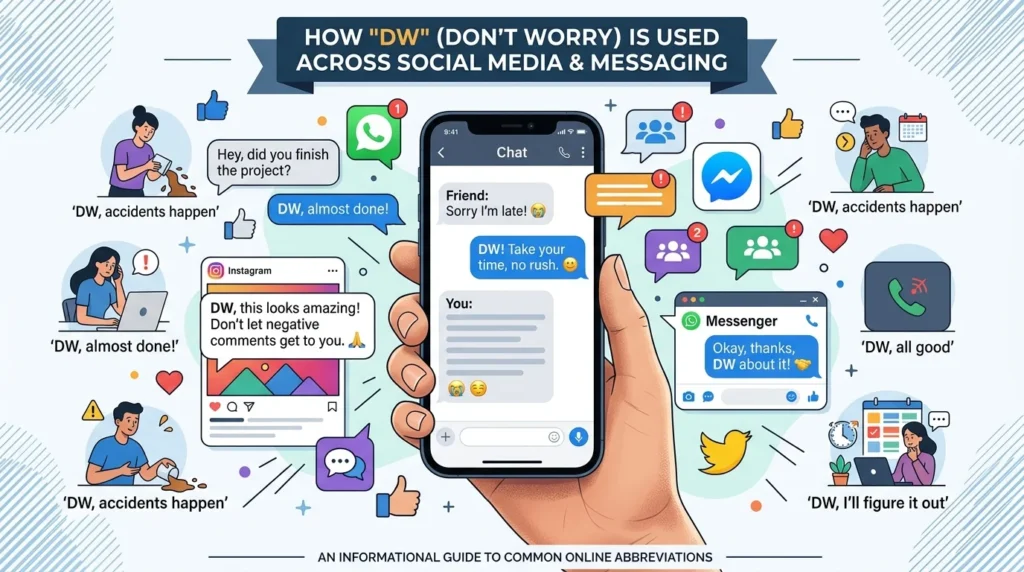
- On WhatsApp, DW usually means “Don’t Worry.”
- Friends and family use it to reassure each other.
- It commonly appears after apologies or concerns.
- The tone is friendly and supportive.
Snapchat
- Snapchat users often use DW in quick chats and snaps.
- It helps keep conversations short and casual.
- Most often, it means there is no reason to stress about something.
- It can also be used playfully among friends.
TikTok
- On TikTok, DW often appears in comments and direct messages.
- Users may write DW when comforting another creator or follower.
- It helps maintain a positive and encouraging interaction.
- The meaning remains “Don’t Worry” in most situations.
- Instagram users frequently use DW in DMs and comment sections.
- It is often used when someone apologizes or expresses concern.
- Influencers and followers may use DW to keep interactions friendly.
- The abbreviation creates a relaxed conversational tone.
Other Meanings in Different Fields
Although “Don’t Worry” is the most common meaning, DW can have different meanings depending on the context.
Medical
- DW may refer to specific medical abbreviations depending on the healthcare setting.
- Medical professionals often use specialized meanings that differ from texting slang.
- Context is necessary to determine the exact definition.
Physics
- In certain scientific discussions, DW may represent variables, formulas, or technical notations.
- The meaning depends entirely on the subject being discussed.
- It is not commonly used this way outside academic environments.
Technology
- DW may appear as a technical abbreviation in software, networking, or engineering documentation.
- Different organizations may assign different meanings to the abbreviation.
- Technical context is required for accurate interpretation.
Examples of DW Meaning in Text in Sentences
Example 1
- Sarah: “Sorry I forgot to send the file.”
- Jake: “DW, I already found it.”
In this conversation, Jake reassures Sarah that her mistake did not cause a problem.
Example 2
- Emma: “I think I made a mistake.”
- Ryan: “DW, we can fix it together.”
Here, DW is used to provide comfort and support.
Example 3
- Alex: “Sorry for replying so late.”
- Mia: “DW, I was busy too.”
The abbreviation removes any tension from the conversation.
Example 4
- Noah: “I hope I didn’t upset you.”
- Lily: “DW, everything is okay.”
DW helps communicate reassurance and understanding.
Common Misconceptions
Misconception 1
- Some people think DW has a negative meaning.
- In reality, DW is usually positive and reassuring.
Misconception 2
- Some users assume DW always means the same thing.
- While “Don’t Worry” is the most common meaning, context can change its interpretation.
Misconception 3
- Many believe DW is only used by teenagers.
- In fact, people of all ages use DW in online communication.
Similar Terms & Alternatives
- NVM – Never Mind
- NP – No Problem
- IDC – I Don’t Care
- TBH – To Be Honest
- BRB – Be Right Back
- TY – Thank You
- YW – You’re Welcome
- IMO – In My Opinion
- IDK – I Don’t Know
- No worries – Full phrase similar to DW
How to Respond to DW Meaning in Text When Someone Uses It
When someone sends DW, they are usually trying to reassure you. A friendly response keeps the conversation positive and natural.
Possible responses include:
- “Thanks, I appreciate it.”
- “Glad to hear that.”
- “Okay, thank you!”
- “That’s a relief.”
- “You’re very kind.”
- “I was worried for a moment.”
- “Good to know.”
These replies acknowledge the reassurance and help continue the conversation smoothly.
Difference Between DW Meaning in Text and Similar Terms
Although DW is similar to other internet abbreviations, there are important differences.
DW (Don’t Worry) focuses on reassuring someone and reducing concern.
NP (No Problem) focuses on indicating that something did not cause inconvenience.
NVM (Never Mind) is used when a topic is no longer important.
IDC (I Don’t Care) expresses indifference, which can sometimes sound rude.
No worries is essentially the full version of DW and carries the same meaning.
Understanding these differences helps users choose the most appropriate response in different situations.
Relevance in Online Conversations & Dating Apps
The importance of understanding the DW meaning in text has grown as online communication continues to dominate everyday life. Whether people are chatting with friends, building professional relationships, or meeting new people through dating apps, abbreviations like DW make conversations faster and more natural.
On dating platforms, DW is often used to create a comfortable atmosphere. For example, if someone feels nervous about sending a message or apologizes for a delayed reply, the other person may respond with DW. This helps reduce anxiety and encourages open communication.
In online friendships and social communities, DW promotes positivity. It signals patience, understanding, and emotional support. Because digital communication lacks facial expressions and tone of voice, simple abbreviations such as DW can help clarify intentions and prevent misunderstandings.
The abbreviation is also valuable because it saves time. Instead of typing a longer reassurance message, users can quickly communicate the same idea with two letters. As messaging apps continue to evolve, DW remains relevant because its meaning is easy to understand and universally useful.
Its continued popularity shows how digital language adapts to meet the need for fast, friendly, and effective communication.
DW Meaning in Text From Girl
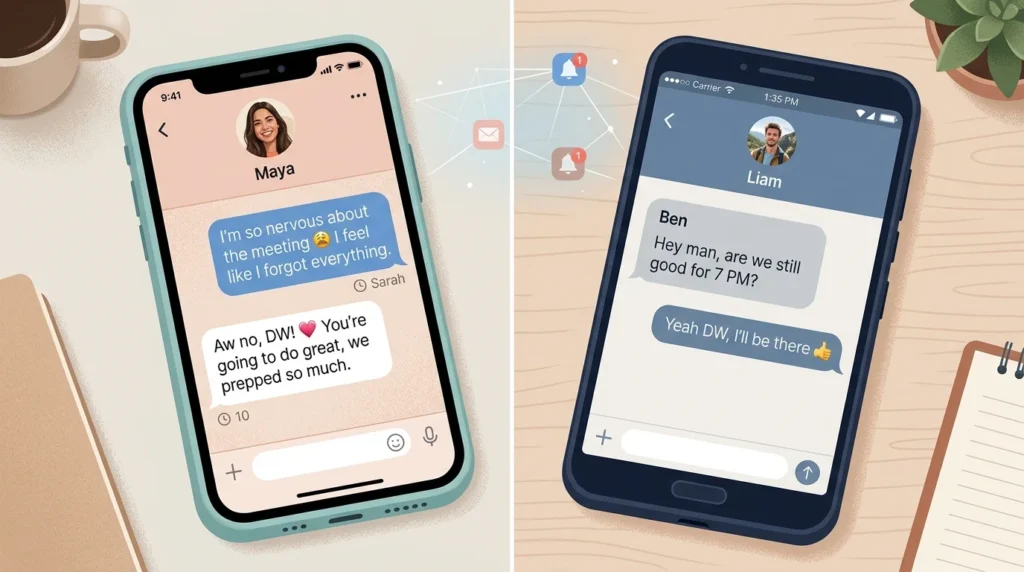
When a girl uses DW in a text message, it usually carries the same meaning: “Don’t Worry.” In most situations, she is simply trying to reassure the other person or remove tension from the conversation.
For example, if you apologize for replying late and she responds with “DW,” she is likely saying that it is not a problem. The abbreviation often reflects kindness, patience, and understanding.
However, context matters. Sometimes the tone may be warm and friendly, while in other cases it may simply be a casual acknowledgment. The surrounding conversation is the best way to understand the intended meaning.
It is important not to overanalyze the abbreviation. Most of the time, a girl using DW is simply trying to make the conversation comfortable and positive.
DW Meaning in Text From a Guy
When a guy uses DW in a text, the meaning is generally the same: “Don’t Worry.” He may be reassuring someone, accepting an apology, or letting another person know that everything is fine.
For example:
Person A: “Sorry for missing your call.”
Person B: “DW, I was busy anyway.”
In this situation, the guy is communicating understanding and removing any sense of guilt or concern. Many men use DW because it is quick, efficient, and commonly understood in digital conversations.
Just like with messages from girls, the context determines the tone. Sometimes it may sound supportive and caring, while other times it may simply be a casual response. Regardless of the tone, the core meaning usually remains the same: there is no need to worry.
Frequently Asked Questions
What does DW stand for in texting?
DW usually stands for “Don’t Worry.”
Is DW a positive abbreviation?
Yes. It is generally used to reassure someone and create a positive conversation.
What does DW mean on Snapchat?
On Snapchat, DW most commonly means “Don’t Worry.”
Can DW have different meanings?
Yes. In technical, medical, or academic fields, DW can have alternative meanings depending on the context.
Is DW rude?
No. DW is usually considered friendly, supportive, and reassuring rather than rude.
Conclusion
Understanding the DW meaning in text is important for anyone who communicates online. In most cases, DW stands for “Don’t Worry,” a simple abbreviation used to reassure someone, reduce concern, and keep conversations friendly. Whether it appears in text messages, WhatsApp chats, Snapchat conversations, TikTok comments, Instagram DMs, or dating apps, the meaning remains largely the same. The abbreviation has become a valuable part of modern internet language because it allows people to express understanding and support quickly.
While DW can occasionally have different meanings in specialized fields such as medicine, technology, or science, the texting definition is by far the most common. Knowing how to recognize and respond to DW helps improve communication and prevents misunderstandings. As online conversations continue to evolve, abbreviations like DW remain popular because they are simple, effective, and easy to understand. The next time someone sends you DW in a message, you’ll know they are most likely saying, “Don’t worry, everything is okay.”
See Also:
FW Meaning in Text: What It Really Means in Messages & Social Media
WTV Meaning in Text: What It Really Means in Chatting
TBH Meaning in Text Explained: Full Form, Uses, Examples & Replies